A pre-negotiated adult fantasy that stages resistance, capture or apparent loss of control while real consent remains active, bounded and withdrawable outside the fiction.
Sources and evidence type
Manual claim and limitation notes are shown where an individual source audit is complete. Other evidence-type labels are a publisher aid awaiting source-by-source confirmation.
Dunkley & Brotto (2020), BDSM consent reviewResearch study
Source design
Peer-reviewed research or review
What it can support
The specific population, measures and findings reported by the paper.
Important limitation
It cannot automatically establish UK prevalence, causation, diagnosis, consent or an individual outcome. Check recruitment, definitions and study design.
Service pathways, health definitions and recommended public-health or clinical actions within its stated scope.
Important limitation
General guidance cannot assess an individual’s symptoms, exposure, medicine, contraindications or urgency.
Open the original source Willis et al. (2024), consent norms in a sexually diverse sampleResearch study
Source design
Peer-reviewed research or review
What it can support
The specific population, measures and findings reported by the paper.
Important limitation
It cannot automatically establish UK prevalence, causation, diagnosis, consent or an individual outcome. Check recruitment, definitions and study design.
EDITORIAL ILLUSTRATIONConsensual non-consent fantasy
Fantasy & performance
Illustration created using generative AI; not documentary evidence.
In brief
The fictional refusal never replaces the real stop signal—or the right to withdraw consent.
Consensual non-consent is a deliberately paradoxical community label: the performance may contain scripted words or gestures that look like refusal, but the ethical basis is specific advance agreement and an unmistakable way to stop. It is not actual non-consent, advance permission for anything, or a defence to assault. Because ordinary resistance cues may be part of the fiction, participants need an especially clear consent architecture, capacity and emergency plan.
Fantasy, interest and behaviour
Fantasy content is not a confession, request or prediction. Population research distinguishes sexual interests from behaviour, and an individual may value the symbolism while choosing fiction only.
Atypical fantasy is not itself a clinical disorder. ICD-11 focuses on non-consent, marked distress not caused only by stigma, or significant risk of injury or death rather than unusual content alone.
EDITORIAL ILLUSTRATIONFiction is not a real-world waiver
Research on CNC is limited and often overlaps with broader fantasy or BDSM categories. A fictional refusal does not predict behaviour or remove the need for real, current consent.
Illustration created using generative AI; not documentary evidence.
Status
Detailed editorial draft
Publisher
The UK Kink Guide
Reviewed
Structured draft present; individual review date not recorded
Evidence
4 cited sources · types labelled below
Jurisdiction
UK-focused general education
Read the rest: evidence, law, safety and sources
CNC fantasy
An imagined or narrated scenario that may never be enacted and does not predict a wish for real assault.
CNC role-play
A bounded adult performance with agreed participants, content, exclusions, stop mechanism and aftercare.
Consensual restraint
Agreed restriction that may involve power but does not necessarily stage resistance or non-consent.
Sexual assault
Sexual activity without consent; applying CNC language before or after the event does not make it consensual.
Consent architecture
Agreement should identify the adults involved, setting, acts in scope, hard exclusions, recording rules, duration, contraception or barrier needs and what ends the fiction. Consent to one version does not transfer to another day, partner or escalation.
Use a stop signal that cannot plausibly be confused with scripted resistance, plus a non-verbal alternative. Silence, freezing, intoxication, sleep or inability to signal is not continuing consent.
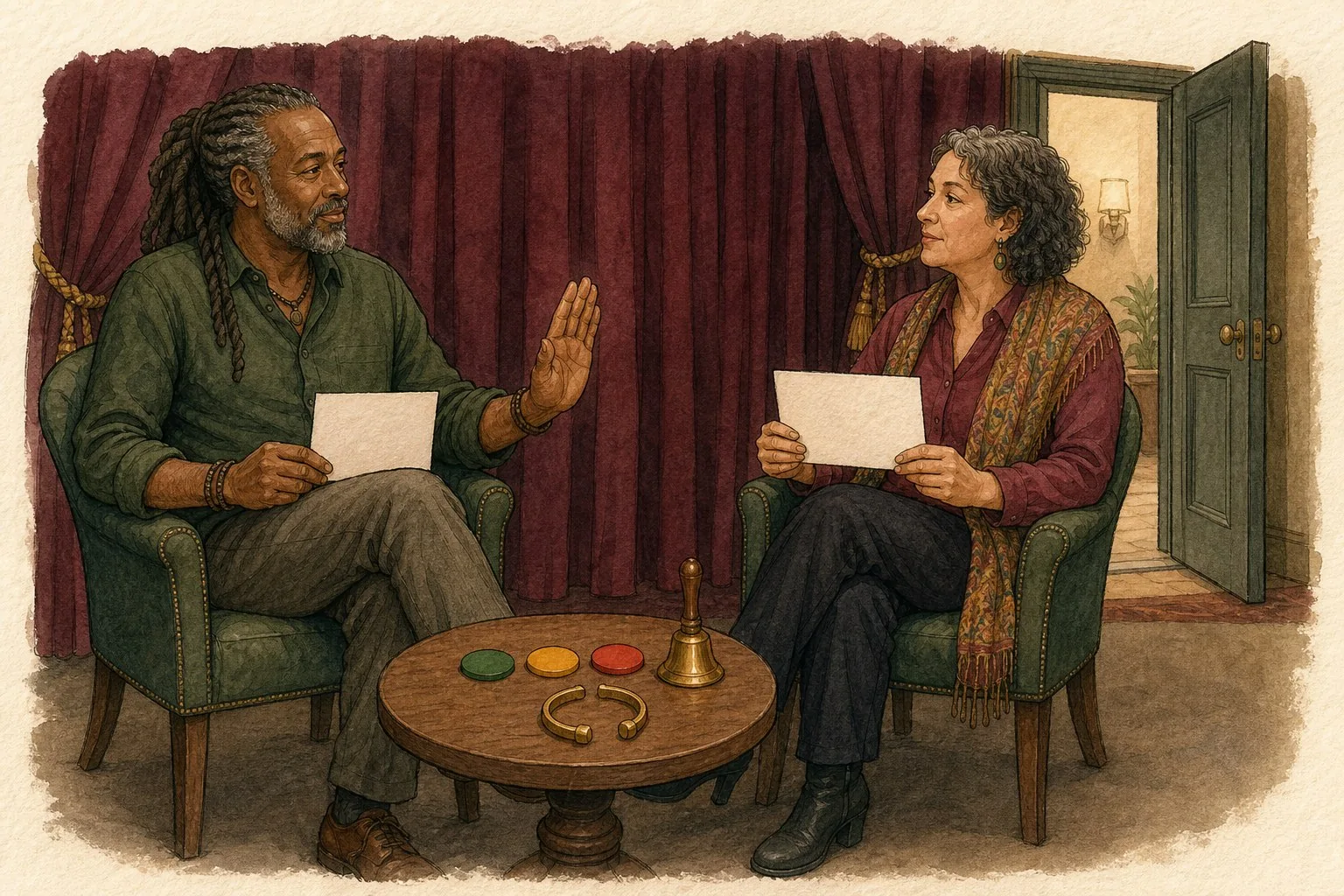
EDITORIAL ILLUSTRATIONMake the real stop unmistakable
The stop mechanism must remain distinguishable from scripted resistance, with a usable non-verbal alternative. Silence, freezing or inability to signal is not continuing consent.
Illustration created using generative AI; not documentary evidence.
Risk, capacity and safeguarding
Avoid impaired capacity, surprise enactment, weapons presented as real, airway restriction, abandonment and situations where help cannot be reached. Restraint adds circulation, nerve, fall and release risks requiring continuous monitoring.
Trauma history neither explains nor forbids the interest. Participants may choose trauma-informed boundaries, check-ins or fiction-only exploration; nobody owes disclosure or enactment as therapy.
EDITORIAL ILLUSTRATIONPlanning must preserve a safe exit
Capacity, emergency contact, release and access to help belong outside the fiction. Real uncertainty or withdrawal ends the scene regardless of the planned script.
Illustration created using generative AI; not documentary evidence.
UK legal and support context
In England and Wales, consent under section 74 of the Sexual Offences Act 2003 requires agreement by choice with freedom and capacity. Private agreements and safewords are evidence of planning, not waivers of criminal law or bodily autonomy.
Stop immediately if real consent is withdrawn or uncertain. After a violation, prioritise safety and medical or specialist support; do not frame an ignored signal as a scene-management mistake the harmed person must resolve privately.
Non-graphic examples
What the umbrella may include
Keeping the interest as private fantasy or fiction.
Agreeing a distinctive word that is never part of the script.
Using a held object as a non-verbal stop signal.
Excluding surprise appearances and recording in advance.
Stopping when a participant freezes despite no spoken safeword.
Prepare for an appointment
Questions you could ask a professional
What information would help you understand my question?
What are the realistic options and uncertainties?
How can disability, communication or privacy needs be accommodated?
When should the situation be reviewed again?
These prompts do not replace assessment and do not imply that every reader needs professional care.
Continue learning
Take the next step from definition to context.
Continue with independent guidance connecting consensual non-consent fantasy to evidence, consent, safety, uncertainty and practical decisions.