Paraphilic disorder is a diagnosis made by a suitably qualified clinician, not a polite-sounding synonym for an unusual interest. It requires a persistent and intense atypical arousal pattern plus the relevant ICD-11 conditions concerning consent, behaviour, marked distress or serious risk.
 The UK Kink GuideEvidence-led glossary
 Back to the glossaryFoundationsIn plain English Words in context A non-graphic adult example What not to assume
Paraphilic disorder
An ICD-11 mental-health diagnosis, not a synonym for paraphilia, fetish or kink. The relevant diagnostic requirements concern a persistent and intense atypical arousal pattern involving non-consenting individuals or, where behaviour is solitary or involves consenting adults, marked distress not explained solely by rejection or fear of rejection, or substantial risk of injury or death. An unconventional interest alone is not a disorder.
Start here
New to this term?
A paraphilia is an interest category; a paraphilic disorder is a diagnosis. ‘Marked distress’ means substantial personal suffering, not simply embarrassment caused by other people’s disapproval. ‘Impairment’ means meaningful disruption to daily life. Criminal offences are legal findings about conduct, not clinical labels.
An adult with a consensual clothing fetish is not diagnosed merely because the interest is unusual. Someone may also ask a clinician about unwanted thoughts or distress without automatically meeting diagnostic requirements. An individual assessment has to examine the actual pattern and context.
Clothing, a collection, internet use, one fantasy, one act, a kink identity or seeking therapy cannot establish this diagnosis. Diagnosis neither proves nor excuses unlawful conduct. Research from clinical or forensic samples cannot be used as a risk test for every person with an atypical interest.
Sources and evidence type
Manual claim and limitation notes are shown where an individual source audit is complete. Other evidence-type labels are a publisher aid awaiting source-by-source confirmation.
WHO ICD-11 clinical descriptions and diagnostic requirements (2024)Clinical guideline
- Source design
- Current public-health or clinical guidance
- What it can support
- Service pathways, health definitions and recommended public-health or clinical actions within its stated scope.
- Important limitation
- General guidance cannot assess an individual’s symptoms, exposure, medicine, contraindications or urgency.
Krueger et al. (2017), ICD-11 proposals for paraphilic disordersResearch study
- Source design
- Peer-reviewed research or review
- What it can support
- The specific population, measures and findings reported by the paper.
- Important limitation
- It cannot automatically establish UK prevalence, causation, diagnosis, consent or an individual outcome. Check recruitment, definitions and study design.
Reed et al. (2016), sexuality and gender classifications in ICD-11Community context
- Source design
- Contextual or community source
- What it can support
- Terminology, reported practice or community context within the source’s own setting.
- Important limitation
- Community usage is not universal and does not establish safety, prevalence, clinical benefit or legal permission.
Joyal and Carpentier (2017), adult population study of interests and behavioursResearch study
- Source design
- Peer-reviewed research or review
- What it can support
- The specific population, measures and findings reported by the paper.
- Important limitation
- It cannot automatically establish UK prevalence, causation, diagnosis, consent or an individual outcome. Check recruitment, definitions and study design.
CPS consent guidance (England and Wales)Law or regulator
- Source design
- Primary legislation, prosecutorial or regulator guidance
- What it can support
- The legal provision or official regulatory position for the jurisdiction and date stated.
- Important limitation
- It is not fact-specific legal advice. Commencement, amendments, jurisdiction and case law may affect application.
Sexual Offences Act 2003, section 74 (England and Wales)Law or regulator
- Source design
- Primary legislation, prosecutorial or regulator guidance
- What it can support
- The legal provision or official regulatory position for the jurisdiction and date stated.
- Important limitation
- It is not fact-specific legal advice. Commencement, amendments, jurisdiction and case law may affect application.
Sexual Offences (Scotland) Act 2009, section 12Law or regulator
- Source design
- Primary legislation, prosecutorial or regulator guidance
- What it can support
- The legal provision or official regulatory position for the jurisdiction and date stated.
- Important limitation
- It is not fact-specific legal advice. Commencement, amendments, jurisdiction and case law may affect application.
Sexual Offences (Northern Ireland) Order 2008, article 3Law or regulator
- Source design
- Primary legislation, prosecutorial or regulator guidance
- What it can support
- The legal provision or official regulatory position for the jurisdiction and date stated.
- Important limitation
- It is not fact-specific legal advice. Commencement, amendments, jurisdiction and case law may affect application.

Foundations
Illustration created using generative AI; not documentary evidence.
In brief
Clinical thresholds beyond unconventional interest.
Paraphilic disorder is a formal clinical diagnosis with defined requirements; it is not a general label for unconventional sexuality. Assessment considers the nature and persistence of an arousal pattern, consent, whether behaviour has occurred, the source of any distress and any serious risk of harm. These questions require individual professional judgement and cannot be answered from a glossary, an object or a community identity.
What a clinical assessment considers
The WHO describes paraphilic disorders as persistent and intense patterns of atypical sexual arousal manifested through thoughts, fantasies, urges or behaviours. A clinician must first establish the pattern itself rather than infer it from one event, possession or self-chosen label. They then consider which diagnostic requirements, if any, apply to the individual's circumstances.
Assessment may include the person's account of the interest, its duration and focus, any behaviour, capacity and consent, the nature and source of distress, safety, daily functioning and other health factors. This is not a points-based checklist. Only a suitably qualified clinician can weigh the evidence, consider alternative explanations and determine whether a diagnosis is appropriate.
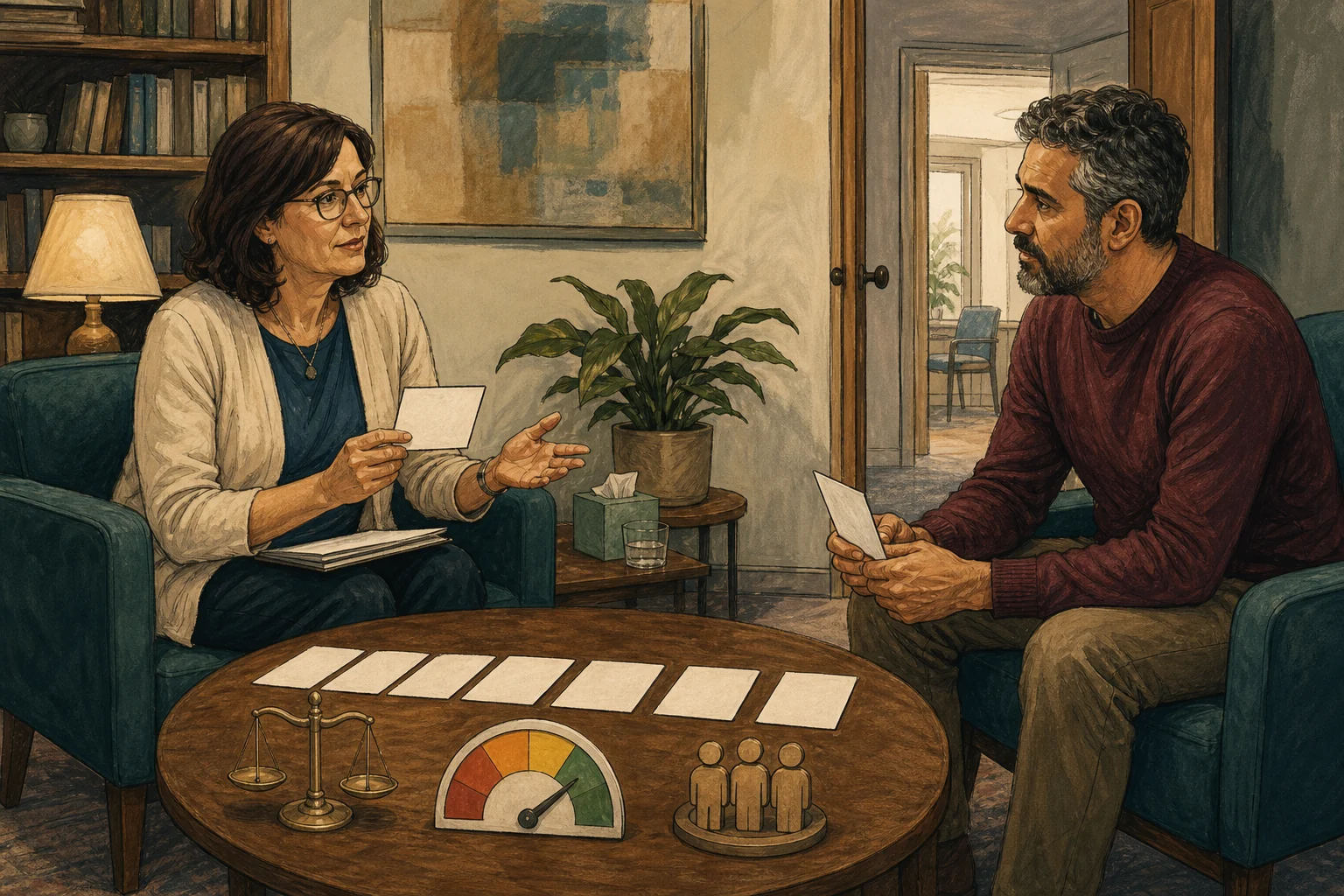
A careful assessment considers distress, impairment, risk, conduct, consent, context and alternative explanations. No object or preference is diagnostic on its own.
Illustration created using generative AI; not documentary evidence.- Status
- Detailed editorial draft
- Publisher
- The UK Kink Guide
- Reviewed
- Structured draft present; individual review date not recorded
- Evidence
- 8 cited sources · types labelled below
- Jurisdiction
- UK-focused general education
Read the rest: evidence, law, safety and sources
An interest that differs from social or cultural convention. Difference alone does not establish a mental disorder, risk or unlawful behaviour.
A research and clinical term for a sustained, focused atypical sexual interest. It describes an interest category and is not automatically a diagnosis.
An ICD-11 diagnosis requiring a persistent and intense atypical arousal pattern plus the relevant requirements concerning non-consent, action, marked distress or significant risk.
A legal determination about conduct and evidence under the applicable law. Diagnosis neither proves an offence nor excuses one, and a diagnosis is not required for conduct to be criminal.
Solitary behaviour and consenting adults
For an arousal pattern involving solitary behaviour or consenting adults, atypicality alone is insufficient under ICD-11. The relevant category requires marked distress about the nature of the pattern that is not simply a consequence of rejection or feared rejection by others, or a significant risk of injury or death to the person or a partner.
This distinction helps prevent consensual adult fetish, kink or BDSM interests being classified as disorders merely because they are unfamiliar or stigmatised. It does not mean every consensual activity is harmless or lawful: consent, capacity, physical risk and the specific act still require separate consideration.

Private interests and consensual adult behaviour are not disorders solely because they are uncommon. Clinical definitions require additional features such as marked distress or impairment.
Illustration created using generative AI; not documentary evidence.Non-consent, action and legal questions
ICD-11 treats sustained patterns focused on people who are unwilling or unable to consent differently from patterns involving consenting adults. The classification considers whether the person has acted on the pattern or is markedly distressed by it. This clinical framework does not replace safeguarding, emergency action or the criminal law.
A diagnosis and a criminal offence answer different questions. UK courts and authorities apply the law to conduct, circumstances and evidence; mental-health terminology neither grants consent nor supplies a defence by itself. England and Wales, Scotland and Northern Ireland have separate statutory definitions of consent, and additional rules may apply to a particular act. Individual cases need appropriately qualified clinical or legal advice.

Non-consent, serious risk and harmful action raise safeguarding and legal questions distinct from private fantasy or interest. The facts and UK jurisdiction determine the response.
Illustration created using generative AI; not documentary evidence.Objects, appearance and identity are not diagnostic
Clothing, footwear, a collar, fabric, decorative rope, a collection or an abstract symbol cannot establish a paraphilic disorder. The same object may be fashion, craft, comfort, community dress, a relationship symbol or part of a consensual adult interest. Meaning depends on the person and context, and even a focused interest does not by itself establish a disorder.
Likewise, identifying as kinky, practising BDSM or using a fetish label is not clinical evidence on its own. Joyal and Carpentier's population research separates reported interests from behaviours, reinforcing that one dimension should not be assumed from another. Diagnosis must not be inferred from appearance, possessions, internet use or group membership.
Evidence limits and respectful support
Reed and colleagues described the ICD-11 revision as an effort to improve scientific validity, clinical utility and human-rights protections. Krueger and colleagues also emphasised that a single behaviour or offence does not establish the sustained, focused and intense pattern required for diagnosis. Clinical and forensic samples cannot be treated as representative of everyone with an atypical interest.
Support may be appropriate where someone experiences persistent distress, unwanted or difficult-to-control behaviour, impaired daily life, serious risk or concern about consent. Seeking help does not itself confirm a diagnosis. Respectful care should address actual needs and safety while avoiding the assumption that consensual adult difference is inherently disordered.
Non-graphic examples
What the umbrella may include
- A consensual adult clothing or material fetish is not a paraphilic disorder merely because other people consider it unusual.
- Distress caused only by anticipated rejection is distinguished from the marked-distress requirement for the consenting-adult ICD-11 category.
- A person may discuss an unwanted fantasy with a clinician without that conversation automatically producing a diagnosis.
- A serious physical risk can be clinically relevant even where adults consent, because consent does not remove the possibility of injury or death.
- A criminal investigation can proceed on evidence of conduct without requiring a paraphilic-disorder diagnosis; the two processes answer different questions.
Prepare for an appointment
Questions you could ask a professional
- What information would help you understand my question?
- What are the realistic options and uncertainties?
- How can disability, communication or privacy needs be accommodated?
- When should the situation be reviewed again?
These prompts do not replace assessment and do not imply that every reader needs professional care.
Continue learning
Take the next step from definition to context.
Continue with independent guidance connecting paraphilic disorder to evidence, consent, safety, uncertainty and practical decisions.
Plain-language distinctions among kink, fetish, BDSM, roles and clinical terms, with questions that turn labels into clear choices.
Read the guide