BDSM is a broad label for consensual adult interests involving restraint, agreed rules, exchanged authority, strong sensation or role-play. The letters combine three overlapping pairs: bondage/discipline, dominance/submission and sadism/masochism. A person may relate to only one part.
 The UK Kink GuideEvidence-led glossary
 Back to the glossaryFoundationsIn plain English Words in context A non-graphic adult example What not to assume
BDSM
Also known as bondage and discipline · dominance and submission · sadism and masochism
An umbrella term for consensual adult practices involving restraint, rules, power exchange, intense sensation or role-based experiences. Its initials commonly group bondage and discipline, dominance and submission, and sadism and masochism; not every participant is interested in every element.
Start here
New to this term?
A ‘scene’ is a bounded period of agreed activity or role-play. ‘Power exchange’ means adults deliberately agree that one person will direct some choices within stated limits. A top or dominant directs; a bottom or submissive receives or follows in the agreed context. These roles are not ownership.
One adult may enjoy wearing a symbolic collar during an agreed role-play but dislike restraint and pain. Another may enjoy the craft and sensation of rope without adopting a submissive identity. Both can use the BDSM umbrella without sharing the same interests.
The label does not reveal personality, trauma history, preferred role, relationship style or mental health. Fantasy, occasional behaviour, identity and community membership are different dimensions. Consent to one BDSM element never supplies consent to another, and serious harm is not made lawful by the label.
Sources and evidence type
Manual claim and limitation notes are shown where an individual source audit is complete. Other evidence-type labels are a publisher aid awaiting source-by-source confirmation.
De Neef et al. (2019)Research study
- Source design
- Peer-reviewed research or review
- What it can support
- The specific population, measures and findings reported by the paper.
- Important limitation
- It cannot automatically establish UK prevalence, causation, diagnosis, consent or an individual outcome. Check recruitment, definitions and study design.
Dunkley & Brotto (2020)Research study
- Source design
- Peer-reviewed research or review
- What it can support
- The specific population, measures and findings reported by the paper.
- Important limitation
- It cannot automatically establish UK prevalence, causation, diagnosis, consent or an individual outcome. Check recruitment, definitions and study design.
Wuyts & Morrens (2022)Research study
- Source design
- Peer-reviewed research or review
- What it can support
- The specific population, measures and findings reported by the paper.
- Important limitation
- It cannot automatically establish UK prevalence, causation, diagnosis, consent or an individual outcome. Check recruitment, definitions and study design.
WHO ICD-11 clinical descriptions (2024)Clinical guideline
- Source design
- Current public-health or clinical guidance
- What it can support
- Service pathways, health definitions and recommended public-health or clinical actions within its stated scope.
- Important limitation
- General guidance cannot assess an individual’s symptoms, exposure, medicine, contraindications or urgency.
CPS consent guidance (England and Wales)Law or regulator
- Source design
- Primary legislation, prosecutorial or regulator guidance
- What it can support
- The legal provision or official regulatory position for the jurisdiction and date stated.
- Important limitation
- It is not fact-specific legal advice. Commencement, amendments, jurisdiction and case law may affect application.
CPS offences-against-the-person guidance (England and Wales)Law or regulator
- Source design
- Primary legislation, prosecutorial or regulator guidance
- What it can support
- The legal provision or official regulatory position for the jurisdiction and date stated.
- Important limitation
- It is not fact-specific legal advice. Commencement, amendments, jurisdiction and case law may affect application.

Foundations
Illustration created using generative AI; not documentary evidence.
In brief
Three overlapping families, many adult meanings.
BDSM names a broad family of consensual adult interests rather than one activity, personality type or relationship model. For some people it is an occasional fantasy or scene; for others it is a social community, a continuing relationship language, an identity or a combination of these. The acronym is useful shorthand, but it cannot reveal an individual's preferred role, limits, motivations or level of experience.
What research can—and cannot—define
De Neef and colleagues' 2019 systematic review found that research uses BDSM to cover a wide spectrum, from fantasy and occasional activities to relationships, leisure, community participation and identity. Studies that ask about a broad label often produce different results from studies that ask about particular interests, so headline prevalence figures are not directly interchangeable.
The evidence base has grown but remains uneven. Samples are often self-selected, definitions vary, and findings from one country or community should not be treated as a universal profile. Research does not support assigning every participant the same motive, childhood explanation, personality or preferred role.
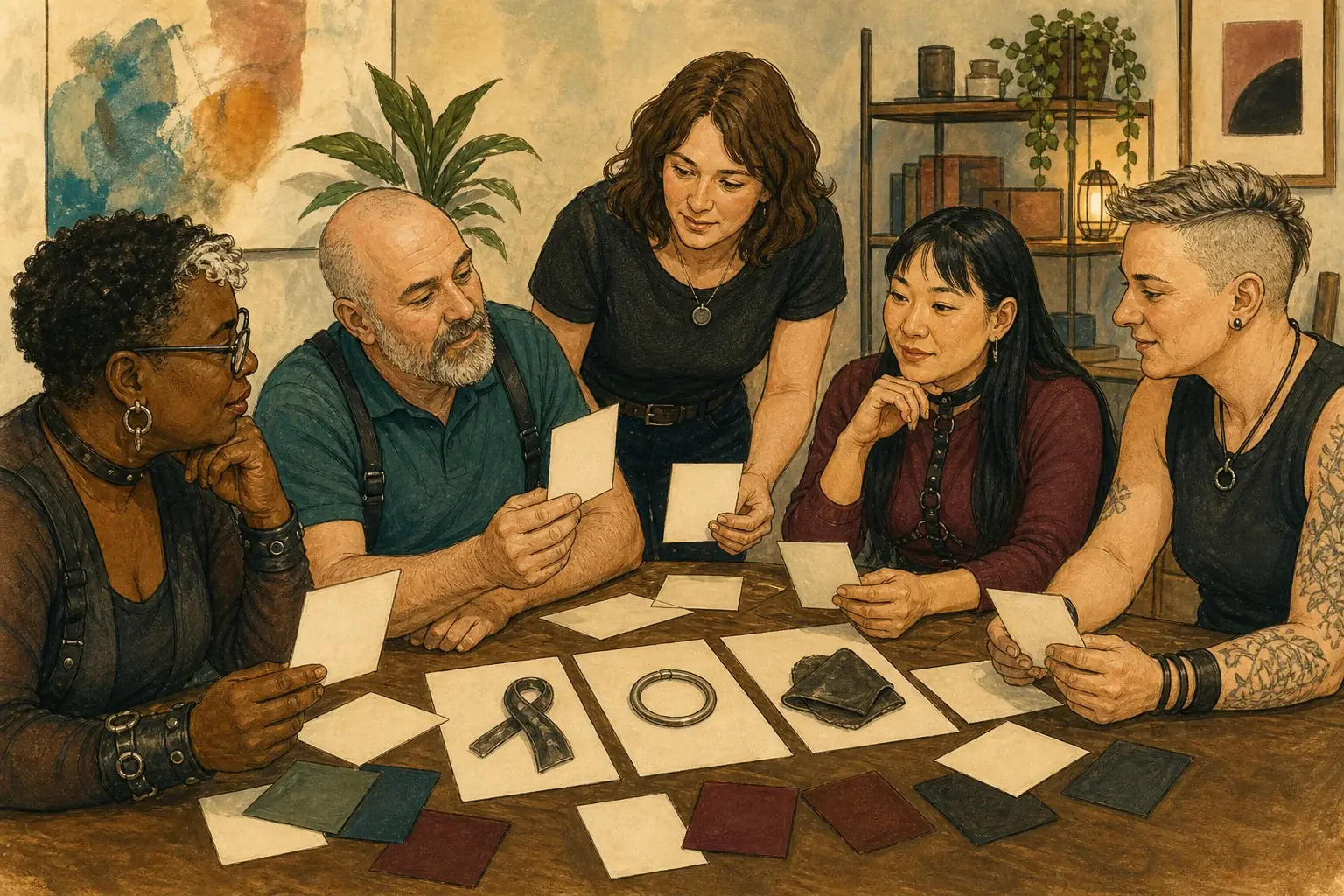
Research uses BDSM to cover fantasy, occasional activity, relationships, community and identity. A shared label cannot reveal an individual's practices, roles or motivations.
Illustration created using generative AI; not documentary evidence.- Status
- Detailed editorial draft
- Publisher
- The UK Kink Guide
- Reviewed
- Structured draft present; individual review date not recorded
- Evidence
- 6 cited sources · types labelled below
- Jurisdiction
- UK-focused general education
Read the rest: evidence, law, safety and sources
Groups interests involving restraint or restricted movement with negotiated rules, ritual, structure and consequences. Either element may exist without the other.
Centres on a negotiated distribution of authority. It may be confined to a scene, expressed through recurring rituals or form part of a wider relationship; authority is never unlimited.
In consensual kink, describes interest in giving or receiving controlled pain, intense sensation or psychological intensity. This is distinct from harming someone without consent.
A person may identify with several, one or none of these pairs while still using BDSM or kink as a convenient community term. Roles and interests can also change by partner or context.
Consent, coercion and UK law
Consent in BDSM is specific, informed, continuing and withdrawable. Agreement to a relationship, role, object or previous scene does not create blanket permission. Capacity, relevant risks, limits and ways to pause or stop matter; conduct after consent is withdrawn is non-consensual and may be criminal.
For England and Wales, Crown Prosecution Service guidance states that consent may be a defence to battery but generally not to actual or grievous bodily harm outside recognised exceptions. Scotland and Northern Ireland have separate legal systems, and the legal position depends on the act and facts. This glossary is therefore not a substitute for current legal advice.
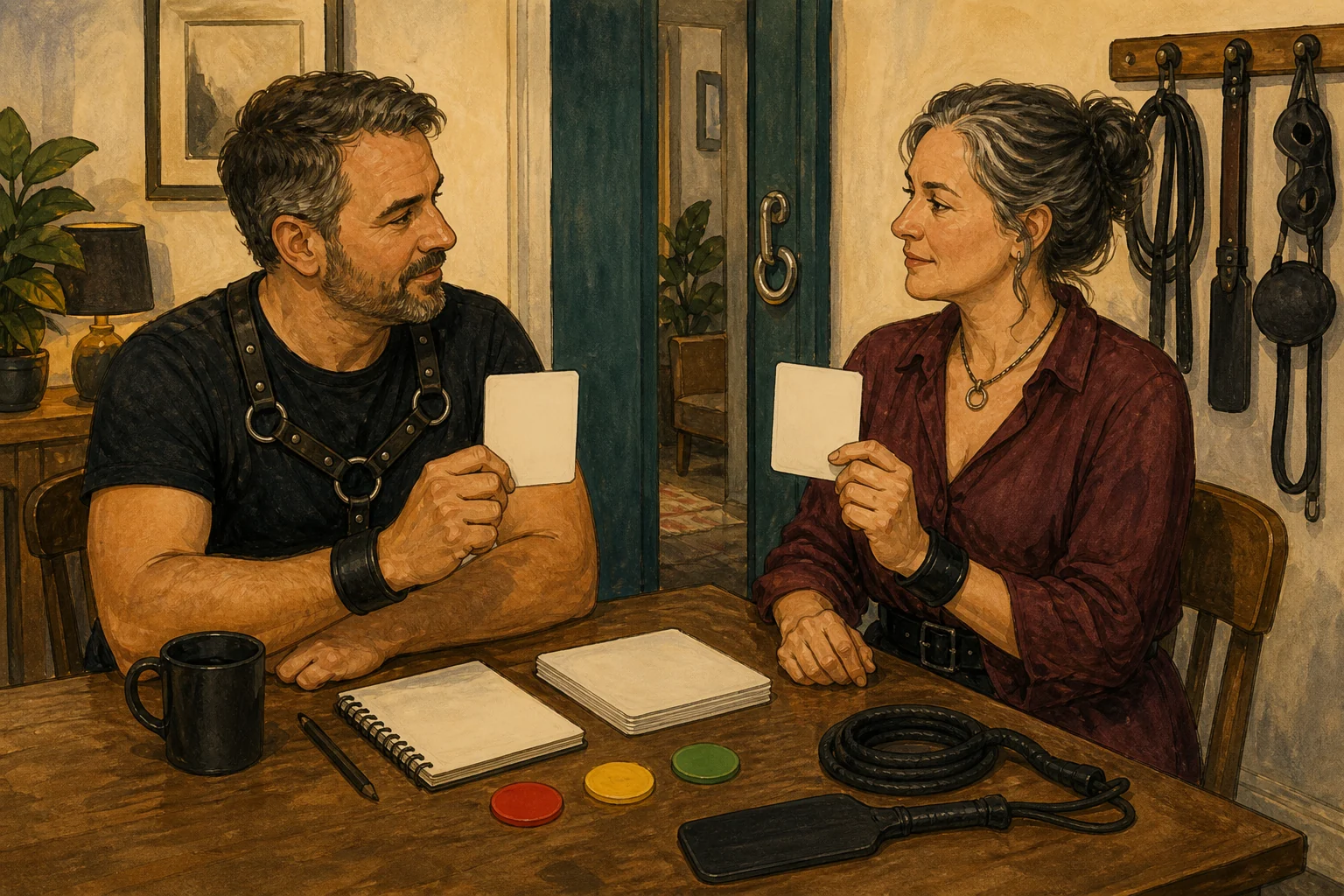
Consent remains specific, informed, continuing and withdrawable. A relationship, role, previous scene or specialist object does not remove the need for present agreement.
Illustration created using generative AI; not documentary evidence.Objects, garments and symbols
BDSM-associated objects can be grouped by meaning rather than by a presumed script. Restraint objects may include openable padded cuffs or rope; sensory objects may emphasise texture, sound, pressure or anticipation; clothing and materials may include leather, latex, boots, gloves, masks or uniforms; symbolic objects may include a collar, key, written protocol, timer or agreed communication token.
The same object may function as equipment, costume, craft, collection, status symbol or private reminder, and some BDSM experiences use no specialist object at all. A product's appearance, price or adult-retailer label does not make it suitable for every body or activity. Design, condition, fit, material sensitivity, hygiene, health, communication and reliable release all affect risk.
Wellbeing and clinical distinction
The World Health Organization distinguishes atypical sexual interests from paraphilic disorders. Consensual adult BDSM is not a disorder merely because it is unconventional; clinical concern instead turns on matters such as marked distress not explained solely by social rejection, substantial impairment, serious risk of injury or death, or involvement of non-consenting people.
A 2022 systematic review found emerging evidence that BDSM interactions engage stress, reward, pain and social systems, but only ten biological studies met its criteria. That small evidence base does not justify claims that BDSM automatically improves health, causes trauma or produces one predictable hormonal response. Individual wellbeing and actual conduct matter more than the label.

Consensual adult BDSM is not a disorder merely because it is unconventional. Distress, impairment, serious risk and non-consent are the clinically relevant distinctions.
Illustration created using generative AI; not documentary evidence.Non-graphic examples
What the umbrella may include
- Two adults negotiating a time-limited scene involving a role, agreed boundaries and a clear stopping signal.
- A continuing power-exchange relationship whose authority applies only within specifically agreed areas.
- Wearing leather, latex, boots, gloves, a collar or another adult garment for its material, aesthetic or symbolic meaning.
- Exploring restraint, rules, focused sensation or psychological intensity separately rather than treating the acronym as a checklist.
- Taking part in an adult discussion group, social event, craft practice or community identity without participating in a scene.
Prepare for an appointment
Questions you could ask a professional
- What information would help you understand my question?
- What are the realistic options and uncertainties?
- How can disability, communication or privacy needs be accommodated?
- When should the situation be reviewed again?
These prompts do not replace assessment and do not imply that every reader needs professional care.
Continue learning
Take the next step from definition to context.
Continue with independent guidance connecting bdsm to evidence, consent, safety, uncertainty and practical decisions.
How three overlapping adult terms differ, where clinical language has a separate purpose, and how to ask what someone means.
Read the full guideRelated in-depth reading
Read the full guide.
Explore a connected question with context and UK support routes.
Is BDSM legal in the UK? Understand consent, injury, images and public places, with separate rules for England and Wales, Scotland and NI.
Read the full guide UK lawR v Peacock: the 2012 obscenity trial explainedR v Peacock’s reported 2012 acquittal, the obscenity test, later CPS guidance and why a jury verdict did not repeal England and Wales law.
Read the full guide UK lawThe 2014 UK porn rules and the face-sitting protestThe 2014 UK on-demand porn rules, the Westminster protest, criticism of censorship and how Ofcom and online-safety regulation developed.
Read the full guide Community & cultureWhat is BDSM? A beginner's guideA plain-English introduction to adult BDSM, its language, consent, risk, UK law and the questions worth asking before any activity.
Read the full guide UK lawOperation Spanner and R v Brown: the case explainedOperation Spanner (1987) led to R v Brown: the House of Lords ruled consent was no defence to injury in that case. Read what the courts decided and why.
Read the full guide Community & cultureA history of BDSM in BritainA careful, non-graphic account of British leather and fetish archives, law and changing public visibility.
Read the full guide Community & cultureQueer kink history in the UKWhat UK archives, museums and films reveal about queer leather and fetish networks, and where the record is incomplete.
Read the full guide Community & cultureThe Fifty Shades effectHow a bestselling novel and its film changed public conversation, and why fiction cannot establish consent or safety practice.
Read the full guide Community & cultureKink in film and TV: what gets it rightA critical way to watch verified screen works for consent, power and perspective without mistaking a story for instruction.
Read the full guide Community & cultureDocumentaries worth watchingVerified UK documentary starting points and a way to separate filmed testimony, archive evidence and production framing.
Read the full guide Community & culturePodcasts about sex and kinkA verified listening guide spanning relationships, sex education and queer history, with activity checked in October 2026.
Read the full guide Community & cultureYour first fetish club: dress codes and what happensA first visit to an adult fetish club: checking a dress code, consent, access, privacy and how to leave.
Read the full guide