A scent or odour fetish is an adult erotic or strongly pleasurable focus on particular smells. The source might be a consenting adult, a garment, a material such as leather, a fragrance or an environment.
 The UK Kink GuideEvidence-led glossary
 Back to the glossaryBody & object focusIn plain English Words in context A non-graphic adult example What not to assume
Scent and odour fetish
Also known as olfactophilia
An erotic focus on particular body, material, garment or environmental scents. Smell is closely linked with memory and emotion, but preferred scents and meanings are highly individual.
Start here
New to this term?
Olfactophilia is a synonym. Body-scent interest, material scent and perfume appreciation are related but distinct focuses, and ordinary enjoyment or collection of fragrance is not automatically fetishistic.
One adult may associate a consenting partner's familiar fragrance with intimacy, while another values the scent of leather or rubber. A perfume collector may study the same notes without any erotic meaning.
Smell is closely linked with memory and emotion, but that does not establish one cause or meaning. An interest never grants access to someone's body, clothing or bodily material. Research can show that odour affects perception and memory, but cannot predict individual preferences or provide dependable prevalence for olfactophilia.
Sources and evidence type
Manual claim and limitation notes are shown where an individual source audit is complete. Other evidence-type labels are a publisher aid awaiting source-by-source confirmation.
Havlíček et al. (2020), MHC and odour meta-analysisResearch study
- Source design
- Peer-reviewed research or review
- What it can support
- The specific population, measures and findings reported by the paper.
- Important limitation
- It cannot automatically establish UK prevalence, causation, diagnosis, consent or an individual outcome. Check recruitment, definitions and study design.
Roberts et al. (2008), human odour-preference studyResearch study
- Source design
- Peer-reviewed research or review
- What it can support
- The specific population, measures and findings reported by the paper.
- Important limitation
- It cannot automatically establish UK prevalence, causation, diagnosis, consent or an individual outcome. Check recruitment, definitions and study design.
NHS, contact-dermatitis causesClinical guideline
- Source design
- Current public-health or clinical guidance
- What it can support
- Service pathways, health definitions and recommended public-health or clinical actions within its stated scope.
- Important limitation
- General guidance cannot assess an individual’s symptoms, exposure, medicine, contraindications or urgency.
NHS, anaphylaxisClinical guideline
- Source design
- Current public-health or clinical guidance
- What it can support
- Service pathways, health definitions and recommended public-health or clinical actions within its stated scope.
- Important limitation
- General guidance cannot assess an individual’s symptoms, exposure, medicine, contraindications or urgency.
WHO ICD-11 clinical requirements (2024)Clinical guideline
- Source design
- Current public-health or clinical guidance
- What it can support
- Service pathways, health definitions and recommended public-health or clinical actions within its stated scope.
- Important limitation
- General guidance cannot assess an individual’s symptoms, exposure, medicine, contraindications or urgency.

Body & object focus
Illustration created using generative AI; not documentary evidence.
In brief
A powerful sense, an individual meaning.
Scent and odour fetish, sometimes called olfactophilia, is an adult erotic focus on particular body, garment, material or environmental smells. Smell can be intimate because it is tied closely to memory, recognition and emotion, but preferences are highly individual and context-dependent. Interest in a scent does not imply permission to smell, collect, wear or share another person's belongings or bodily material.
Smell research and its limits
Human-odour research supports a role for scent in social and partner perception, but results about biological matching are modest and inconsistent. Havlíček and colleagues' meta-analysis found no overall consistent effect for MHC dissimilarity, cautioning against claims that attraction can be decoded from genes or a single smell.
There is little direct olfactophilia research. Laboratory odour ratings, online fetish groups and selected community surveys cannot establish population prevalence, a universal preferred scent or the meaning of smell for one adult.

Human-odour studies find variable social effects, while direct olfactophilia research is sparse. A laboratory rating cannot establish compatibility, prevalence or personal meaning.
Illustration created using generative AI; not documentary evidence.- Status
- Detailed editorial draft
- Publisher
- The UK Kink Guide
- Reviewed
- Structured draft present; individual review date not recorded
- Evidence
- 5 cited sources · types labelled below
- Jurisdiction
- UK-focused general education
Read the rest: evidence, law, safety and sources
Erotic or intensely pleasurable focus on particular scents or odours.
Focus on a consenting adult's characteristic smell; preference may depend on person, context or garment.
Interest in leather, rubber, wood, fragrance or another object's aroma rather than body odour.
Enjoyment or collecting of perfume and scent with no necessary erotic meaning.
Bottles, garments and materials
Possible still-life objects include sealed unlabelled scent bottles, fabric swatches, leather or wood samples, a scent dome or an empty garment bag. Natural body scent, perfume, laundry products and material odour are distinct sources and may be appealing separately.
Scent can also function as a memory cue, symbol of a partner, marker of use or feature of a material such as leather or rubber. See the Leather, Latex and rubber, Foot fetish and Hair fetish field notes for overlapping meanings.
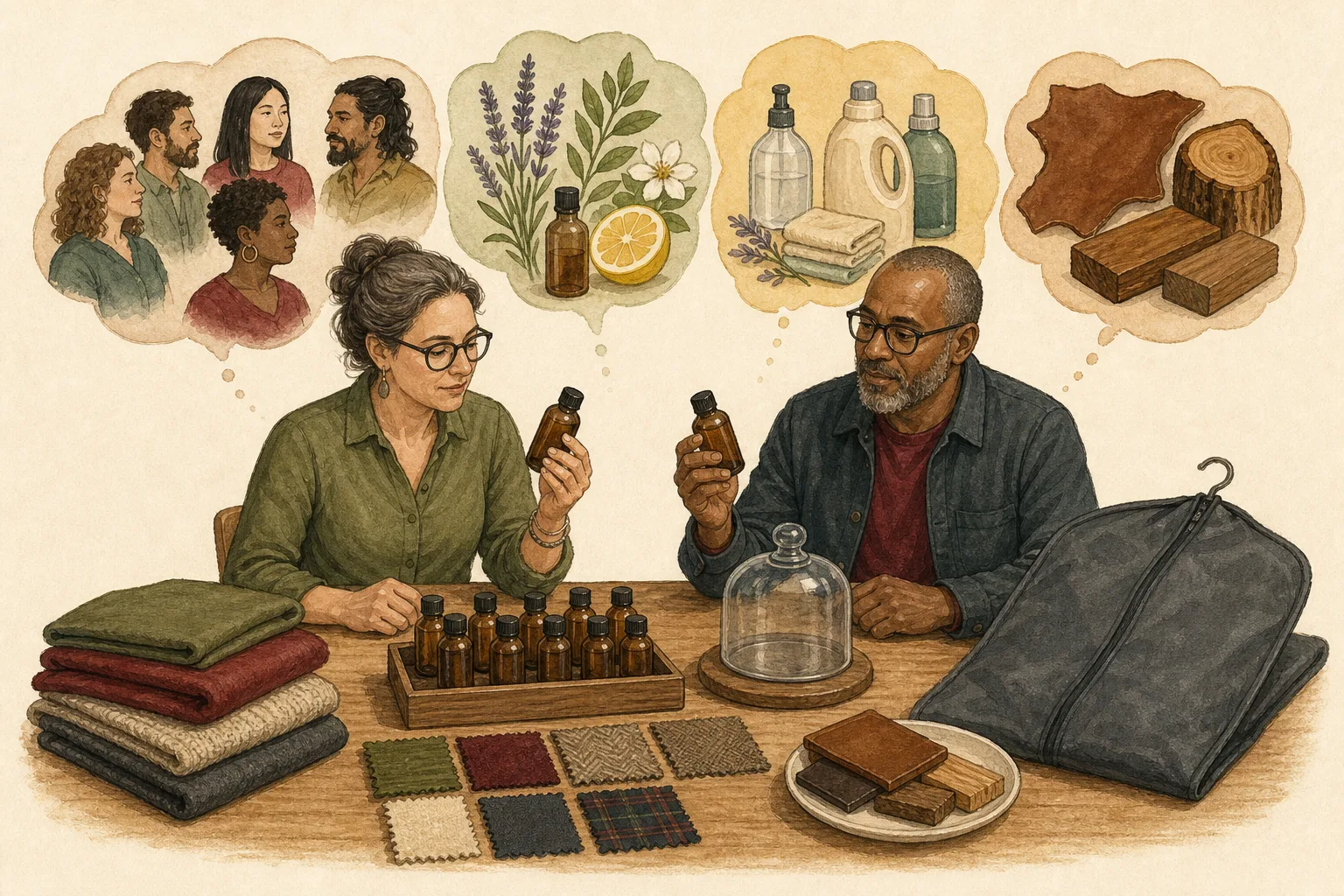
Body scent, fragrance, laundry products and material odours are distinct. A familiar aroma may cue memory or material interest without revealing a universal preference.
Illustration created using generative AI; not documentary evidence.Consent, allergy and ventilation
Consent should cover smelling, wearing, sharing, retaining or deliberately altering a scent source. Clothing and personal items remain private property, and a preference does not justify taking or storing them without agreement.
Fragrances and cleaning products can trigger contact dermatitis, asthma or other sensitivity, and unknown concentrated substances can be harmful. Breathing difficulty, facial or throat swelling, faintness or severe reaction needs urgent medical help; exposure should never be forced as a test of commitment.

Smelling, wearing, sharing and retaining a scent source need permission. Asthma, allergy and sensory needs can make stopping or avoiding an exposure essential.
Illustration created using generative AI; not documentary evidence.Interest versus disorder
A consensual adult interest in scent is not a paraphilic disorder merely because smell is central. WHO guidance distinguishes disorder through marked distress, significant impairment, serious risk or non-consent.
Dislike, anosmia, sensory sensitivity and fragrance-free access needs are equally valid. Nobody should be pressured to tolerate an odour, disclose health information or participate because another person describes scent as natural.
Non-graphic examples
What the umbrella may include
- Associating a familiar adult partner's agreed fragrance with intimacy.
- Being drawn to the smell of leather or rubber without interest in body odour.
- Keeping sealed samples as an abstract way to discuss scent categories.
- Choosing fragrance-free space because an adult participant has asthma or sensory sensitivity.
- Asking before retaining a garment rather than treating personal scent as shared property.
Prepare for an appointment
Questions you could ask a professional
- What information would help you understand my question?
- What are the realistic options and uncertainties?
- How can disability, communication or privacy needs be accommodated?
- When should the situation be reviewed again?
These prompts do not replace assessment and do not imply that every reader needs professional care.
Continue learning
Take the next step from definition to context.
Continue with independent guidance connecting scent and odour fetish to evidence, consent, safety, uncertainty and practical decisions.
Explore body-part and object-focused interests through meaning, consent, privacy, partner discussion and UK support.
Read the guide