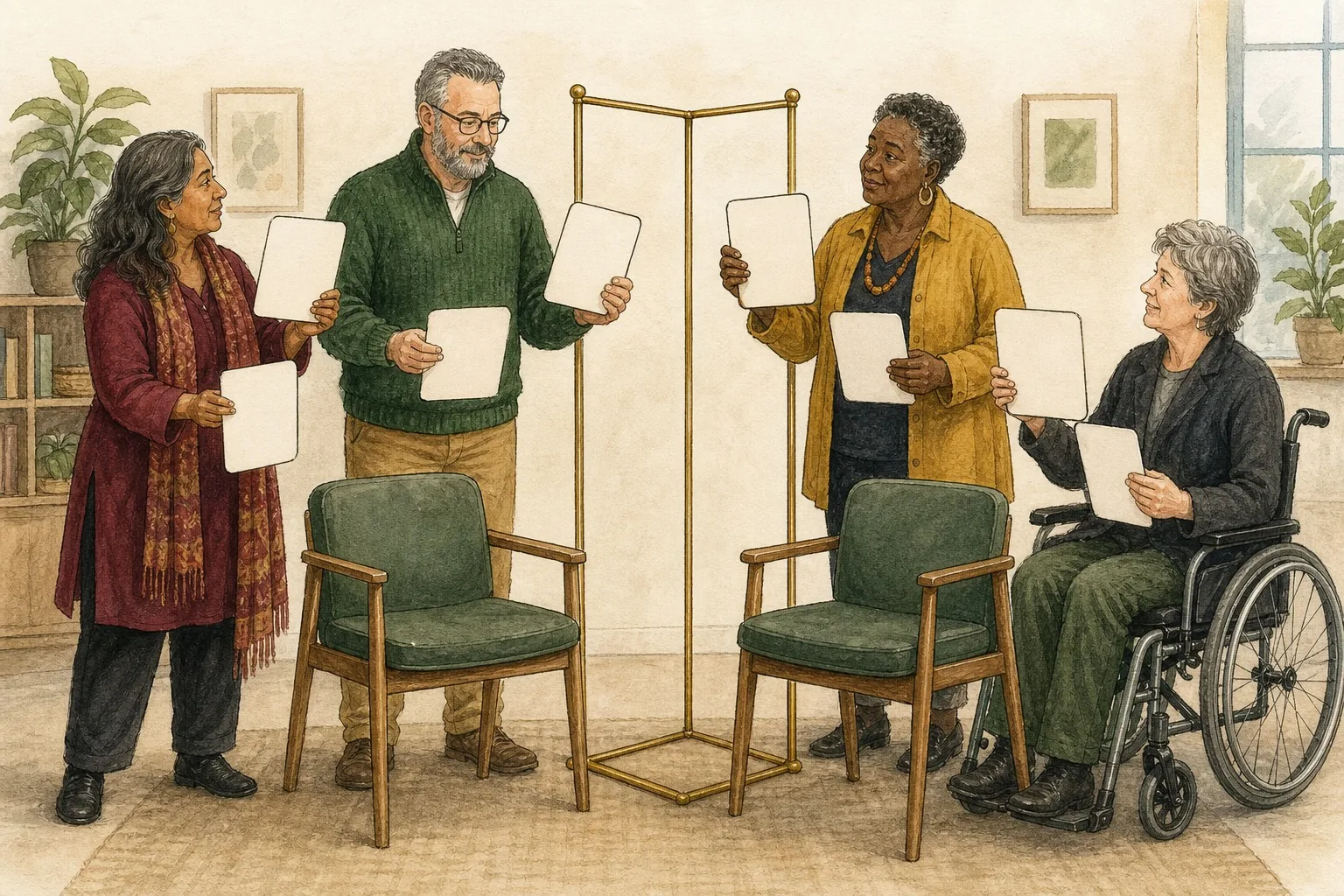
A switch is an adult who may enjoy more than one BDSM role, such as dominant and submissive or top and bottom, depending on the partner, activity or occasion.
Sources and evidence type
Manual claim and limitation notes are shown where an individual source audit is complete. Other evidence-type labels are a publisher aid awaiting source-by-source confirmation.
Martinez (2018), BDSM role fluidity mixed-methods studyResearch study
Source design
Peer-reviewed research or review
What it can support
The specific population, measures and findings reported by the paper.
Important limitation
It cannot automatically establish UK prevalence, causation, diagnosis, consent or an individual outcome. Check recruitment, definitions and study design.
The specific population, measures and findings reported by the paper.
Important limitation
It cannot automatically establish UK prevalence, causation, diagnosis, consent or an individual outcome. Check recruitment, definitions and study design.
Illustration created using generative AI; not documentary evidence.
In brief
Role flexibility is a valid pattern—not a halfway point between two fixed identities.
Switch is a self-chosen community identity or practical description, not a diagnosis or evidence of indecision. Some switches enjoy roughly equal role variation; others have a strong usual preference and occasionally choose another role. Switching between top and bottom does not necessarily mean switching dominance and submission, because activity and authority are separate dimensions.
Identity and variation
Research documents shifts by partner, scene, time and context and shows that binary role models miss substantial variation. A label does not reveal frequency, preferred activities or relationship structure.
Gender and orientation do not determine role. Studies finding group-level patterns cannot predict an individual's preference or justify stereotypes.
EDITORIAL ILLUSTRATIONFlexibility is not indecision
Switch may describe a stable identity, a contextual preference or occasional movement between roles. It does not reveal frequency, skill, hierarchy or what someone will agree to do.
Illustration created using generative AI; not documentary evidence.
Status
Detailed editorial draft
Publisher
The UK Kink Guide
Reviewed
Keyword definition and metadata checked 12 October 2026
Evidence
3 cited sources · types labelled below
Jurisdiction
UK-focused general education
Read the rest: evidence, law, safety and sources
Switch
Someone who identifies with or practises more than one side of a relevant BDSM role distinction.
Dominant/submissive
Authority roles; a switch may take either, but not every switch uses D/s.
Top/bottom
Activity roles involving giving, directing or receiving an agreed action; these may switch independently of authority.
Versatile
A related term, often used for sexual-position roles, whose meaning should be asked rather than assumed.
Negotiating each role
Discuss the role being taken now, the authority attached to it, relevant skills and limits. Experience in one role does not automatically confer competence in its counterpart.
A person may switch within an interaction, on different occasions or only with particular partners. No one owes reciprocal role exchange because they use the label.
EDITORIAL ILLUSTRATIONNegotiate the role each time
An adult may want different roles with different people, activities or days. Previous flexibility is not standing consent to switch direction during a scene or relationship.
Illustration created using generative AI; not documentary evidence.
Consent and wellbeing
Role transitions require mutual agreement and a clear way to pause. Emotional expectations, aftercare and physical tolerances may differ substantially between roles.
Switching can offer perspective but does not make someone inherently safer or more empathic. Consent practice, accountability and technical competence remain observable behaviours.
EDITORIAL ILLUSTRATIONEither role retains full agency
Giving or receiving direction does not change the right to pause, withdraw or ask for care. Access needs and responsibilities remain relevant on every side of a role.
Illustration created using generative AI; not documentary evidence.
Clinical and social context
Switch identity is not a mental disorder. ICD-11 does not classify consensual atypical interests as disorders solely because they differ from social norms.
Community spaces should avoid treating switches as confused, available for every role or less committed. Accurate forms and profiles allow multiple or self-described roles.
Non-graphic examples
What the umbrella may include
Topping rope while remaining relationally submissive.
Choosing dominance with one partner and submission with another.
Changing roles between planned scenes.
Preferring bottoming most of the time while identifying as a switch.
Declining a requested role despite the label.
Prepare for an appointment
Questions you could ask a professional
What information would help you understand my question?
What are the realistic options and uncertainties?
How can disability, communication or privacy needs be accommodated?
When should the situation be reviewed again?
These prompts do not replace assessment and do not imply that every reader needs professional care.
Continue learning
Take the next step from definition to context.
Continue with independent guidance connecting switch to evidence, consent, safety, uncertainty and practical decisions.