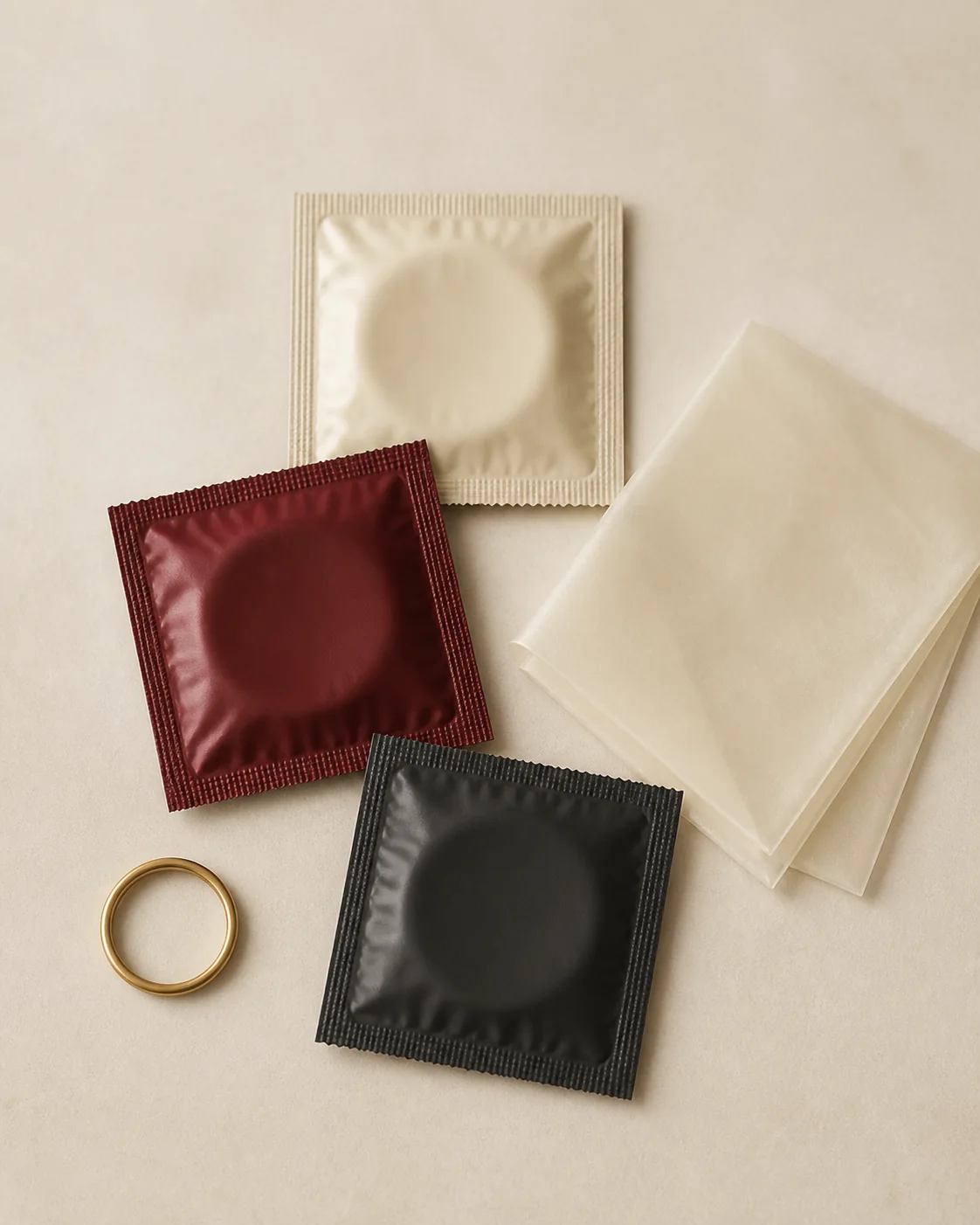
Products used to reduce contact with bodily fluids or skin and lower the likelihood of some infections and/or pregnancy. Protection depends on material, fit, correct use and the exposure involved.
Sources and evidence type
Manual claim and limitation notes are shown where an individual source audit is complete. Other evidence-type labels are a publisher aid awaiting source-by-source confirmation.
NHS: condomsClinical guideline
Source design
Current public-health or clinical guidance
What it can support
Service pathways, health definitions and recommended public-health or clinical actions within its stated scope.
Important limitation
General guidance cannot assess an individual’s symptoms, exposure, medicine, contraindications or urgency.
Illustration created using generative AI; not documentary evidence.
In brief
Match the barrier, material and lubricant to the purpose.
External condoms, internal condoms and other barriers work by reducing particular contact. They do not offer identical coverage or protection for every infection. Choosing the correct product, lubricant and size improves comfort and reduces breakage; using two condoms together increases friction rather than safety.
Correct use
Check the expiry date and package, open carefully and use a new barrier for each appropriate activity or partner. Follow the manufacturer's directions rather than improvising with untested materials.
Do not use two external condoms together or combine internal and external condoms; friction can increase failure.
Status
Detailed editorial draft
Publisher
The UK Kink Guide
Reviewed
Structured draft present; individual review date not recorded
Evidence
3 cited sources · types labelled below
Jurisdiction
UK-focused general education
Read the rest: evidence, law, safety and sources
External condom
A barrier worn on a penis or compatible object, available in latex and non-latex materials.
Internal condom
A barrier placed internally before sex, with product-specific instructions.
Dental dam
A sheet barrier used to reduce contact during some oral sexual activities.
Glove
A hand barrier useful in selected circumstances, with material and allergy considerations.
Material and lubricant
Oil-based products damage latex and polyisoprene condoms. NHS guidance recommends water- or silicone-based lubricant with latex; non-latex products require their own package instructions.
Allergy or sensitivity may require a non-latex option. Fragrance, additives and topical medicines can also affect comfort or compatibility.
What barriers can and cannot do
Condoms reduce HIV, many STI and pregnancy risks when used correctly, but protection varies for infections spread through uncovered skin. No barrier promises zero risk in every context.
Contraception and STI prevention remain separate questions. Internal and external condoms are contraceptive options; other barriers generally are not.
If something fails
If a condom breaks, slips or was used with an incompatible product, stop and replace it. Depending on circumstances, seek timely advice about emergency contraception, PEP, STI testing or hepatitis prevention.
Do not wash internally or use harsh chemicals in an attempt to prevent infection. A clinic can assess actual next steps.
Non-graphic examples
What the umbrella may include
Checking the package expiry and material.
Using water-based lubricant with a latex condom.
Choosing a non-latex condom for latex sensitivity.
Changing barriers between partners or body sites as appropriate.
Seeking urgent PEP advice after a relevant condom failure.
Prepare for an appointment
Questions you could ask a professional
What possible causes should be considered?
Could medicines, treatment, pain, hormones or another condition contribute?
Which symptoms or changes would need urgent review?
What options fit my priorities, access needs and health history?
These prompts do not replace assessment and do not imply that every reader needs professional care.
Continue learning
Take the next step from definition to context.
Continue with independent guidance connecting condoms and barriers to evidence, consent, safety, uncertainty and practical decisions.