Protocol is an agreed way that adults express a kink role through behaviour, words, clothing, objects or repeated rituals. It might mark when a role begins, make expectations predictable or give an ordinary action emotional weight. There is no universal protocol rulebook.
 The UK Kink GuideEvidence-led glossary
 Back to the glossaryPower & roleIn plain English Words in context A non-graphic adult example What not to assume
Protocol
Also known as D/s protocol · high protocol · low protocol
An agreed pattern of behaviour, communication, presentation or ritual used by consenting adults to express a kink or power-exchange role. Protocol can be informal, occasional or highly structured, but it never overrides present consent, capacity, accessibility or ordinary legal rights.
Start here
New to this term?
A protocol describes how something is done; a rule describes what is expected; and a ritual is repeated for symbolic or emotional meaning. ‘High’ and ‘low’ protocol are informal community descriptions of relative formality, not certified levels. Etiquette is a local convention, not automatic consent.
Two adults agree to use particular titles and place an ordinary object in a set position during a private ritual. Outside that time they use everyday language. If either person is tired or needs an accessible alternative, the form changes without treating that as failure.
A title, posture, garment or repeated behaviour does not prove submission, competence or permanent authority. Another household’s or event’s custom does not bind a newcomer who has not agreed. Protocol must yield to present consent, capacity, health, accessibility and the law.
Sources and evidence type
Manual claim and limitation notes are shown where an individual source audit is complete. Other evidence-type labels are a publisher aid awaiting source-by-source confirmation.
Hébert & Weaver (2015), qualitative study of dominant and submissive rolesResearch study
- Source design
- Peer-reviewed research or review
- What it can support
- The specific population, measures and findings reported by the paper.
- Important limitation
- It cannot automatically establish UK prevalence, causation, diagnosis, consent or an individual outcome. Check recruitment, definitions and study design.
Cascalheira, Thomson & Wignall (2022), 24/7 BDSM and dynamic consentResearch study
- Source design
- Peer-reviewed research or review
- What it can support
- The specific population, measures and findings reported by the paper.
- Important limitation
- It cannot automatically establish UK prevalence, causation, diagnosis, consent or an individual outcome. Check recruitment, definitions and study design.
Tarleton, Mackenzie & Sagarin (2025), BDSM consent normsResearch study
- Source design
- Peer-reviewed research or review
- What it can support
- The specific population, measures and findings reported by the paper.
- Important limitation
- It cannot automatically establish UK prevalence, causation, diagnosis, consent or an individual outcome. Check recruitment, definitions and study design.
Bowling et al. (2024), disclosure and reporting of consent violationsResearch study
- Source design
- Peer-reviewed research or review
- What it can support
- The specific population, measures and findings reported by the paper.
- Important limitation
- It cannot automatically establish UK prevalence, causation, diagnosis, consent or an individual outcome. Check recruitment, definitions and study design.
WHO ICD-11 clinical descriptions and diagnostic requirements (2024)Clinical guideline
- Source design
- Current public-health or clinical guidance
- What it can support
- Service pathways, health definitions and recommended public-health or clinical actions within its stated scope.
- Important limitation
- General guidance cannot assess an individual’s symptoms, exposure, medicine, contraindications or urgency.
Sexual Offences Act 2003, section 74 (England and Wales)Law or regulator
- Source design
- Primary legislation, prosecutorial or regulator guidance
- What it can support
- The legal provision or official regulatory position for the jurisdiction and date stated.
- Important limitation
- It is not fact-specific legal advice. Commencement, amendments, jurisdiction and case law may affect application.
Serious Crime Act 2015, section 76 (England and Wales)Law or regulator
- Source design
- Primary legislation, prosecutorial or regulator guidance
- What it can support
- The legal provision or official regulatory position for the jurisdiction and date stated.
- Important limitation
- It is not fact-specific legal advice. Commencement, amendments, jurisdiction and case law may affect application.

Power & role
Illustration created using generative AI; not documentary evidence.
In brief
Structure can express a role without becoming permanent authority.
Protocol is the choreography adults choose around a role: perhaps a particular greeting, title, garment, way of presenting an object or signal that marks when a dynamic begins and ends. The behaviour may look ordinary from outside; its importance comes from shared meaning, consistency and context. There is no universal protocol book, and terms such as ‘high’ and ‘low’ protocol are informal descriptions rather than certified levels.
Informal language, varied structures
People sometimes describe low, medium or high protocol to indicate increasing formality, attention or consistency. These are not standardised categories: one group may use ‘high protocol’ for ceremonial behaviour, another for precise speech, and another not at all. The useful questions are what the adults mean, where it applies and whether everyone affected has agreed.
Protocol can overlap with dominance and submission, discipline, service, role-play or a 24/7 relationship, but it does not require any one of them. A greeting ritual can exist in a time-limited scene; a continuing relationship may use only a small private cue. Formality also says nothing about intensity, sexual activity or the value of either participant.

A protocol may organise greetings, language, posture or routines, but there is no universal hierarchy of correctness. Adults may revise, simplify or decline it.
Illustration created using generative AI; not documentary evidence.- Status
- Detailed editorial draft
- Publisher
- The UK Kink Guide
- Reviewed
- Structured draft present; individual review date not recorded
- Evidence
- 7 cited sources · types labelled below
- Jurisdiction
- UK-focused general education
Read the rest: evidence, law, safety and sources
An agreed way of doing or communicating something within a role—for example a form of address, presentation style or transition cue.
An agreed expectation about what should or should not happen. A rule may be expressed through protocol, but the two terms are often used loosely and overlap.
A repeated action valued for its emotional or symbolic meaning. Ritual may be part of protocol without implying discipline or a consequence.
A community, event or household convention. It should not be assumed universal, and another person's etiquette does not bind someone who has not agreed to it.
Words, objects, garments and sensory cues
Protocol may involve a chosen title, plain-language response, scheduled check-in, way of greeting, arrangement of an ordinary object or an agreed change of clothing. Repetition can create anticipation, calm, focus, role clarity or a deliberate contrast with everyday interaction. The same word or gesture can mean something entirely different outside that private agreement.
Associated objects may include a notebook, printed card, checklist, timer, key, tray, place setting, bell, collar, badge or adult garment. Colour, material, sound, weight and placement may work as sensory or symbolic cues. These objects can support memory and accessibility, but they do not prove consent, authority or relationship status; a lost token, missed timer or unworn garment must never be treated as consent or misconduct by itself.

Words, garments and objects can cue an agreed role, yet none proves authority, consent or community standing. Meaning must be explained rather than inferred.
Illustration created using generative AI; not documentary evidence.Consent, accessibility and other people
A workable protocol identifies its scope, exceptions and ways to pause, revise or end it. Fatigue, pain, neurodivergence, medication, language, mobility, hearing, speech and sensory needs can affect whether a behaviour remains possible or comprehensible. Plain wording, alternative formats and additional response time may help, but an accessibility aid is not evidence that agreement continues.
Protocol should not demand performance during healthcare, emergencies, employment duties or circumstances where it creates danger. Nor should it involve bystanders, staff, housemates or other partners without their knowledge where their participation or privacy would be affected. Public clothing or private titles may be personally meaningful, but strangers are not thereby included in a dynamic.
A written protocol or contract can record an agreement; it cannot transfer legal ownership, waive the right to stop or make silence permanent consent. Expectations about money, sleep, food, healthcare, communications, housing or relationships need particular scrutiny because dependency and fear of consequences can undermine freedom to choose.
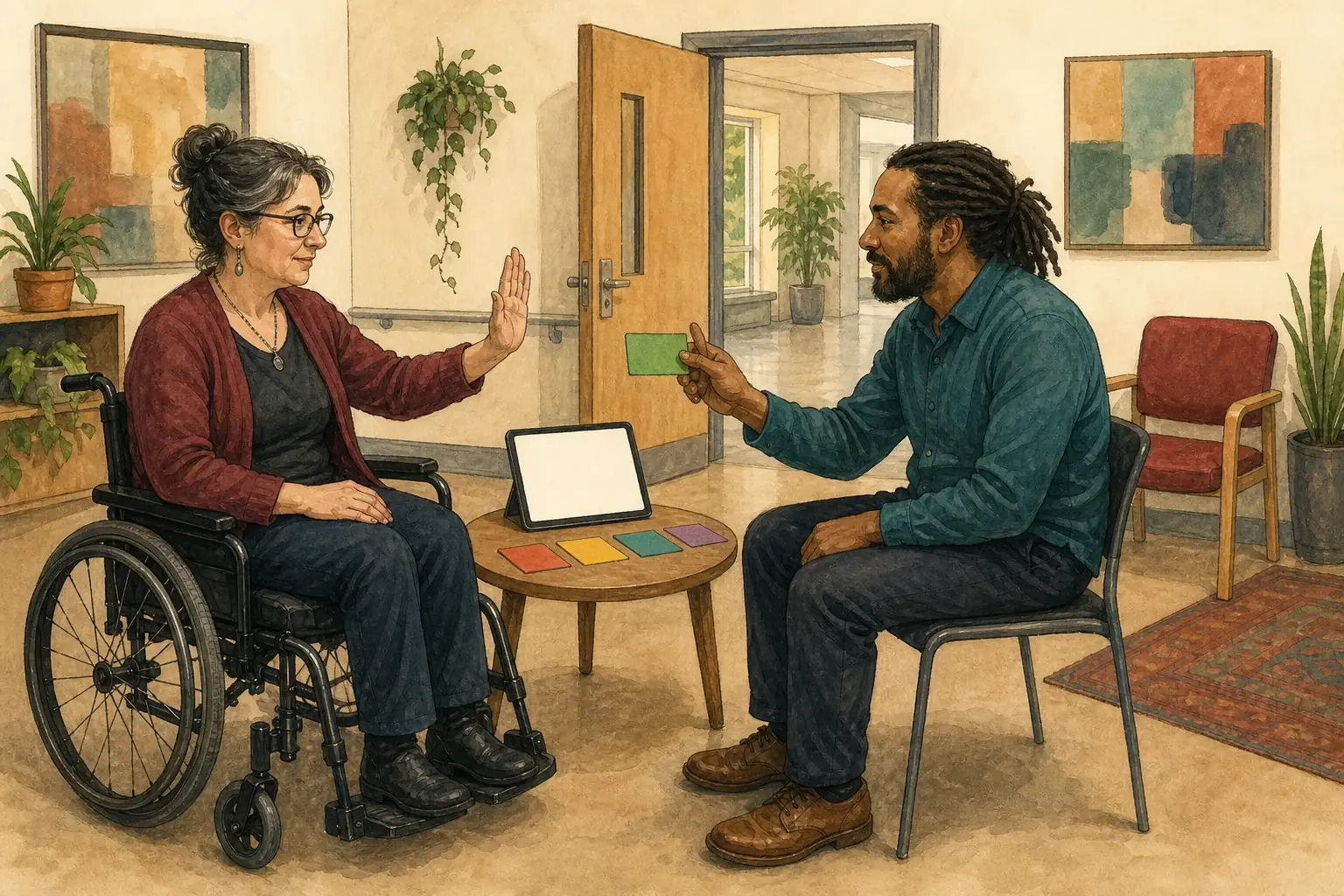
Mobility, speech, hearing, fatigue, culture and public setting can affect a ritual. Protocol should accommodate the adults involved and avoid imposing roles on other people.
Illustration created using generative AI; not documentary evidence.Research, clinical context and UK law
Direct empirical research treating ‘protocol’ as a separate BDSM category is scarce. Hébert and Weaver's qualitative work explored dominant and submissive roles more broadly, while Cascalheira and colleagues' four-person study of 24/7 BDSM identified flexible rules, contextual communication and dynamic consent. These studies help describe possible meanings but cannot define a universal protocol system or show that formal rules prevent harm.
Tarleton and colleagues found strong explicit-consent norms among 202 BDSM practitioners, with some greater flexibility reported in established relationships. Bowling and colleagues nevertheless documented consent violations within kink contexts. A relationship's duration, a formal script or confidence in community etiquette therefore cannot substitute for attention to what a person agrees to now.
Protocol, formal clothing and repetitive ritual are not diagnostic evidence. The World Health Organization distinguishes consensual adult interests from paraphilic disorders using specific requirements concerning distress, impairment, non-consent and serious risk. UK law likewise addresses conduct rather than kink vocabulary: sexual consent must remain freely chosen, while controlling or coercive behaviour in an intimate or family relationship may be criminal. England and Wales set out these principles in section 74 of the Sexual Offences Act 2003 and section 76 of the Serious Crime Act 2015; Scotland and Northern Ireland have separate frameworks.
Non-graphic examples
What the umbrella may include
- Using a chosen title only while an agreed role is active, then returning to ordinary names afterwards.
- A repeated greeting or object-presentation ritual that both adults can change or skip.
- Wearing a collar, badge or adult garment as a private role cue without treating it as evidence of ownership.
- Keeping an accessible written card of agreed wording while recognising that present wishes take priority.
- Pausing a formal routine because of fatigue, disability, work, healthcare or an unexpected interruption.
Prepare for an appointment
Questions you could ask a professional
- What information would help you understand my question?
- What are the realistic options and uncertainties?
- How can disability, communication or privacy needs be accommodated?
- When should the situation be reviewed again?
These prompts do not replace assessment and do not imply that every reader needs professional care.
Continue learning
Take the next step from definition to context.
Continue with independent guidance connecting protocol to evidence, consent, safety, uncertainty and practical decisions.
Set the scope of adult power-exchange roles, keep a working stop route, recognise pressure and find UK support.
Read the guideRelated in-depth reading
Read the full guide.
Explore a connected question with context and UK support routes.
A non-graphic adult guide to collaring, 24/7 or total power exchange, check-ins, exit plans and warning signs of coercion.
Read the full guide consent relationshipsAdult authority roleplay: a consent-first guideAdult authority roleplay: agree fictional roles, boundaries, costumes, privacy and stopping without confusing character power with consent.
Read the full guide Consent & relationshipsD/s contracts: symbolic, not legalHow adults can use a D/s agreement to discuss roles and boundaries without treating it as permanent consent or legal protection.
Read the full guide Consent & relationshipsLong-distance D/s dynamicsHow adults can define remote power exchange, communication, privacy and stopping without turning distance into constant access.
Read the full guide