Service is when consenting adults give ordinary acts of care, organisation or assistance a special role-based meaning. The task itself may be everyday—such as preparing a drink or organising an agreed object—but attention, competence, ritual or chosen submission makes it significant to them.
 The UK Kink GuideEvidence-led glossary
 Back to the glossaryPower & roleIn plain English Words in context A non-graphic adult example What not to assume
Service
What it means
Also known as service submission · service-oriented submission
A consensual adult dynamic in which practical care, assistance, attention or completed tasks carry relational, symbolic or erotic meaning. The actions may be ordinary; what makes them service is the meaning the adults agree to give them, not an automatic duty owed by a submissive person.
Start here
New to this term?
Service is the broad act; service submission is a submissive role centred partly on chosen helpful tasks. Protocol is the agreed form surrounding an action, such as timing or wording. Discipline concerns rules and feedback. These concepts may overlap but none automatically includes the others.
An adult agrees to prepare a preferred drink and present it during a private evening ritual. The same action at breakfast may be an ordinary household courtesy. Its kink meaning comes from the shared agreement and context, not from the object or chore alone.
A submissive label does not create an unpaid duty or entitlement to labour, sex, money or obedience. Service does not prove a person enjoys every task. Fear, dependency, manipulation, unsafe workloads or inability to refuse are not made consensual by role language.
Sources and evidence type
Manual claim and limitation notes are shown where an individual source audit is complete. Other evidence-type labels are a publisher aid awaiting source-by-source confirmation.
Hébert & Weaver (2015), qualitative study of dominant and submissive rolesResearch study
- Source design
- Peer-reviewed research or review
- What it can support
- The specific population, measures and findings reported by the paper.
- Important limitation
- It cannot automatically establish UK prevalence, causation, diagnosis, consent or an individual outcome. Check recruitment, definitions and study design.
Cascalheira, Thomson & Wignall (2022), 24/7 BDSM and dynamic consentResearch study
- Source design
- Peer-reviewed research or review
- What it can support
- The specific population, measures and findings reported by the paper.
- Important limitation
- It cannot automatically establish UK prevalence, causation, diagnosis, consent or an individual outcome. Check recruitment, definitions and study design.
Tarleton, Mackenzie & Sagarin (2025), BDSM consent normsResearch study
- Source design
- Peer-reviewed research or review
- What it can support
- The specific population, measures and findings reported by the paper.
- Important limitation
- It cannot automatically establish UK prevalence, causation, diagnosis, consent or an individual outcome. Check recruitment, definitions and study design.
Bowling et al. (2024), disclosure and reporting of consent violationsResearch study
- Source design
- Peer-reviewed research or review
- What it can support
- The specific population, measures and findings reported by the paper.
- Important limitation
- It cannot automatically establish UK prevalence, causation, diagnosis, consent or an individual outcome. Check recruitment, definitions and study design.
WHO ICD-11 clinical descriptions and diagnostic requirements (2024)Clinical guideline
- Source design
- Current public-health or clinical guidance
- What it can support
- Service pathways, health definitions and recommended public-health or clinical actions within its stated scope.
- Important limitation
- General guidance cannot assess an individual’s symptoms, exposure, medicine, contraindications or urgency.
Sexual Offences Act 2003, section 74 (England and Wales)Law or regulator
- Source design
- Primary legislation, prosecutorial or regulator guidance
- What it can support
- The legal provision or official regulatory position for the jurisdiction and date stated.
- Important limitation
- It is not fact-specific legal advice. Commencement, amendments, jurisdiction and case law may affect application.
Serious Crime Act 2015, section 76 (England and Wales)Law or regulator
- Source design
- Primary legislation, prosecutorial or regulator guidance
- What it can support
- The legal provision or official regulatory position for the jurisdiction and date stated.
- Important limitation
- It is not fact-specific legal advice. Commencement, amendments, jurisdiction and case law may affect application.
NHS Every Mind Matters: healthy relationships and boundariesProfessional guidance
- Source design
- Professional guidance · source record checked manually
- What it can support
- General communication, checking understanding and support boundaries.
- Important limitation
- Not activity-specific safety research or a validation of a kink label.
- Destination checked
- 15 October 2026
Mental Health Foundation: communication and respect for boundariesProfessional guidance
- Source design
- Professional guidance · source record checked manually
- What it can support
- General listening and boundary-setting principles.
- Important limitation
- Does not establish clinical effects, causes or safety of a particular activity.
- Destination checked
- 15 October 2026

Power & role
Illustration created using generative AI; not documentary evidence.
In brief
Ordinary tasks can carry chosen meaning.
Service or service submission describes adults deliberately giving everyday acts of care, organisation or assistance a role-based meaning. Preparing a drink, maintaining an agreed object or recording a completed task can feel significant because it expresses attention, competence, ritual or chosen submission. Service may form one scene, a recurring practice or part of a wider relationship, but the label never creates entitlement to labour, sex, money or obedience.
Meanings, roles and overlaps
Service overlaps with dominance and submission, protocol, discipline and caregiving, but it is not identical to any of them. A dominant may request or receive service, yet another dynamic may centre on mutual service or on a top performing an attentive task for a bottom. The person doing the task is not automatically powerless, and the person receiving it is not automatically entitled to direct other areas of life.
For some adults the appeal lies in usefulness, concentration, reliability, ritual or visible appreciation. For others it is the transformation of an ordinary activity into a private symbol of commitment or role. These interpretations are personal and contextual: completing domestic work, wearing an apron or helping a partner does not reveal a kink identity without the person's own account.

Service may express care, ritual, role or practical help. The meaning comes from the adults' agreement rather than from the task or object itself.
Illustration created using generative AI; not documentary evidence.- Status
- Source-checked editorial page
- Publisher
- The UK Kink Guide
- Reviewed
- Targeted additions checked 15 October 2026
- Evidence
- 9 cited sources · types labelled below
- Jurisdiction
- UK-focused general education
Read the rest: evidence, law, safety and sources
The broad activity: an agreed task or act of attention that carries special meaning. Either participant may value giving, receiving or directing it.
A submissive role organised partly around chosen acts of practical care, assistance or competence. Not every submissive person is service-oriented.
The agreed form or etiquette surrounding an action—such as timing, wording or presentation. Service can exist without formal protocol, and protocol can exist without service.
Work extracted through fear, dependency, manipulation or inability to refuse is not made consensual by calling it service. A role label does not settle whether an arrangement is fair or freely chosen.
Tasks, objects and sensory features
Non-graphic examples can include preparing a preferred hot drink, laying out an agreed adult garment, organising a shared calendar, polishing an owned pair of boots, keeping a private task record or presenting an ordinary care item. The same actions may also be routine household work with no kink meaning. Service is therefore defined by informed agreement and context rather than by a special catalogue of chores.
Associated objects may include a tray, cup, notebook, checklist, timer, key, cleaning cloth, storage box, apron, uniform-style garment or symbolic token. Their significance may come from neatness, texture, sound, presentation, repetition or a shared ritual. Objects can support memory and accessibility, but they do not prove consent, ownership or completion; ordinary hygiene, product instructions, allergies, fit and disability-related needs still apply.
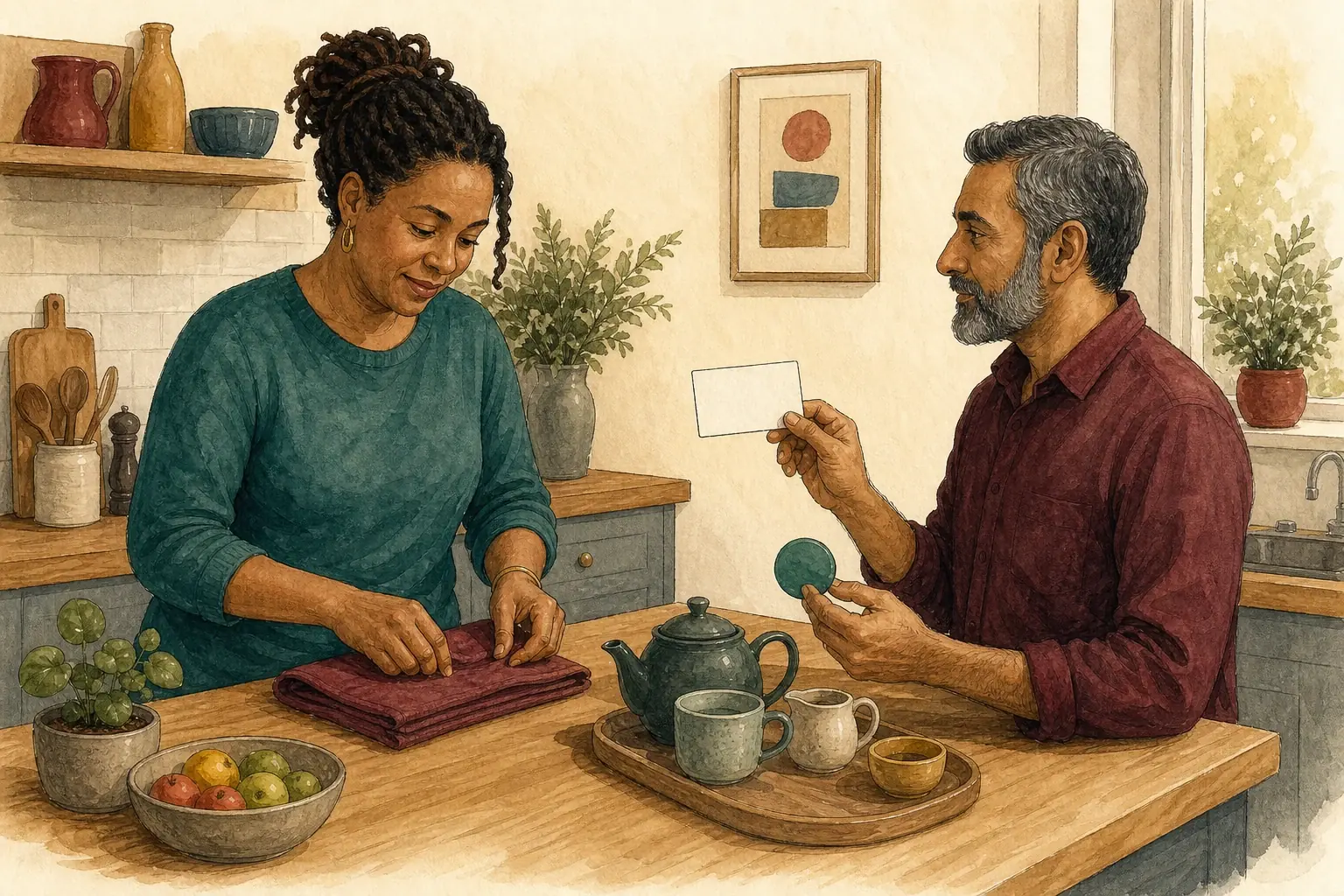
Repetition, posture, heat, cleaning products, allergies and fatigue can turn an ordinary task into a health or access issue. Chosen service remains adjustable.
Illustration created using generative AI; not documentary evidence.Consent, workload and everyday boundaries
Consent should cover what is being asked, when the role applies, who benefits, how either person can decline and what happens when health, work, caring responsibilities or circumstances change. A standing routine can be revised. Fatigue, pain, executive-function needs, sensory differences and mobility can all affect whether a task remains practical, and adapting it is not role failure.
Service language must not disguise control over essential needs, healthcare, sleep, communication, employment, housing, money or contact with other people. Nor should it transfer all ordinary responsibility to one partner by default. A checklist, written agreement, collar or title may help describe a dynamic but cannot make consent permanent or turn coercion into a consensual relationship.

Time, energy, money, care duties and disability can change what is sustainable. Declining or returning a task should not trigger punishment, debt or coercion.
Illustration created using generative AI; not documentary evidence.Research, clinical context and UK law
Direct peer-reviewed research devoted specifically to service submission is scarce. Hébert and Weaver's qualitative study explored dominant and submissive roles more broadly, while Cascalheira and colleagues' phenomenological study of four 24/7 practitioners described flexible rules, dynamic consent and practicalities across life domains. These small, self-selected studies can illuminate reported meanings but cannot establish how common service is, define one healthy arrangement or predict an individual's motives.
Tarleton and colleagues found strong explicit-consent norms among 202 BDSM practitioners, while Bowling and colleagues documented that consent violations can still occur in kink contexts. Community ideals therefore require attention to actual conduct. Consensual adult service is not a paraphilic disorder merely because it is unconventional; the World Health Organization applies specific requirements involving distress, impairment, non-consent or serious risk rather than diagnosing from tasks, clothing or a role title.
UK law applies to conduct rather than community labels. Where sexual activity is involved, agreement must remain freely chosen and capacity must be present; England and Wales define this in section 74 of the Sexual Offences Act 2003. Controlling or coercive behaviour may also be criminal in an intimate or family relationship under section 76 of the Serious Crime Act 2015, with separate legal frameworks in Scotland and Northern Ireland. This page cannot determine the legal status of an individual arrangement.
Common misunderstandings
Doing a household task does not announce a service role. A person can enjoy a negotiated ritual while wanting ordinary care and shared responsibilities to remain separate. Neither a role title nor praise makes unpaid labour automatically available.
Safety and consent
Agree the task, time, cost and ability to stop before assigning responsibility. Protect access needs, paid work, rest and essential care. If the arrangement becomes unwanted or unequal, discuss the practical impact rather than treating refusal as a failure of identity.
Non-graphic examples
What the umbrella may include
- Preparing an agreed drink and presenting it as a brief role-based ritual.
- Laying out an adult garment or maintaining an owned pair of boots because care and presentation carry shared meaning.
- Using a private notebook or accessible checklist to record optional tasks without treating the document as permanent consent.
- Agreeing that a service role applies during one scene or event and ends afterwards.
- Changing or cancelling a planned task because of fatigue, disability, work or caring responsibilities without treating the change as failure.
Prepare for an appointment
Questions you could ask a professional
- What information would help you understand my question?
- What are the realistic options and uncertainties?
- How can disability, communication or privacy needs be accommodated?
- When should the situation be reviewed again?
These prompts do not replace assessment and do not imply that every reader needs professional care.
Continue learning
Take the next step from definition to context.
Continue with independent guidance connecting service to evidence, consent, safety, uncertainty and practical decisions.
What service submission can mean, how adults agree tasks and limits, and when a supposed dynamic becomes unpaid labour or coercion.
Read the full guideRelated in-depth reading
Read the full guide.
Explore a connected question with context and UK support routes.
A guide to praise kink, individual wording, negotiation, self-esteem, service and D/s dynamics—without making affection or respect conditional.
Read the full guide identity diversityFeminisation play: a beginner's guideFeminisation play: understand adult clothing and role preferences, agree respectful language, protect privacy and keep consent reversible.
Read the full guide identity diversityWhat sissy means in kink, and when it is wantedSissy meaning in kink: understand this contested adult term, ask about preferred language and respect consent, identity and boundaries.
Read the full guide Community & cultureWhat is a sub? What is a dom? Roles explainedWhat submissive and dominant roles mean, how they differ from top and bottom, and what an adult role agreement must leave open.
Read the full guide Consent & relationshipsLong-distance D/s dynamicsHow adults can define remote power exchange, communication, privacy and stopping without turning distance into constant access.
Read the full guide