Exact construction
Check total length, active section, weight, flexibility, edges, tips, falls, joins, handle and hardware.
 The UK Kink GuideIndependent product discovery
Product discovery / Impact play
Compare construction, dimensions, materials, flexibility, care and seller information across distinct impact-product categories. This guide names no preferred company or individual product.
Independent education · optional affiliate linksAn optional Uberkinky category box below is clearly disclosed and separate from the guidance. It is not a product recommendation. No on-site affiliate tracking is added. This category guide does not teach technique or validate retailer intensity labels; external specialist review is still pending.
Start here
Treat each construction as a distinct product category; a shared label or retailer intensity scale does not predict handling, effect or suitability.
Buying checklist
Check total length, active section, weight, flexibility, edges, tips, falls, joins, handle and hardware.
Require a full description of contact surfaces, core, coatings, adhesives, leather treatments and metal parts.
Look for splitting, sharp edges, loose falls, cracked coatings, exposed cores, corrosion or movement at joins before each use.
Dimensions and flexibility affect required clearance. Plan around people, furniture, lighting and a reliable stop method.
Follow material-specific care, drying and storage guidance; multi-part and porous constructions may be harder to clean.
Check maker or importer details, limitations, instructions, fault handling, recalls and returns before use.
Compare approaches
Multiple falls create construction and care questions that differ from single-piece products.
Check: Fall count, material, edge finish, attachment, balance and tangling or damage.
Usually combine a shaft, handle and tip whose joins and flexibility need separate inspection.
Check: Shaft integrity, tip attachment, grip, wrist loop and exact dimensions.
Material, diameter, finish and flexibility vary substantially and should not be reduced to one intensity label.
Check: Straightness, cracks, splinters, end finish, storage and maker limitations.
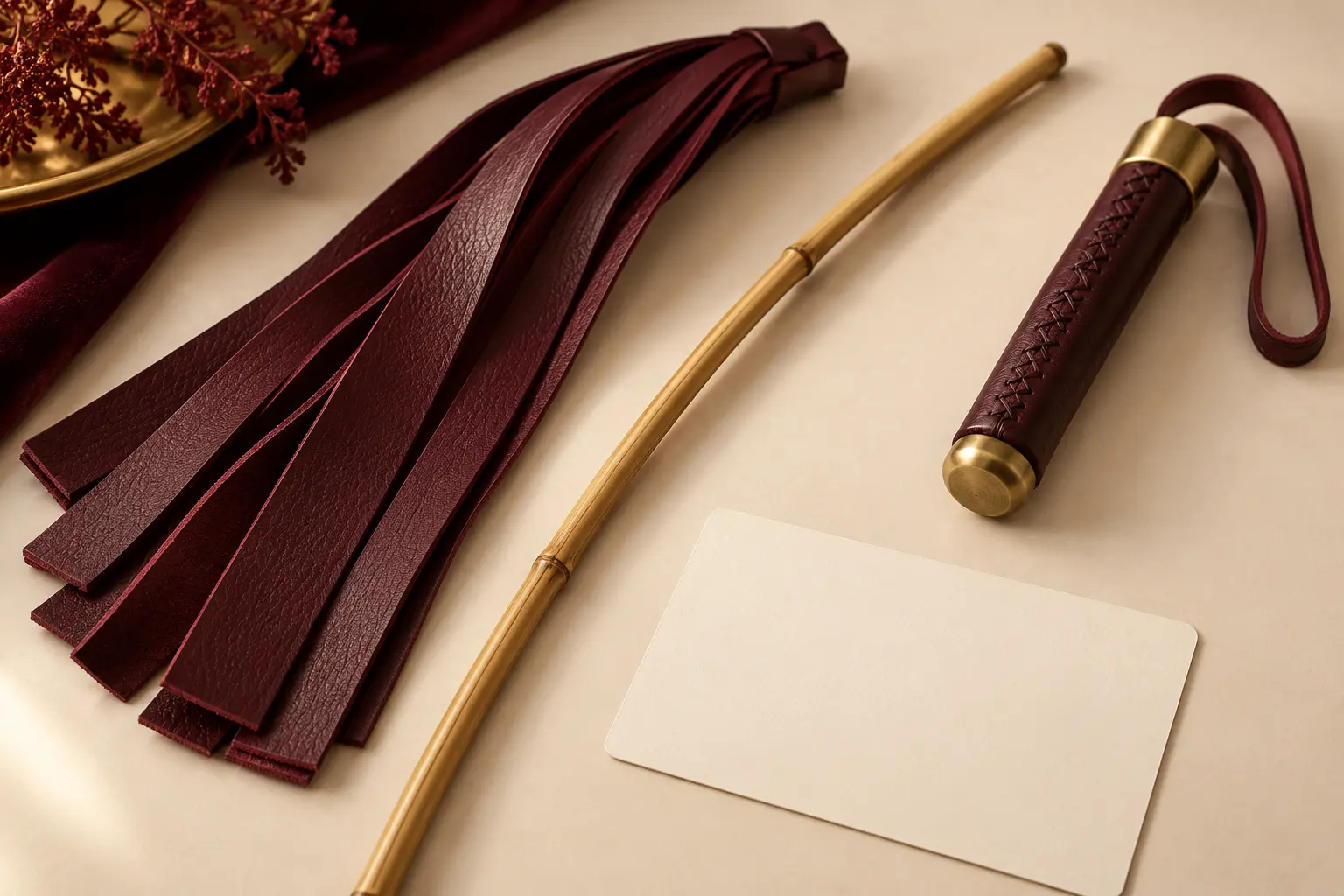
Choose among floggers, crops and canes only after deciding whether impact activities are appropriate and wanted, then compare the complete construction and stated limitations. These names describe substantially different categories; they do not provide a beginner safety rating or a reason to copy something seen in a photograph.
This is adult buying literacy rather than instruction in impact technique. Someone seeking a decorative prop should say so and avoid assuming it is also suitable for contact. Consider grip, arm movement, fatigue, vision and whether the item can be stored securely. Longer or multi-part designs can be harder to inspect and organise, so the simplest purchase may still be no purchase until the relevant education and consent questions are settled.
People with a bleeding disorder, unexplained bruising, reduced sensation or relevant medical treatment should check with a GP or treating clinician before considering impact activities. NHS guidance notes excessive bleeding and bruising among concerns associated with anticoagulants. Never change prescribed treatment to suit an activity. Any ongoing pain, new numbness or significant injury needs appropriate clinical help. Neither a soft material nor a retailer's light-intensity description overrides individual health risks.
A flogger's overall length, handle, number of tails and each tail's material are separate specifications. Ask about joins and attachment points as well as the visible finish. For a crop, distinguish shaft length from the end piece and handle. For a cane, length, diameter, material and flexibility need explicit descriptions. None of these measurements can be converted into a universally safe level of activity.
Leather, synthetic fibres, coated materials, wood and composites vary within their own categories. A photograph cannot reveal the full construction, hidden reinforcement or an internal break. Check for a clear material list, smooth intact surfaces and maker guidance on inspection. Do not substitute a household or sporting item simply because it has a similar shape. The comparison cards are prompts for questions, not a set of interchangeable choices or individual product recommendations.
A bundle can make categories look equivalent because they share packaging. Assess each component separately: one clear description does not explain the other items. Ask whether care instructions cover everything supplied and whether faults can be reported by individual component. A photograph of a large collection is not evidence that several tools are necessary. Read the related impact education first and make stopping, privacy and support decisions independently of the purchase.
Cleaning has to suit every component, including handles, bindings, glued layers and metal hardware. A tail or shaft that can be wiped does not establish that the whole item can be washed. Follow the manufacturer's directions and allow full drying before storage. Organise multi-part items so that surfaces can be inspected without untangling them under pressure. Keep damp cleaning cloths out of the storage bag.
Retire items with loose tails, weakened bindings, cracked shafts, splinters, deteriorating coatings or uncertain attachment points. A cosmetic repair may conceal rather than resolve structural damage. If a defect appears soon after purchase, document it and contact the trader before modifying the item. A damaged crop or cane should not become an improvised alternative with a new assumed purpose. Price, reviews and a familiar category name do not establish a remaining usable life.
UK traders must supply goods meeting the Consumer Rights Act 2015 standards of satisfactory quality, description and fitness for a purpose made known where reliance is reasonable. These protections are in force in England, Wales, Scotland and Northern Ireland, checked on legislation.gov.uk on 8 October 2026. Save the original specifications and the seller's stated purpose when those details inform a buying decision.
Online change-of-mind cancellation generally allows 14 days to notify the trader and a further 14 days to return. An applicable sealed hygiene exclusion after unsealing does not remove rights for faults or misdescription. Regulation 28 is in force in all four UK nations, checked 8 October 2026. The Sex-toy returns and consumer rights guide explains the distinction. Check Office for Product Safety and Standards notices for the exact item rather than assuming that an absent recall proves safety.
What is the difference between a flogger, crop and cane? They have different constructions, components and limitations. Compare the stated purpose and complete specifications; a shared impact category does not make their risks or care requirements identical.
Are floggers safe for beginners? A category name cannot answer that. Understanding risk, consent and the legal limits is necessary before an equipment choice, and this buying guide provides no technique or safety guarantee.
Is leather better than synthetic material? Neither broad label settles the decision. Finish, joins, coatings, cleaning and traceability are more useful questions, particularly where skin sensitivity or allergy matters.
Can a decorative crop be used for impact? Do not infer suitability from appearance. If the manufacturer has not specified the purpose and limitations, do not reinterpret a prop or accessory as specialist equipment.
How do I know when a cane needs replacing? Cracks, splinters, damaged finish or an uncertain shaft are reasons to withdraw it. Do not wait for complete breakage or rely on a retailer's expected lifespan.
Ask before buying
Evidence and limits
These sources support the category-level checks and signposting. They do not certify an individual product or turn general guidance into a safety guarantee.
Keep learning