Aftercare means the support adults may choose after an agreed kink experience. A ‘scene’ is simply the bounded period in which that experience or role-play takes place. Aftercare helps people return to ordinary interaction; it is not a compulsory ceremony.
 The UK Kink GuideEvidence-led glossary
 Back to the glossaryFoundationsIn plain English Words in context A non-graphic adult example What not to assume
Aftercare
Planned support or communication after a consensual kink or BDSM scene, used to help participants move out of roles, attend to comfort and make sense of the experience. It may be emotional, social or practical, and its meaning and preferred form vary between people rather than following one universal routine.
Start here
New to this term?
Immediate aftercare happens as the scene ends; a delayed check-in happens later. ‘Top’, ‘bottom’, ‘dominant’ and ‘submissive’ describe different roles, not who deserves care. Self-aftercare means a person uses their own chosen transition or recovery routine.
Two adults finish an agreed role-play, drop the role titles and sit quietly. One wants a blanket and conversation; the other prefers space and a message the next day. Both are valid because the preference was discussed rather than assumed.
Needing aftercare does not prove that someone is fragile, and not wanting it does not prove that they are unaffected. Aftercare cannot make an earlier boundary crossing consensual, treat an injury or replace emergency, safeguarding or mental-health support.
Sources and evidence type
Manual claim and limitation notes are shown where an individual source audit is complete. Other evidence-type labels are a publisher aid awaiting source-by-source confirmation.
Mercer (2026)Research study
- Source design
- Peer-reviewed research or review
- What it can support
- The specific population, measures and findings reported by the paper.
- Important limitation
- It cannot automatically establish UK prevalence, causation, diagnosis, consent or an individual outcome. Check recruitment, definitions and study design.
Martin (2025)Research study
- Source design
- Peer-reviewed research or review
- What it can support
- The specific population, measures and findings reported by the paper.
- Important limitation
- It cannot automatically establish UK prevalence, causation, diagnosis, consent or an individual outcome. Check recruitment, definitions and study design.
Wuyts & Morrens (2022)Research study
- Source design
- Peer-reviewed research or review
- What it can support
- The specific population, measures and findings reported by the paper.
- Important limitation
- It cannot automatically establish UK prevalence, causation, diagnosis, consent or an individual outcome. Check recruitment, definitions and study design.
Sagarin et al. (2009)Research study
- Source design
- Peer-reviewed research or review
- What it can support
- The specific population, measures and findings reported by the paper.
- Important limitation
- It cannot automatically establish UK prevalence, causation, diagnosis, consent or an individual outcome. Check recruitment, definitions and study design.
NHS first-aid guidanceClinical guideline
- Source design
- Current public-health or clinical guidance
- What it can support
- Service pathways, health definitions and recommended public-health or clinical actions within its stated scope.
- Important limitation
- General guidance cannot assess an individual’s symptoms, exposure, medicine, contraindications or urgency.
NHS low-mood guidanceClinical guideline
- Source design
- Current public-health or clinical guidance
- What it can support
- Service pathways, health definitions and recommended public-health or clinical actions within its stated scope.
- Important limitation
- General guidance cannot assess an individual’s symptoms, exposure, medicine, contraindications or urgency.

Foundations
Illustration created using generative AI; not documentary evidence.
In brief
A responsive process, not a prescribed ritual.
Aftercare is the negotiated transition out of a scene: a period in which participants may attend to comfort, communication, role exit and anything that should be revisited later. It can be mutual, self-directed, immediate, delayed, brief or unnecessary for a particular person. The useful question is not whether someone follows a standard ritual, but whether the support offered matches what the adults involved actually want and need.
What research describes
Mercer's interview study of 40 US adults who take a top or dominant role found that aftercare was not only about physical or emotional comfort. Participants also used it to communicate how they understood themselves, their partners and responsible BDSM practice. The study identified gendered expectations around caregiving, which cautions against assuming that care naturally belongs to one role or gender.
A 2025 qualitative study by Martin, focused on a specific community of gay men, likewise described aftercare as responsive and negotiated rather than one fixed sequence. Together these studies help document how practitioners understand care, but their small, self-selected samples cannot establish a universal routine or prove that a particular form of aftercare produces a particular health outcome.

Aftercare may involve closeness, practical comfort, quiet or space. Small qualitative studies describe varied negotiated practices rather than one universal routine.
Illustration created using generative AI; not documentary evidence.- Status
- Detailed editorial draft
- Publisher
- The UK Kink Guide
- Reviewed
- Structured draft present; individual review date not recorded
- Evidence
- 6 cited sources · types labelled below
- Jurisdiction
- UK-focused general education
Read the rest: evidence, law, safety and sources
Support offered as a scene ends, such as quiet company, privacy, warmth, a drink, reassurance or a simple check-in. Some people instead prefer space and minimal conversation.
Contact or reflection later that day or on a subsequent day, when participants may be better able to describe what felt good, difficult or worth changing.
A person's own chosen transition or recovery routine. This can complement mutual care, and may be especially relevant after solo activity or when partners are not in the same place.
A later conversation about meaning, boundaries and future changes. It is distinct from immediate comfort and should happen when everyone is ready to reflect.
Roles, choice and consent
Any participant may want to give, receive or decline aftercare, regardless of whether they acted as a top, bottom, dominant, submissive or switch. Wanting solitude can be a valid preference; so can asking for a later message rather than immediate closeness. Discussing these preferences before a scene reduces guesswork when people may be tired or emotionally affected afterwards.
Aftercare does not make an earlier act consensual, extend consent into new activity or erase a boundary crossing. It can provide space to listen and record concerns, but it cannot substitute for accountability, safeguarding, medical attention or specialist support when any of those are needed.

Any participant may want to give, receive or decline support. A later check-in can be more useful than assuming what a top, bottom, dominant or submissive should need.
Illustration created using generative AI; not documentary evidence.Objects and sensory cues
Objects associated with aftercare are usually ordinary care objects rather than fetish equipment: a soft blanket, temperature-appropriate clothing, a sealed non-alcoholic drink, a familiar comfort object, a towel, a written check-in note or an accessible phone. Their significance comes from comfort, orientation or a shared transition out of role, not from a compulsory checklist.
Preferences can conflict. Touch, food, scent, bright light or conversation may be welcome for one person and uncomfortable for another, especially where allergies, disability, medication, sensory sensitivity or trauma history are relevant. The object or gesture should therefore be agreed and adjustable, not imposed as proof of care.
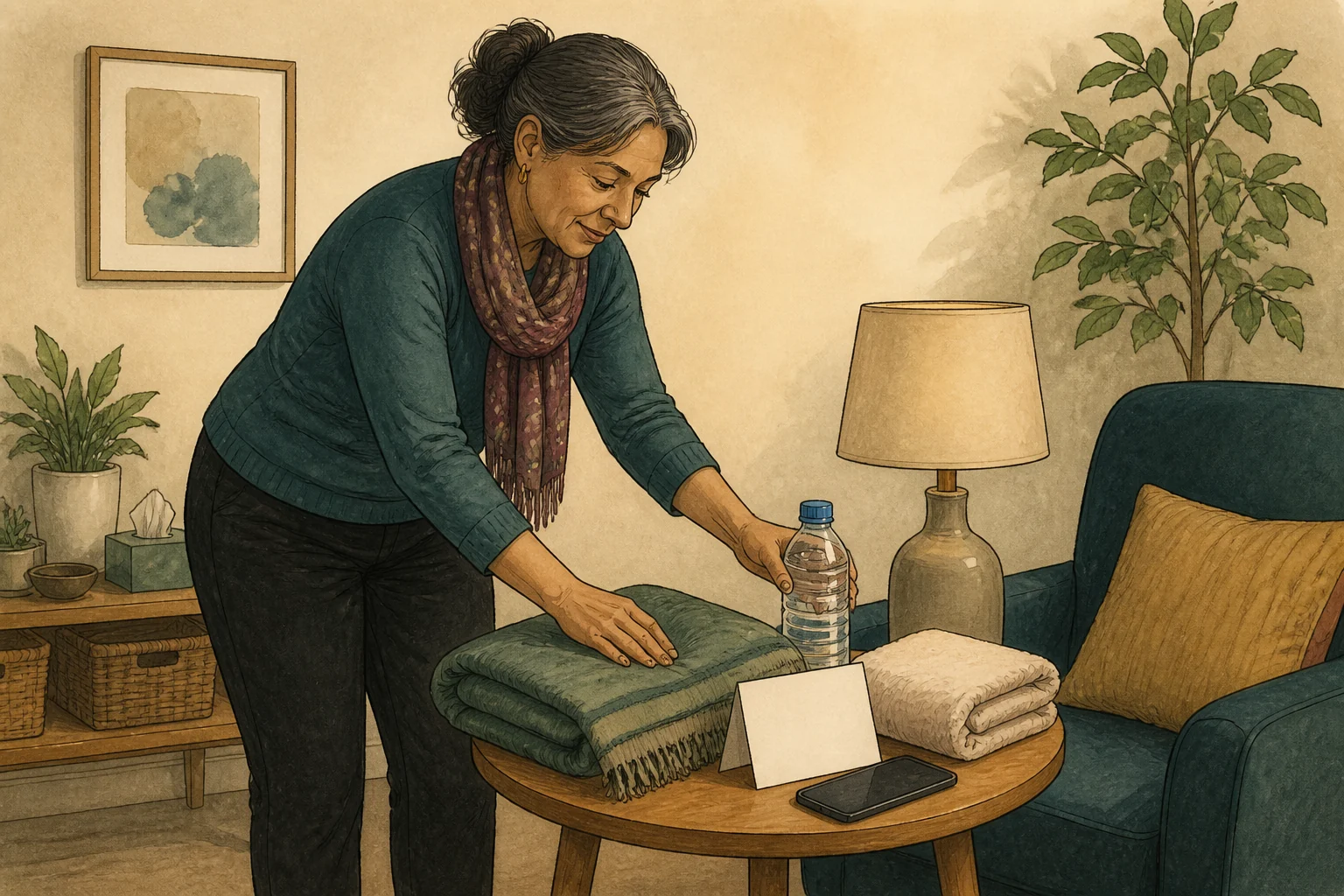
Temperature, touch, food, scent, light and conversation affect people differently. Agreeing accessible options avoids turning a familiar gesture into a compulsory checklist.
Illustration created using generative AI; not documentary evidence.Body, mood and the limits of the concept
Small studies have measured changes in stress- and reward-related biological markers during consensual BDSM interactions. A 2022 systematic review found the evidence promising but limited, with only ten biological studies and a need for replication. This does not support popular claims that every participant experiences a predictable hormonal 'drop' or that one aftercare routine can prevent it.
Ordinary tiredness, quietness or a wish to reflect should not be diagnosed from a glossary page. Equally, loss of consciousness, abnormal breathing, sudden confusion, serious injury or severe and persistent distress are not routine aftercare matters. NHS guidance treats unresponsiveness and abnormal breathing as emergencies; ongoing low mood or difficulty coping warrants appropriate professional support.
Non-graphic examples
What the umbrella may include
- Sitting quietly together while roles and formal language are set aside.
- Agreeing that one participant would prefer personal space, followed by a message later.
- Using a blanket, ordinary clothing or a familiar neutral object as a cue that the scene has ended.
- Making brief notes for a later debrief rather than trying to analyse the experience immediately.
- A top, bottom, dominant, submissive or switch asking for reassurance or practical support without treating that need as role failure.
Prepare for an appointment
Questions you could ask a professional
- What information would help you understand my question?
- What are the realistic options and uncertainties?
- How can disability, communication or privacy needs be accommodated?
- When should the situation be reviewed again?
These prompts do not replace assessment and do not imply that every reader needs professional care.
Continue learning
Take the next step from definition to context.
Continue with independent guidance connecting aftercare to evidence, consent, safety, uncertainty and practical decisions.
Choose practical, physical and emotional aftercare ideas, plan distance check-ins and print a flexible checklist for each adult’s needs.
Read the full guideRelated in-depth reading
Read the full guide.
Explore a connected question with context and UK support routes.
Pup play means adult human roleplay. Understand handlers, headspace, UK community, optional gear, consent and privacy before taking part.
Read the full guide Consent & relationshipsPrimal play: meaning, consent and safetyPrimal play means different things to adults. Understand predator and prey roles, negotiation, injury risks, stopping signals and UK help.
Read the full guide Consent & relationshipsWhat is subspace? Meaning, signs and aftercareWhat is subspace? Understand the community term, limited research, consent concerns, advance check-ins, aftercare and when to get UK help.
Read the full guide Clinical literacySadism and masochism in kink: meaning and consentSadism and masochism meaning, consensual kink versus diagnoses, UK injury-law limits, aftercare and qualified support.
Read the full guide Community & cultureShibari and kinbaku: meaning, history and safetyShibari and kinbaku meaning, Japanese history, respectful learning, teacher checks, consent and rope risks without tying instructions.
Read the full guide Consent & relationshipsConsensual non-consent (CNC): meaning, limits and riskCNC meaning, real refusal, stop mechanisms, trauma risks, legal consent limits and specialist UK support without scenarios or scripts.
Read the full guide Community & culturePet play and pup play: meaning, community and consentPet play and pup play are adult roleplay interests. Understand community, optional gear, consent, comfort, privacy and UK support.
Read the full guide Consent & relationshipsDegradation and humiliation kink: meaning and limitsA non-graphic adult guide to negotiated degradation or humiliation, boundaries, emotional effects, aftercare and UK support.
Read the full guide Consent & relationshipsSpanking: meaning, consent and safetyA non-instructional guide to adult spanking, consent, safer and higher-risk body areas, marks, aftercare and the UK legal context.
Read the full guide Bodies & functionPegging: meaning, communication and safetyA non-graphic guide to what pegging means, how adults discuss it, anal-health basics, barriers, lubricant, hygiene and when to seek help.
Read the full guide Consent & relationshipsPraise kink: meaning and how to talk about itA guide to praise kink, individual wording, negotiation, self-esteem, service and D/s dynamics—without making affection or respect conditional.
Read the full guide Consent & relationshipsRoleplay kink: a beginner's guide for adultsBuild an adult fictional scene with clear boundaries, check-ins and a simple way to step out of character, without pressure to perform.
Read the full guide Consent & relationshipsFear play: meaning, consent and safetyA non-graphic guide to agreed fear themes, clear exits, panic and trauma boundaries, and UK support when a scene no longer feels safe.
Read the full guide Consent & relationshipsMarking kink: meaning, consent and aftercareA non-graphic guide to temporary marks and symbols, privacy, skin concerns, consent and when a mark needs medical care.
Read the full guide consent relationshipsSafewords, stepping out of role and debriefingStaying safe in character: plan check-ins, pauses, a clear exit from adult roleplay and a debrief that respects changing boundaries.
Read the full guide identity diversityFeminisation play: a beginner's guideFeminisation play: understand adult clothing and role preferences, agree respectful language, protect privacy and keep consent reversible.
Read the full guide identity diversityPrivacy and aftercare in feminisation playFeminisation privacy and aftercare: agree disclosure, photos, clothing boundaries and a supportive end to adult roleplay without pressure.
Read the full guide Consent & relationshipsSub drop and top dropWhat people mean by sub drop and top drop, how to plan a check-in, and when an experience calls for UK health or support services.
Read the full guide Consent & relationshipsYour first scene: from idea to aftercareA non-instructional plan for an adult's first agreed scene, from a small idea and clear limits to stopping and follow-up.
Read the full guide