
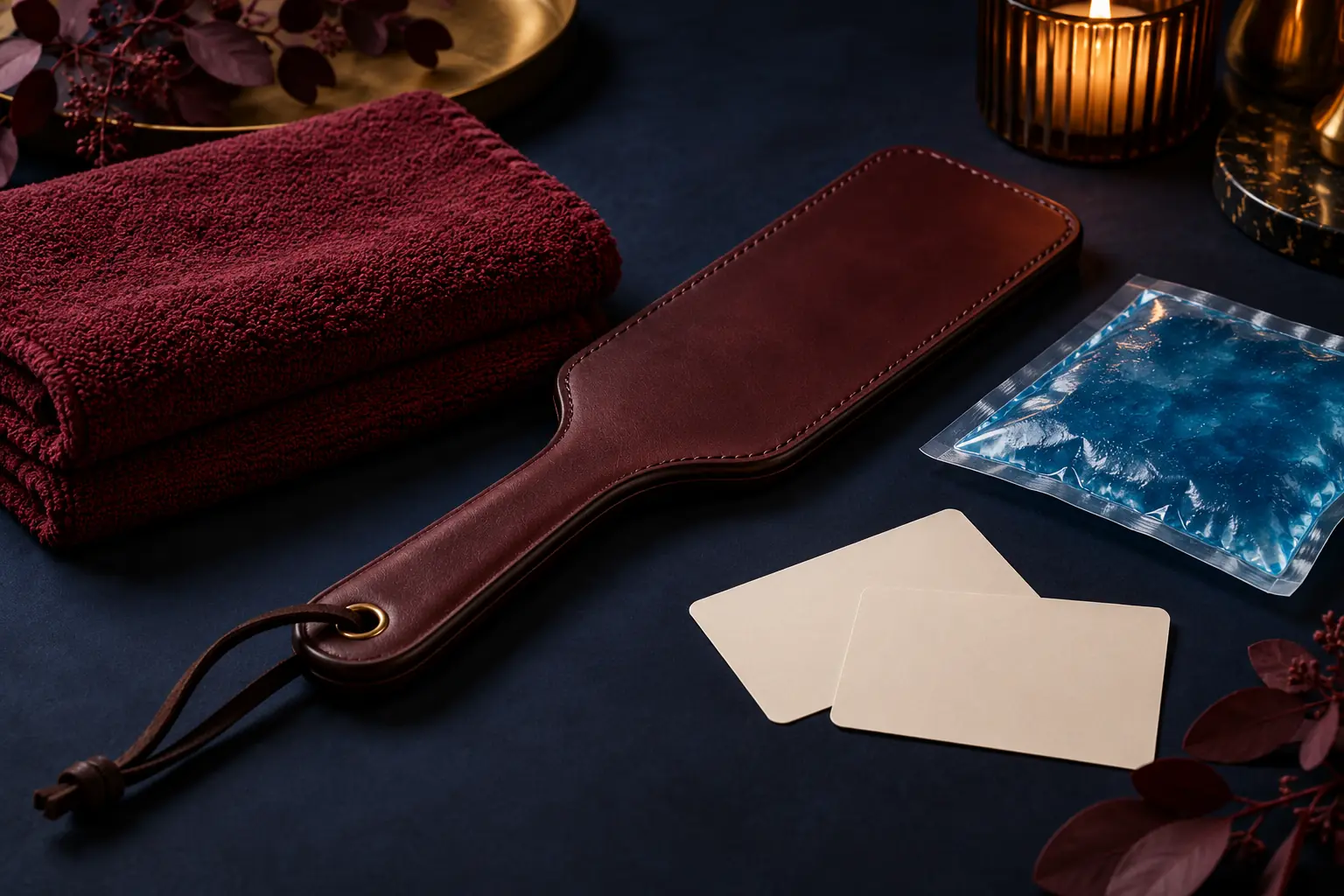
What adult spanking means
Adult spanking is consensual hand-based impact play. Adults may enjoy its sound, rhythm, warmth, anticipation, playfulness or an agreed role. The label specifies neither intensity, body area, clothing, emotional meaning nor whether someone wants it in reality. Fantasy, jokes, clothing or past experience never give permission for a present touch; ask what the individual wants.
Spanking sits within impact play, a wider term that can include many forms of contact. Those forms are not interchangeable. Consent to a hand-based activity does not imply consent to an object, a different kind of contact, a particular role or a repeat on another day. A person can enjoy only the language, sound or imagined meaning, or decide that the whole subject is not for them. Start with the meaning rather than treating the label as an instruction.
Ask before the scene, and keep asking
Choose a calm, private time to ask whether the topic is welcome. Be concrete: are you only discussing a fantasy, is any touch wanted, what would be off limits, and what would make someone stop? A yes to a conversation is not a yes to contact. An enthusiastic answer can become no, maybe or not now when circumstances change. Consent negotiation works when both people have room to decline without being mocked, guilted, punished or told they are disappointing.
Agree ordinary words for pause and stop, with a non-verbal alternative where it is needed. A safeword can be useful, but it is not the only sign to notice. A sudden quietness, freezing, a change in breathing, moving away, pain, panic or uncertainty are reasons to stop and check in. Do not make someone prove distress perfectly before you listen. Intoxication, sleep, severe tiredness or fear can reduce a person's ability to choose or communicate freely; leave the plan aside rather than trying to work around that problem.
Roles do not erase autonomy. Terms such as discipline, correction, reward or punishment can be fictional adult language, but they must remain bounded by the actual agreement. A partner cannot use a role to impose contact during an argument, to retaliate for an ordinary mistake or to make another person feel afraid to say no. If a boundary is disputed, stop the activity and have a normal conversation outside the role.
Body areas and why caution matters
This is a risk guide, not a technique guide. Keep away from the head, face, neck, throat, spine, joints, kidneys and genitals. These areas contain vulnerable structures or can be associated with serious injury; do not treat a person's size, fitness or previous tolerance as a safety clearance. The body can also respond differently with illness, medication, fatigue, alcohol, skin conditions, disability, anticoagulants or an injury that is not obvious to a partner.
A visible mark is not a reliable measure of what happened underneath the skin, and the absence of a mark does not prove there was no injury. Pain that is sharp, worsening, unusual or out of proportion is a reason to stop. Bruising can happen after impact, but a bruise should not be treated as a required achievement or dismissed because it was planned. The impact-play law guide explains the medical and legal context in more depth.
Do not use this page to decide how much force, time or repetition is acceptable. Those variables cannot be converted into a universal rule. If an activity depends on guessing whether a partner is close to an injury threshold, it is a poor plan. Choose a lower-risk way of expressing the same interest, or leave the idea as fantasy. A person does not owe a trial to prove trust, openness or devotion.
Marks, bruises and when to stop
Stop immediately for numbness, tingling, weakness, dizziness, faintness, severe pain, swelling, broken skin, bleeding, a severe headache, confusion or any symptom that worries the person. Do not continue because a role calls for endurance or because someone says they are embarrassed. Treat any injury as a health concern first and a scene question later. If breathing is difficult, someone loses consciousness, there is serious bleeding, or there is immediate danger, call 999.
A GP, NHS 111 or urgent-care service can advise on a concerning bruise, persistent pain or symptoms that are getting worse. Explain what happened as accurately as possible, including the body area and any medication or health condition that may matter. You can use plain medical language; clinicians need relevant facts to assess an injury. The medical-help guide explains when 111, A&E, a GP, sexual-health clinic or a SARC may be appropriate.
Questions from a doctor, employer or gym can feel uncomfortable, but do not invent an explanation that delays care. You can say that an injury is private and ask what information is necessary. For a specific workplace situation, Acas or Citizens Advice can explain employment options; this guide cannot advise on a particular employer, policy or disclosure. If you fear a partner's reaction to seeking help, contact a support service privately.
Aftercare and a later review
Aftercare means agreed support after an adult scene, not a way to make an injury or crossed boundary acceptable. One person may want quiet, water, ordinary conversation, privacy or a check-in the next day. Another may want no special ritual. Ask rather than assuming that the person who received contact must need care, or that the person who gave contact does not. Physical comfort, privacy and medical needs take priority over returning to a role.
A later review can ask whether the consent conversation was specific enough, whether the stop signal worked, what felt welcome, what did not, and what should be removed from any future plan. Do not treat a delay in speaking as proof that everything was fine. Some people need time to identify discomfort. Listen without demanding that they reassure you, and do not use the fact that a plan was agreed as an answer to a report of harm.
If someone is left ashamed, frightened, pressured or unable to discuss the experience, consider support outside the relationship. A caring response means accepting a changed boundary even when it is inconvenient or disappointing. It never means insisting on a repeat to make the first encounter feel successful.
The UK legal context
This page is legal information, not legal advice. In England and Wales, consent may be a defence to battery but does not provide a defence to actual bodily harm or more serious injury in the context of sexual gratification; the CPS discusses this principle and section 71 of the Domestic Abuse Act 2021 states that consent to serious harm for sexual gratification is not a defence. The law in Scotland and Northern Ireland has different statutes and case law, so a shared community term cannot answer a legal question across the UK.
A text exchange, checklist, signed agreement or safeword can record an attempt to communicate, but it does not give permission for serious injury or decide what a court will find. Do not rely on internet summaries when an incident, investigation or real legal risk is involved. Read R v Brown and the Spanner case and the UK law hub for fuller context, then obtain advice specific to the nation and facts if needed.
The legal limit is not a reason to minimise someone else's account. If a person did not freely agree, told you to stop, became unable to respond, or was harmed, their safety and access to support matter more than defending a kink label. Consent should not be used as an argument against medical care, reporting or independent advice.
Common questions
Is adult spanking the same as punishment? No. It can be a consensual adult interest, while punishment, coercion or unwanted contact is not made acceptable by a role label. Is a paddle the same as spanking? No. Spanking is hand-based; implements raise separate questions and this guide gives no use instructions. Can I ask for no marks? Yes. Set that boundary plainly, while remembering an absence of visible marks cannot guarantee no injury. Does a safeword make an activity safe? No; it is a communication aid, not a safety guarantee.
Which body areas should be avoided? Avoid vulnerable areas including the head, neck, spine, joints, kidneys and genitals. What if a bruise appears? Stop, monitor symptoms and seek clinical advice for a worrying, severe or worsening bruise. Can someone change their mind during a role? Yes, immediately. Does consent settle the law? No. UK law can limit consent where injury is serious.
When to get help in the UK
Call 999 for immediate danger, severe bleeding, collapse, serious head symptoms, trouble breathing or loss of consciousness. NHS 111 can direct urgent but non-emergency symptoms; a GP or urgent-care service can assess pain, bruising or other concerns. The NHS bruises and haematoma page and medical-help guide are starting points, not a way to self-diagnose an injury.
If a partner uses a scene or discipline language to frighten, isolate or control you, seek independent support. Relate offers pressure guidance; Galop supports LGBT+ people affected by abuse; Rape Crisis and domestic-abuse services can help people of all genders. For a legal question, Citizens Advice or a solicitor can explain routes, and the appropriate nation's law guide should be checked. This guide is not a substitute for medical, legal or therapeutic advice.