Also known as cuckolding fantasy · hotwife dynamic
Consensual adult fantasies or arrangements in which a partner's erotic attention to another adult carries meaning for the relationship. Different people may emphasise shared excitement, compersion, jealousy, observation, status or humiliation, so the labels do not describe one fixed script.
Sources and evidence type
Manual claim and limitation notes are shown where an individual source audit is complete. Other evidence-type labels are a publisher aid awaiting source-by-source confirmation.
Lehmiller, Ley & Savage (2018), cuckolding fantasies in predominantly gay menResearch study
Source design
Peer-reviewed research or review
What it can support
The specific population, measures and findings reported by the paper.
Important limitation
It cannot automatically establish UK prevalence, causation, diagnosis, consent or an individual outcome. Check recruitment, definitions and study design.
The specific population, measures and findings reported by the paper.
Important limitation
It cannot automatically establish UK prevalence, causation, diagnosis, consent or an individual outcome. Check recruitment, definitions and study design.
The specific population, measures and findings reported by the paper.
Important limitation
It cannot automatically establish UK prevalence, causation, diagnosis, consent or an individual outcome. Check recruitment, definitions and study design.
The specific population, measures and findings reported by the paper.
Important limitation
It cannot automatically establish UK prevalence, causation, diagnosis, consent or an individual outcome. Check recruitment, definitions and study design.
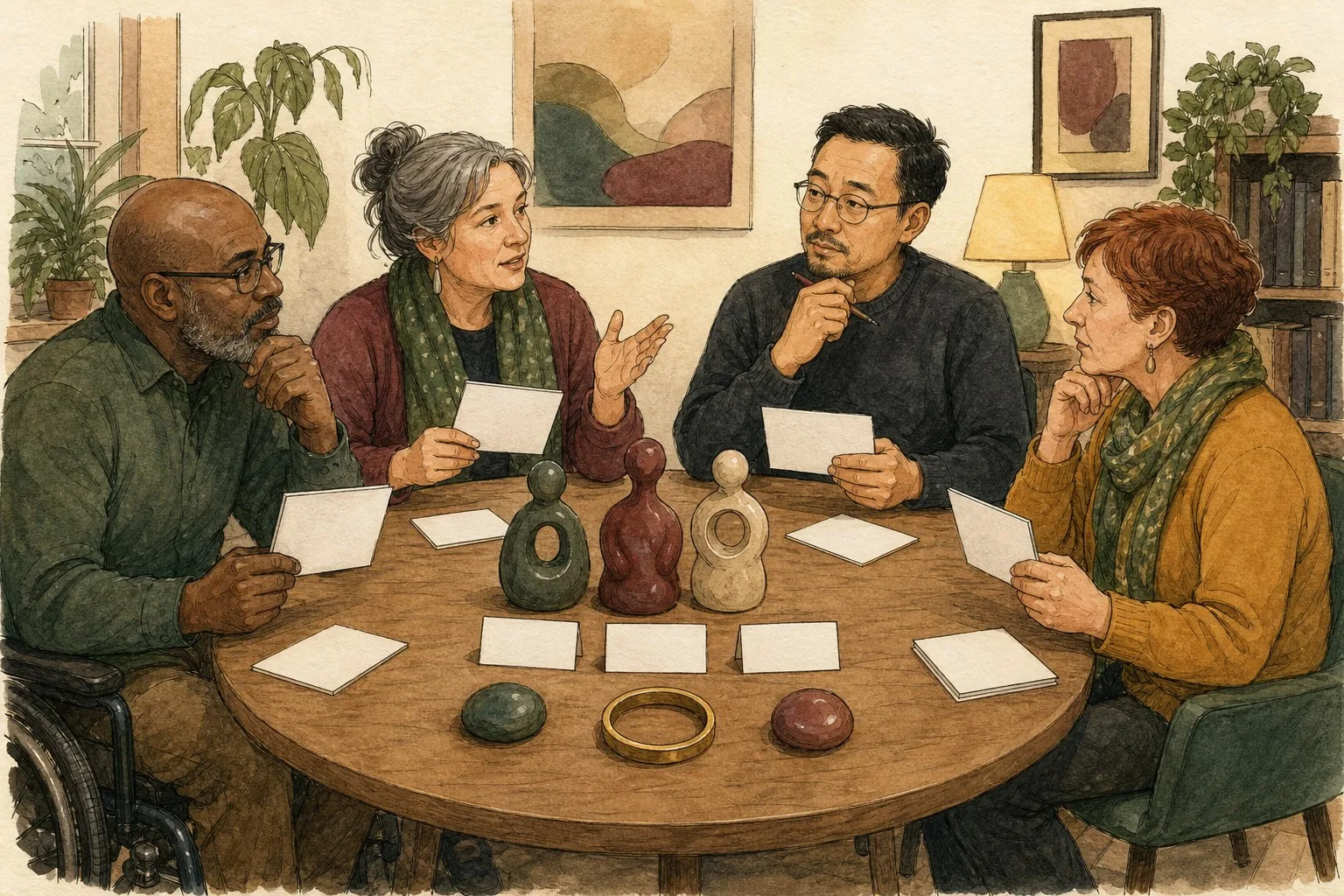
Illustration created using generative AI; not documentary evidence.
In brief
A shared fantasy is not permission on a third person's behalf.
Cuckolding and hotwifing are overlapping adult labels for fantasies or arrangements in which one partner's involvement with another consenting adult becomes meaningful to an established relationship. Some people value shared excitement or compersion; others deliberately explore jealousy, observation or an agreed status difference. The historically gendered terms are used inconsistently, and fantasy does not imply a real-life arrangement. Consent must include every adult directly involved rather than only the established couple.
What direct research can show
Lehmiller, Ley and Savage surveyed 580 predominantly gay-identified men about cuckolding fantasies and experiences. They found varied overlaps with other interests and reported that outcomes differed with individual and relationship factors. The sample is valuable for one understudied group but cannot represent all genders, orientations, cultures or relationship structures.
Research on consensual non-monogamy is broader than research on these specific labels. Rubel and Bogaert's review found broadly similar psychological wellbeing and relationship quality between consensually non-monogamous and monogamous participants, while also noting limitations in the evidence. Neither source establishes how common cuckolding or hotwifing is, a single cause, or a guaranteed relationship outcome.
EDITORIAL ILLUSTRATIONSmall studies cannot define every relationship
Direct research is limited and demographically narrow. Wider consensual-non-monogamy evidence cannot establish how common these fantasies are, why an individual has them or how a relationship will fare.
Illustration created using generative AI; not documentary evidence.
Status
Detailed editorial draft
Publisher
The UK Kink Guide
Reviewed
Structured draft present; individual review date not recorded
Evidence
7 cited sources · types labelled below
Jurisdiction
UK-focused general education
Read the rest: evidence, law, safety and sources
Cuckolding fantasy
Often gives emotional weight to a partner's outside involvement and may include jealousy, observation or consensual humiliation. None of those elements is automatic.
Hotwifing
Often emphasises a woman's agency, desirability or a couple's shared excitement, but the label remains culturally and historically gendered rather than clinically precise.
Consensual non-monogamy
A broader family of relationship agreements allowing more than one intimate or sexual connection. It need not involve kink, observation, jealousy or humiliation.
Infidelity
A breach of the relationship agreement through concealment or deception. It is not made consensual by one person's fantasy or by applying a kink label afterwards.
Jealousy, compersion and humiliation
Compersion refers to positive feelings in response to a partner's other consensual relationship or experience. Mogilski and colleagues found that jealousy and compersion can vary with consent and relationship context; later studies likewise show that positive and negative feelings can coexist. Compersion is therefore not a required achievement or proof that an agreement is healthy.
Jealousy may be an emotion to acknowledge, an intentionally bounded theme or a sign that an agreement needs review. Humiliation belongs only where it has been separately negotiated, with agreed language, audience and limits. The terms cuckold and hotwife do not authorise insults, comparison, exposure or reduced status by themselves. See Consensual humiliation and Consensual voyeuristic play for those distinct overlaps.
EDITORIAL ILLUSTRATIONEvery adult has an independent say
An established couple cannot consent for another adult. Involvement, information-sharing, observation, recording and publication are separate choices for each person.
Illustration created using generative AI; not documentary evidence.
People, symbols and privacy
A calendar, three blank place cards, a closed envelope, a relationship-agreement card or a privacy symbol can represent anticipation, separate relationships or agreed information-sharing without depicting anyone. Their meaning comes from the adults' understanding; a ring, message or shared key does not create consent or establish ownership.
Agreement may cover who knows what, introductions, contact between partners, photographs, messages, public acknowledgement and what remains private. The additional adult is a full participant with independent preferences, not a prop selected by a couple. Permission to hear about an encounter is not permission to watch, record, direct or publish it.
EDITORIAL ILLUSTRATIONHealth needs follow actual contact
Testing, barriers and other sexual-health choices depend on the contact involved, not the relationship label. Privacy and withdrawal remain individual rights throughout.
Illustration created using generative AI; not documentary evidence.
Consent, sexual health and clinical distinction
Each adult needs freedom, capacity and current agreement for their own involvement. In England and Wales, section 74 of the Sexual Offences Act 2003 defines consent as agreement by choice with freedom and capacity; Scotland and Northern Ireland have their own law. A standing relationship rule does not override withdrawal, and deception about an agreed boundary remains a relationship breach even when all activity is otherwise lawful.
Sexual-health needs depend on actual contact, not a relationship label. Lehmiller's comparative survey found more reported condom use and STI testing among its consensually non-monogamous participants than among its monogamous participants, but self-report from one sample cannot predict an individual's risk. NHS sexual-health clinics offer confidential testing, treatment and advice. Consensual adult interest is not a paraphilic disorder by default; WHO guidance focuses on marked distress, impairment, serious risk and non-consent.
Non-graphic examples
What the umbrella may include
Two adults discussing a fantasy about outside attention without deciding to act on it.
Three adults making their own informed choices about a private, consensual arrangement.
A couple enjoying compersion while leaving humiliation and observation outside the agreement.
Using a blank calendar or separate place cards as symbols of anticipation rather than as evidence that anyone is available.
Pausing an arrangement when jealousy or privacy concerns arise and returning to ordinary consent negotiation.
Prepare for an appointment
Questions you could ask a professional
What information would help you understand my question?
What are the realistic options and uncertainties?
How can disability, communication or privacy needs be accommodated?
When should the situation be reviewed again?
These prompts do not replace assessment and do not imply that every reader needs professional care.
Continue learning
Take the next step from definition to context.
Continue with independent guidance connecting cuckolding and hotwifing to evidence, consent, safety, uncertainty and practical decisions.