Negotiation language for boundaries. A hard limit excludes something from the current agreement; a soft limit usually marks uncertainty, conditions or an area someone does not currently want to pursue without a separate discussion. Both remain the individual’s choice, and neither label makes repeated persuasion or surprise testing acceptable.
Sources and evidence type
Manual claim and limitation notes are shown where an individual source audit is complete. Other evidence-type labels are a publisher aid awaiting source-by-source confirmation.
Dunkley & Brotto (2020), BDSM consent reviewResearch study
Source design
Peer-reviewed research or review
What it can support
The specific population, measures and findings reported by the paper.
Important limitation
It cannot automatically establish UK prevalence, causation, diagnosis, consent or an individual outcome. Check recruitment, definitions and study design.
The specific population, measures and findings reported by the paper.
Important limitation
It cannot automatically establish UK prevalence, causation, diagnosis, consent or an individual outcome. Check recruitment, definitions and study design.
Illustration created using generative AI; not documentary evidence.
In brief
A soft limit is still a limit, and an unlisted refusal still counts.
Hard and soft limits are optional shorthand for present boundaries, not a hierarchy of how seriously a refusal must be taken. A hard limit means excluded from the current agreement. A soft limit usually means uncertain, conditional or not open without a separate conversation—not permission to test, persuade or surprise. People can change either label, add a boundary without naming it and stop an activity that was not previously listed.
Present-tense boundaries
Treat lists as snapshots rather than permanent contracts. Health, trust, context and desire can change.
No explanation is required for a limit, and memory failure does not shift responsibility onto the person who set it.
EDITORIAL ILLUSTRATIONBoundaries belong to the present
Treat a limits list as a current snapshot, not a permanent contract. A person may add, remove or change a boundary without having to justify it.
Illustration created using generative AI; not documentary evidence.
Status
Source-checked editorial page
Publisher
The UK Kink Guide
Reviewed
Targeted additions checked 15 October 2026
Evidence
5 cited sources · types labelled below
Jurisdiction
UK-focused general education
Read the rest: evidence, law, safety and sources
Hard limit
Excluded from the current agreement without negotiation during activity.
Soft limit
Uncertain or conditional boundary requiring separate freely chosen discussion.
Preference
Something favoured or disliked that may not function as a boundary.
Safeword or stop signal
A communication tool for pausing or ending; it does not replace stated limits.
Soft does not mean persuade
Discuss a soft limit only outside pressure and accept no immediately. Repeated requests, bargaining and testing erode freedom of choice.
Conditional consent applies only when every stated condition is met.
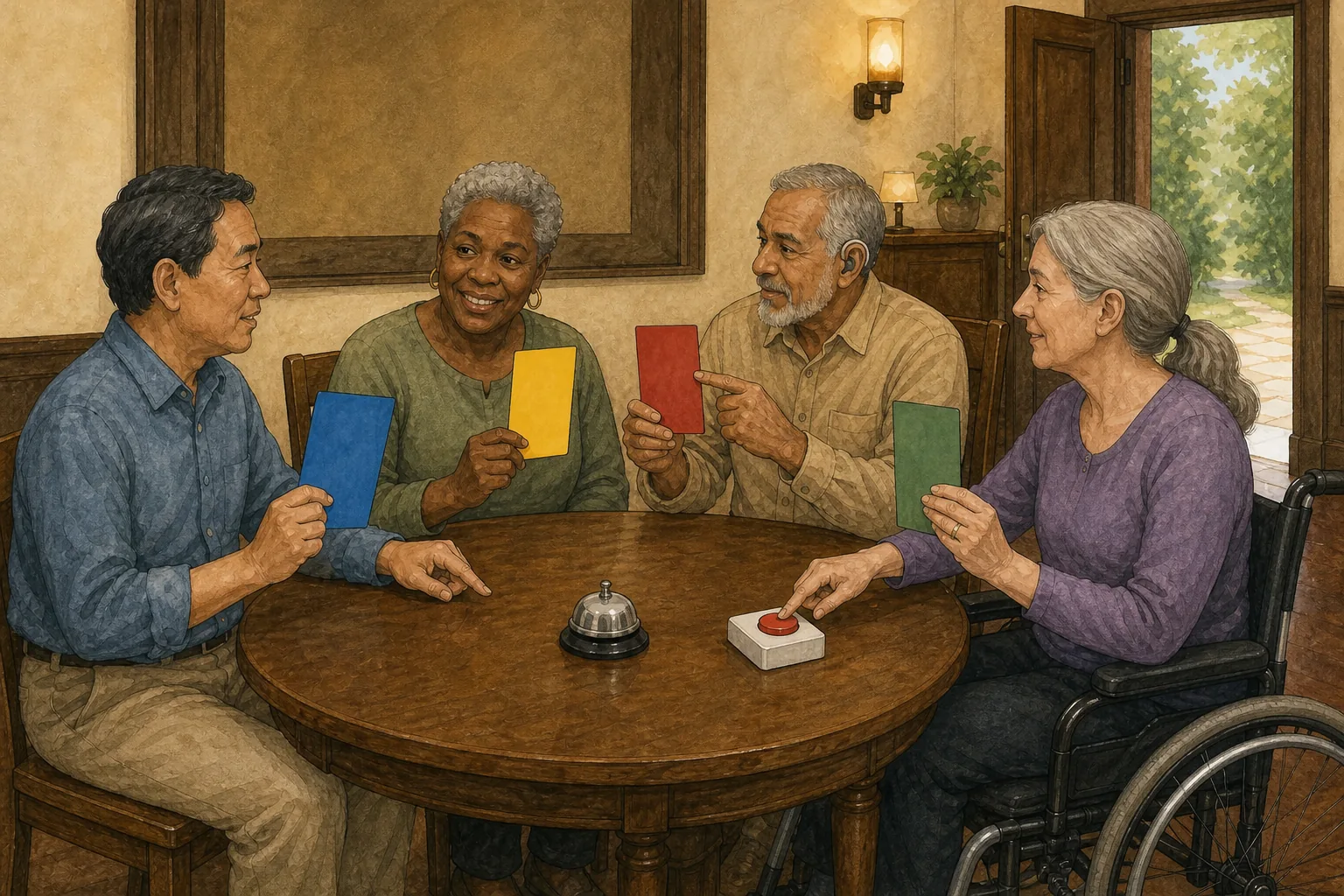
EDITORIAL ILLUSTRATIONSoft never means persuade
A soft limit means no for the current agreement unless a separate, freely chosen conversation changes it. Repeated requests, bargaining and surprise testing undermine consent.
Illustration created using generative AI; not documentary evidence.
Communication and access
Use written, visual, translated or supported communication where helpful, and confirm shared meaning rather than relying on jargon.
A person who cannot speak during activity needs an accessible stop method and attentive monitoring.
EDITORIAL ILLUSTRATIONMake stopping accessible
Written, visual, interpreted and supported communication can help, but shared meaning must be confirmed. Anyone who cannot speak needs another reliable way to pause or stop.
Illustration created using generative AI; not documentary evidence.
Evidence and legal context
Consent research supports explicit negotiation but does not validate one universal limit system.
UK consent requires choice, freedom and capacity; a checklist cannot override withdrawal or legal restrictions.
Common misunderstandings
Hard and soft are not grades of how seriously to take a boundary. A soft limit may mean no in the present situation, uncertainty or a condition that has not been met. It should not be read as an invitation to keep asking until the answer changes.
A former yes does not prevent a new no, and an unlisted boundary still counts. People cannot predict every feeling or circumstance before an encounter. A checklist can record a conversation, but it cannot make someone responsible for anticipating every possible reason they might want to stop later.
Safety and consent
Ask what the person means by their chosen wording and repeat it back in ordinary language. If there is uncertainty, leave the activity out of the current plan. Discuss conditions when everyone can consider them freely; do not demand a decision during an activity or while someone is afraid of disappointing a partner.
Use the Yes, No, Maybe list to support independent choices rather than to compare who is more adventurous. Keep answers private unless their author wants to share them. An accessible stop method matters, but ordinary withdrawal or uncertainty must also be taken seriously. A boundary should be easier to communicate after planning, not harder. Use a new copy when circumstances change.
Non-graphic examples
What the umbrella may include
Treating a soft limit as no for tonight.
Adding an unlisted boundary during a scene.
Using a written list for memory access.
Changing a former yes to a hard limit.
Stopping without giving a reason.
Prepare for an appointment
Questions you could ask a professional
What information would help you understand my question?
What are the realistic options and uncertainties?
How can disability, communication or privacy needs be accommodated?
When should the situation be reviewed again?
These prompts do not replace assessment and do not imply that every reader needs professional care.
Continue learning
Take the next step from definition to context.
Continue with independent guidance connecting hard and soft limits to evidence, consent, safety, uncertainty and practical decisions.
For health concerns, pressure or support after a boundary crossing, use the UK help directory. Describe the actual concern; you do not need a particular label to seek help.
 The UK Kink GuideEvidence-led glossary