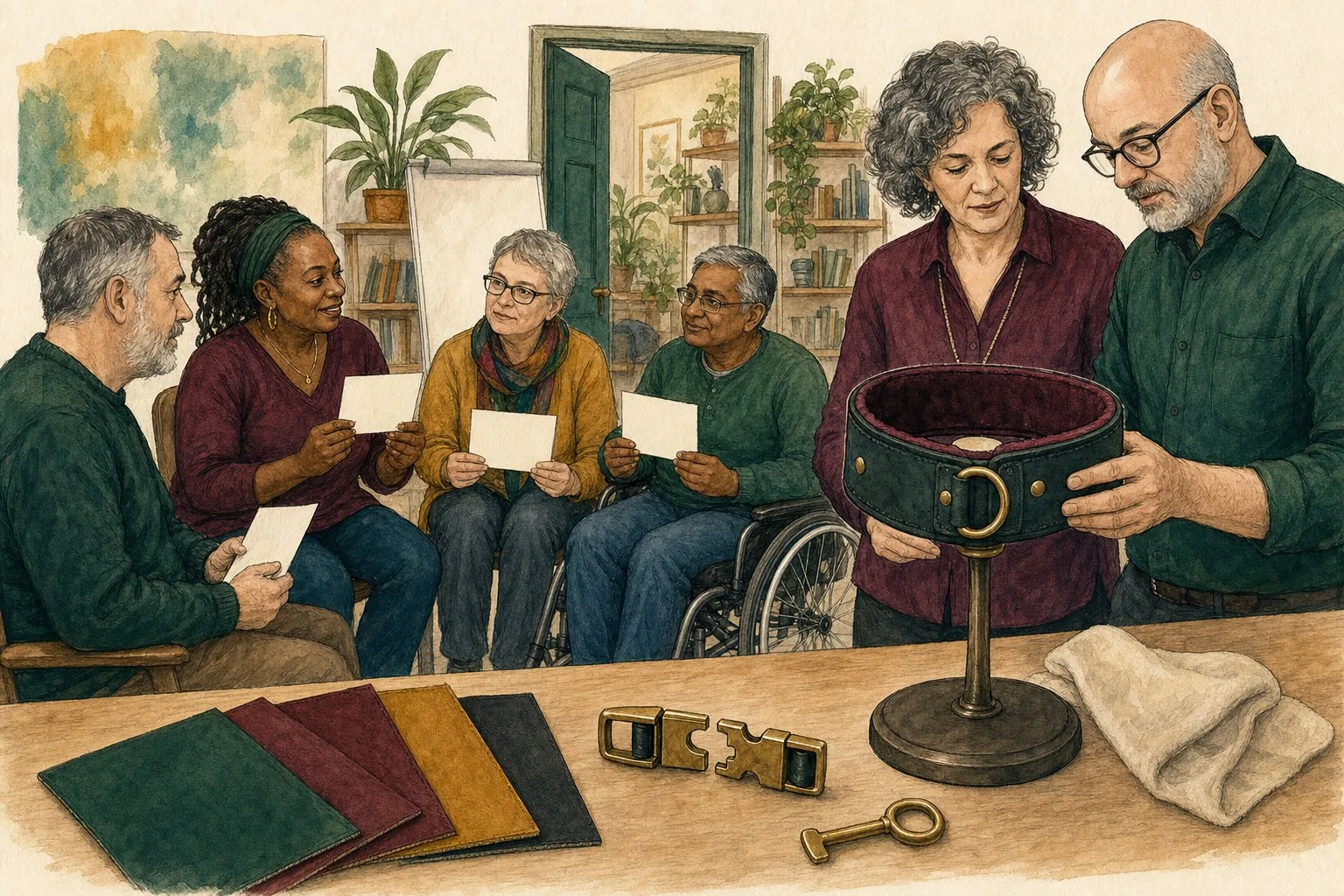
The consensual use or exchange of a collar as clothing, scene equipment or a symbol of role, commitment, belonging, protection, protocol or relationship meaning.
Sources and evidence type
Manual claim and limitation notes are shown where an individual source audit is complete. Other evidence-type labels are a publisher aid awaiting source-by-source confirmation.
Robertson (2017), ethnography of embodied BDSM practiceCommunity context
Source design
Contextual or community source
What it can support
Terminology, reported practice or community context within the source’s own setting.
Important limitation
Community usage is not universal and does not establish safety, prevalence, clinical benefit or legal permission.
Open the original source Turley (2009), phenomenological study of the social world of BDSMResearch study
Source design
Peer-reviewed research or review
What it can support
The specific population, measures and findings reported by the paper.
Important limitation
It cannot automatically establish UK prevalence, causation, diagnosis, consent or an individual outcome. Check recruitment, definitions and study design.
The specific population, measures and findings reported by the paper.
Important limitation
It cannot automatically establish UK prevalence, causation, diagnosis, consent or an individual outcome. Check recruitment, definitions and study design.
Illustration created using generative AI; not documentary evidence.
In brief
Ask what a collar means—never infer consent or relationship status from appearance.
Collars have no universal community meaning. One may be fashion, a temporary scene marker, a private symbol, a training-stage token or a commitment comparable in personal importance to other relationship jewellery. Appearance cannot reveal exclusivity, availability, authority or permission. A collar remains an object worn by an autonomous person; ownership language is symbolic and does not create legal rights over them.
Meaning and ceremony
Discuss whether the collar marks a scene, identity, commitment, protocol or exclusivity and who may see it. A ceremony can be personally important without creating marriage or ownership in law.
Meanings can change. Agree return, replacement, public wear and what happens after a relationship or role transition.
EDITORIAL ILLUSTRATIONAsk what the symbol means
A collar may be fashion, a scene marker, a private symbol or a commitment object. Appearance alone cannot reveal exclusivity, authority, availability or permission.
Illustration created using generative AI; not documentary evidence.
Status
Detailed editorial draft
Publisher
The UK Kink Guide
Reviewed
Structured draft present; individual review date not recorded
Evidence
3 cited sources · types labelled below
Jurisdiction
UK-focused general education
Read the rest: evidence, law, safety and sources
Fashion collar or choker
Clothing or jewellery that may have no kink or relationship meaning.
Play collar
A collar used during a scene or defined role period, often as a transition cue.
Relationship collar
A negotiated symbol of commitment or power exchange whose meaning belongs to the participants.
Restraint collar
Load-bearing or attachment equipment presenting mechanical and neck risks beyond symbolism.
Consent and social etiquette
Wearing a collar does not invite touching, commands, assumptions of submission or contact with the person who provided it. Only the wearer and relevant partners can explain its meaning.
In non-monogamous relationships, discuss how symbolism affects other agreements; no collar grants authority over third parties.
EDITORIAL ILLUSTRATIONWearing is not an invitation
A collar never invites touching, commands or assumptions about submission. Only the wearer and relevant partners can explain its agreed meaning and social boundaries.
Illustration created using generative AI; not documentary evidence.
Fit and physical safety
For ordinary wear, check fit, skin reaction, closures, edges, heat and ability to remove it. Swelling, breathing change, dizziness, numbness or panic requires immediate removal.
Do not attach force to decorative or locking collars. Neck loading, jerking, suspension and unattended locked wear can cause severe injury; an accessible release is essential.
Evidence and clinical distinction
Qualitative BDSM studies document collars as embodied symbols, but small samples cannot define a universal etiquette or meaning.
Collaring is not itself a clinical disorder. Distress, coercion, inability to remove the item or unsafe behaviour should be assessed on their facts rather than pathologising symbolism.
EDITORIAL ILLUSTRATIONFit and release remain practical
Edges, closures, skin reaction, heat and removal matter for ordinary wear. Decorative or locking collars are not load-bearing equipment, and breathing or circulation changes require immediate removal.
Illustration created using generative AI; not documentary evidence.
Non-graphic examples
What the umbrella may include
Wearing a choker purely as fashion.
Using a soft collar only to mark scene time.
Holding a private adult commitment ceremony.
Explaining a collar's meaning rather than relying on community assumptions.
Keeping an accessible key for a locking design.
Prepare for an appointment
Questions you could ask a professional
What information would help you understand my question?
What are the realistic options and uncertainties?
How can disability, communication or privacy needs be accommodated?
When should the situation be reviewed again?
These prompts do not replace assessment and do not imply that every reader needs professional care.
Continue learning
Take the next step from definition to context.
Continue with independent guidance connecting collaring to evidence, consent, safety, uncertainty and practical decisions.