Medical role-play is a consensual adult fantasy using the visual language, dialogue or roles associated with healthcare. The interest may concern authority, care, formality, vulnerability or clinical-looking objects without anyone providing real treatment.
 The UK Kink GuideEvidence-led glossary
 Back to the glossarySensation & activityIn plain English Words in context A non-graphic adult example What not to assume
Medical role-play
Consensual role-play using the imagery, procedures or authority associated with clinical settings. Costumes and non-invasive props can be symbolic; actual medical procedures create substantially different risks and are not implied by the term.
Start here
New to this term?
Symbolic role-play uses costume, staging and non-functional props. Medical-device interest focuses on equipment or design. Clinical treatment is real healthcare governed by professional duties, and invasive procedures are a separate high-risk category outside this entry.
Two adults might agree to use a white coat, an empty chart and fictional dialogue in an obviously staged scene. A real clinician wearing similar clothing at work is not participating and should not be treated as part of anyone's fantasy.
A costume does not create professional authority, diagnosis, capacity or consent. Role-play must not involve impersonating a professional to deceive someone, misusing records or carrying out actual procedures. Research can describe medical themes in adult fantasy, but cannot establish one motivation or therapeutic benefit.
Sources and evidence type
Manual claim and limitation notes are shown where an individual source audit is complete. Other evidence-type labels are a publisher aid awaiting source-by-source confirmation.
Rehor (2015), survey of women from kink communitiesResearch study
- Source design
- Peer-reviewed research or review
- What it can support
- The specific population, measures and findings reported by the paper.
- Important limitation
- It cannot automatically establish UK prevalence, causation, diagnosis, consent or an individual outcome. Check recruitment, definitions and study design.
Dunkley & Brotto (2020), BDSM consent reviewResearch study
- Source design
- Peer-reviewed research or review
- What it can support
- The specific population, measures and findings reported by the paper.
- Important limitation
- It cannot automatically establish UK prevalence, causation, diagnosis, consent or an individual outcome. Check recruitment, definitions and study design.
Sexual Offences Act 2003, section 74Law or regulator
- Source design
- Primary legislation, prosecutorial or regulator guidance
- What it can support
- The legal provision or official regulatory position for the jurisdiction and date stated.
- Important limitation
- It is not fact-specific legal advice. Commencement, amendments, jurisdiction and case law may affect application.
WHO ICD-11 clinical requirements (2024)Clinical guideline
- Source design
- Current public-health or clinical guidance
- What it can support
- Service pathways, health definitions and recommended public-health or clinical actions within its stated scope.
- Important limitation
- General guidance cannot assess an individual’s symptoms, exposure, medicine, contraindications or urgency.

Sensation & activity
Illustration created using generative AI; not documentary evidence.
In brief
Clinical imagery is not clinical practice.
Medical role-play is an adult fantasy built from clinical imagery, examination scripts, authority, care or vulnerability. A white coat, blank chart or theatrical stethoscope can carry the theme without anyone performing medicine. The label does not imply a real diagnosis, professional relationship or invasive procedure, and this page deliberately keeps actual clinical acts and medical-device use outside its scope.
What research can describe
Medical themes appear in broad surveys of kink interests, but there is little high-quality research focused on medical role-play itself. Rehor's large community survey documents diversity among self-selected women in kink communities; it cannot establish population prevalence, a cause or one psychological meaning for this interest.
BDSM consent research is more useful for understanding negotiation and boundaries than for explaining why a particular person likes clinical imagery. No costume, fantasy or role supplies a diagnosis, and a participant should not be analysed from their props.

Medical themes appear in broad kink surveys, but direct evidence is sparse. Costume, fantasy and role cannot establish prevalence, motive, qualifications or a clinical condition.
Illustration created using generative AI; not documentary evidence.- Status
- Detailed editorial draft
- Publisher
- The UK Kink Guide
- Reviewed
- Structured draft present; individual review date not recorded
- Evidence
- 4 cited sources · types labelled below
- Jurisdiction
- UK-focused general education
Read the rest: evidence, law, safety and sources
Costume, dialogue, staging or non-functional props used to create an agreed adult fiction.
A related object focus in which equipment, materials or clinical design may matter more than acting a role.
Real assessment or care delivered for health reasons by an appropriate professional; consent and professional duties differ.
Anything that breaks skin, enters the body or administers a substance introduces risks not covered by symbolic play.
Garments, props and symbols
Common visual cues include an unworn generic coat, plain gloves, a blank clipboard, a non-functional examination light, paper roll, masks or labelled costume accessories. Clean lines, stainless-steel appearance, disposable textures and institutional language may evoke precision, authority, care or exposure.
Real medicines, needles, gases, restraints and diagnostic devices are not ordinary props. Theatrical objects should not be represented as sterile, calibrated or clinically useful, and professional titles should not be used to mislead someone about qualifications.
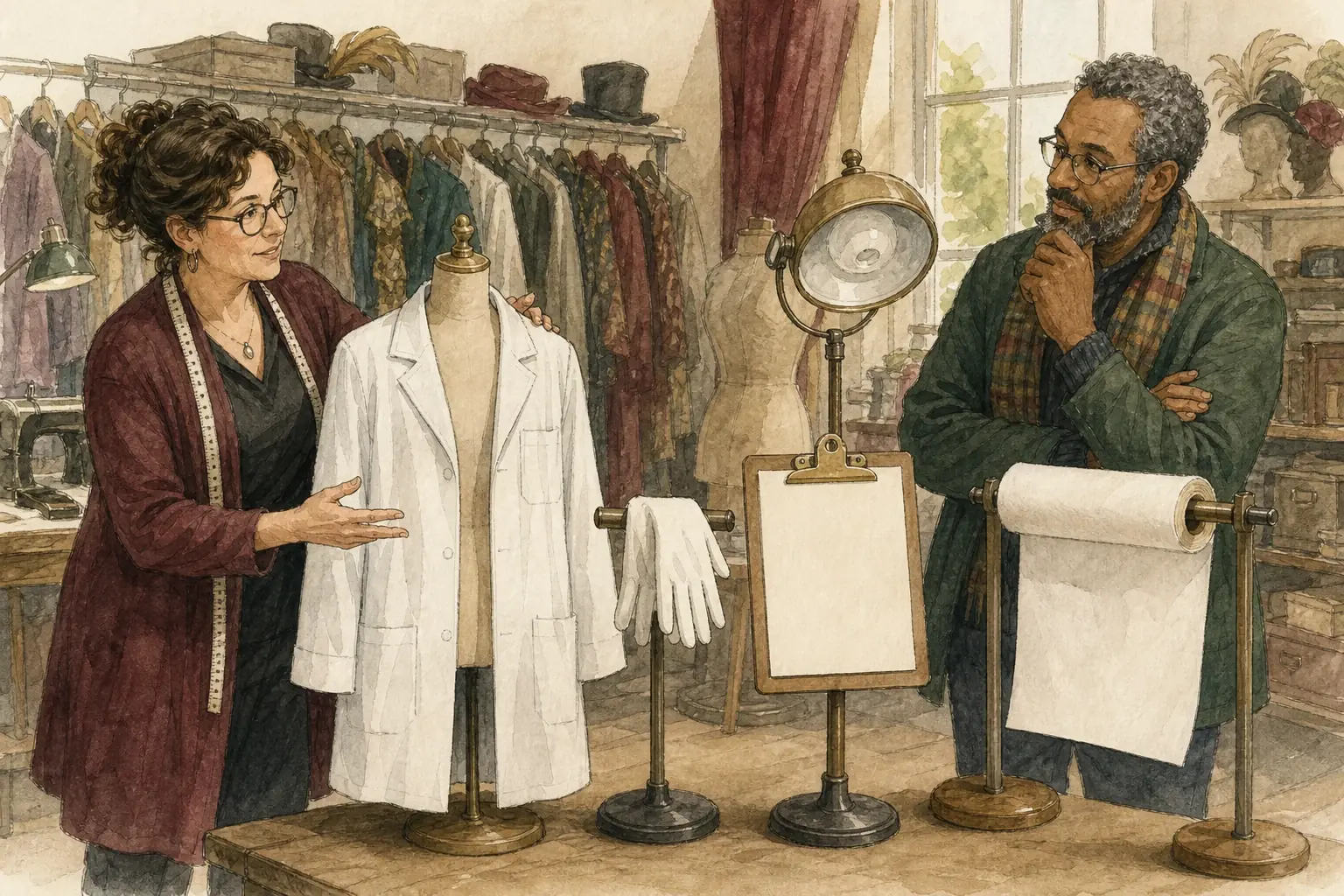
Generic costume and non-functional objects can signal a fictional role. Real medicines, needles, gases and diagnostic devices introduce different risks and duties.
Illustration created using generative AI; not documentary evidence.Consent, power and wellbeing
Consent needs to cover the chosen role, language, touch, garments, privacy and any health-related themes. A real history of illness, disability, medical trauma or healthcare discrimination can make a theme welcome, neutral or distressing; nobody owes disclosure or participation.
Role-play authority is temporary and negotiated. It does not permit diagnosis, treatment, medication, restraint after withdrawal or access to confidential health information, and a safeword is an aid rather than proof that all other signals can be ignored.

Consent should cover language, touch, privacy and health themes. Fictional authority never permits diagnosis, treatment, confidential-data access or continuation after withdrawal.
Illustration created using generative AI; not documentary evidence.Clinical and legal boundaries
A consensual adult interest in medical imagery is not a paraphilic disorder by default. WHO guidance focuses clinical concern on marked distress, impairment, serious risk or non-consent rather than unconventional costume or fantasy.
In England and Wales, sexual consent means agreement by choice with freedom and capacity. Impersonating a professional, causing injury or continuing after withdrawal raises issues that a role-play label cannot resolve; other UK jurisdictions have their own law.
Non-graphic examples
What the umbrella may include
- Two adults using a generic coat and blank chart to establish a fictional examination scene.
- Enjoying the clean visual language of clinical design without wanting any procedure.
- Agreeing that real diagnoses, trauma themes and medicines are outside the role.
- Choosing a non-functional prop rather than borrowing a real medical device.
- Dropping titles and checking in as ordinary adults when the scene ends.
Prepare for an appointment
Questions you could ask a professional
- What information would help you understand my question?
- What are the realistic options and uncertainties?
- How can disability, communication or privacy needs be accommodated?
- When should the situation be reviewed again?
These prompts do not replace assessment and do not imply that every reader needs professional care.
Continue learning
Take the next step from definition to context.
Continue with independent guidance connecting medical role-play to evidence, consent, safety, uncertainty and practical decisions.
Plan sensation play around the person, with specific limits, a working stop route, symptom awareness and UK support.
Read the guide