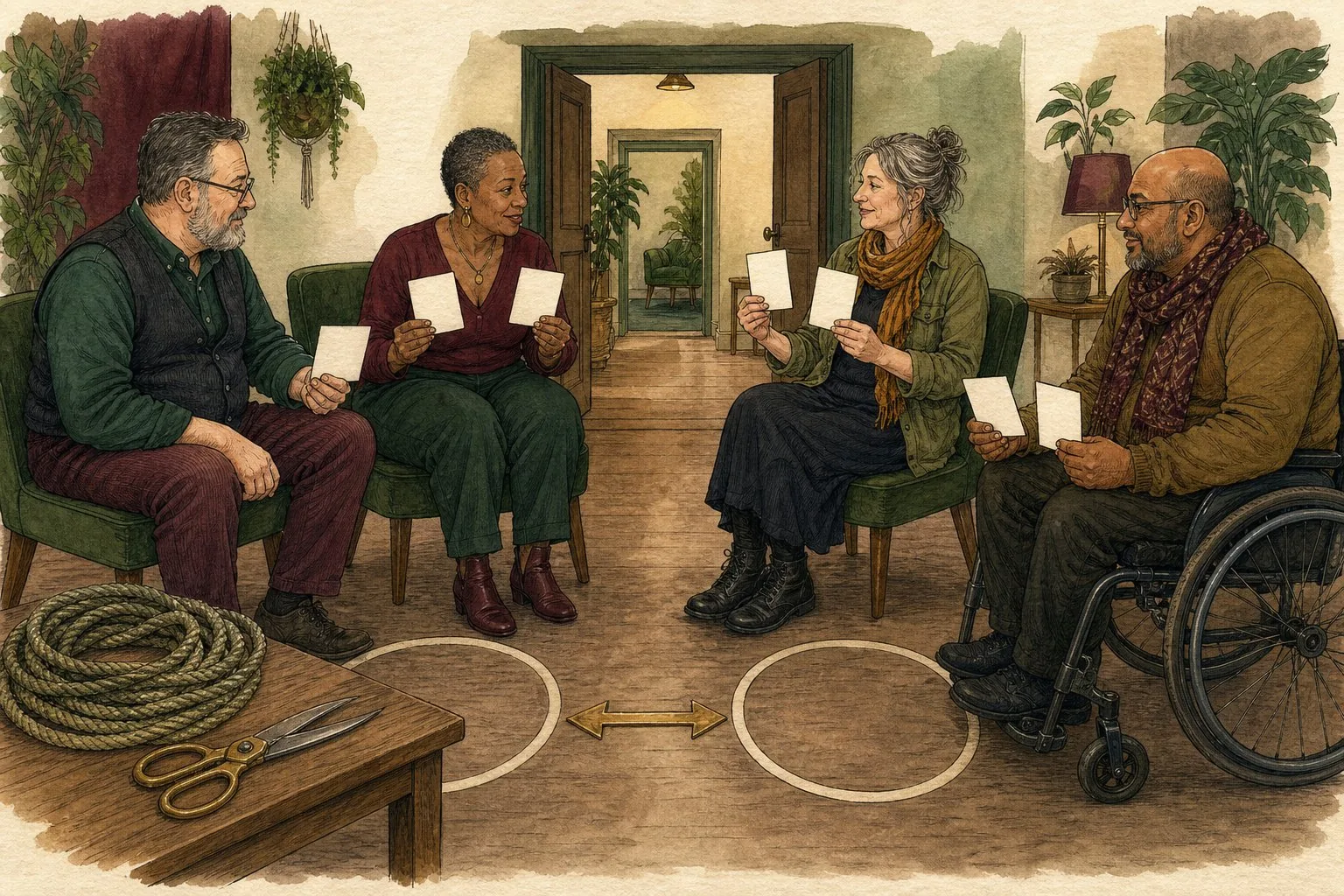
Activity-role terms for the person applying or directing rope and the person receiving it; neither role automatically establishes dominance, submission, expertise or relationship status.
Sources and evidence type
Manual claim and limitation notes are shown where an individual source audit is complete. Other evidence-type labels are a publisher aid awaiting source-by-source confirmation.
Lee et al. (2023), rope-bondage compression neuropathyResearch study
Source design
Peer-reviewed research or review
What it can support
The specific population, measures and findings reported by the paper.
Important limitation
It cannot automatically establish UK prevalence, causation, diagnosis, consent or an individual outcome. Check recruitment, definitions and study design.
Open the original source Ambler et al. (2017), preliminary role-specific altered-state studyResearch study
Source design
Peer-reviewed research or review
What it can support
The specific population, measures and findings reported by the paper.
Important limitation
It cannot automatically establish UK prevalence, causation, diagnosis, consent or an individual outcome. Check recruitment, definitions and study design.
The specific population, measures and findings reported by the paper.
Important limitation
It cannot automatically establish UK prevalence, causation, diagnosis, consent or an individual outcome. Check recruitment, definitions and study design.
Illustration created using generative AI; not documentary evidence.
In brief
Rope roles describe participation—not authority, passivity or qualification.
Rigger and rope top are often used for the tying role, while rope bottom describes the person being tied. Rope bunny is common but not universally welcomed because it can sound passive or objectifying. Both participants contribute knowledge and decisions, and either may be a switch. Rope can compress nerves, impair circulation, restrict breathing, cause falls and complicate emergency release, so role labels must not be mistaken for competence.
Roles and shared agency
Negotiate purpose, body areas, mobility, communication, photography and release before rope is applied. A bottom's feedback and anatomical knowledge are essential evidence, not an interruption.
A top can be service-oriented and a bottom can direct the aesthetic or structure. Do not infer gender, experience or authority from role.
EDITORIAL ILLUSTRATIONActivity roles are not a hierarchy
Rigger and rope bottom describe participation in a particular activity. They do not automatically establish dominance, submission, passivity, relationship status or competence.
Illustration created using generative AI; not documentary evidence.
Status
Detailed editorial draft
Publisher
The UK Kink Guide
Reviewed
Structured draft present; individual review date not recorded
Evidence
3 cited sources · types labelled below
Jurisdiction
UK-focused general education
Read the rest: evidence, law, safety and sources
Rigger or rope top
The person applying or directing rope; the term does not certify training or make them dominant.
Rope bottom
The person receiving rope, with active expertise in their body, communication and consent.
Rope bunny
An informal bottom-role term that some embrace and others find diminishing; use by preference.
Dominant/submissive
Authority roles that may overlap with rope roles but are conceptually separate.
Nerve, circulation and breathing risk
Compression neuropathy can present as tingling, numbness, burning, weakness or loss of movement. Pain is not a reliable early warning, and injury may persist after release.
Stop and release for neurological change, colour or temperature change, breathing difficulty, faintness or unexpected distress. Seek medical assessment for persistent weakness, numbness or severe symptoms.
EDITORIAL ILLUSTRATIONKnowledge is shared
The tying role may bring technical knowledge, while the receiving role brings indispensable bodily knowledge and feedback. Both contribute to negotiation, monitoring and stopping.
Illustration created using generative AI; not documentary evidence.
Skill, progression and equipment
Rope material, placement, movement, anatomy and emergency cutting require practical education. This card intentionally does not teach ties or suspension.
Suspension and partial suspension add fall, anchor and rescue hazards and require qualified in-person instruction, rated systems and independent emergency capability.
Consent and altered states
Small studies suggest participants may experience role-specific altered states, but this does not make reduced communication a consent signal or predictable benefit.
Use check-ins and a non-verbal signal, remain continuously attentive and never leave a restrained person alone. Release must be possible without relying on one knot, key or conscious participant.
EDITORIAL ILLUSTRATIONA label is not a qualification
Nerve, circulation, breathing, fall and release risks depend on the whole situation. Role experience cannot substitute for activity-specific competence, honest feedback or emergency planning.
Illustration created using generative AI; not documentary evidence.
Non-graphic examples
What the umbrella may include
A submissive acting as rope top.
A rope bottom directing an artistic tie.
Asking before using rope bunny as a label.
Stopping immediately after hand weakness appears.
Learning suspension only through qualified in-person teaching.
Prepare for an appointment
Questions you could ask a professional
What information would help you understand my question?
What are the realistic options and uncertainties?
How can disability, communication or privacy needs be accommodated?
When should the situation be reviewed again?
These prompts do not replace assessment and do not imply that every reader needs professional care.
Continue learning
Take the next step from definition to context.
Continue with independent guidance connecting rigger and rope bottom to evidence, consent, safety, uncertainty and practical decisions.