Bondage is the consensual adult interest in restraint, restricted movement or the symbolism of being held. It can be purely visual—such as an unfastened cuff in a photograph—or physically restrictive. The word names a broad interest, not a single method.
 The UK Kink GuideEvidence-led glossary
 Back to the glossaryPower & roleIn plain English Words in context A non-graphic adult example What not to assume
Bondage
The consensual use or representation of restraint and restricted movement between adults for aesthetic, psychological, sensory or role-based meaning. Bondage ranges from symbolic imagery to technically complex restraint; it is distinct from detention, coercion or preventing someone from leaving without agreement.
Start here
New to this term?
Symbolic bondage evokes restraint without substantially limiting movement. Physical restraint actually limits movement and changes the risk. Rope bondage is one specialist branch. A person applying restraint is sometimes called a top, and a person receiving it a bottom; those practical roles do not automatically mean dominant and submissive.
Two adults may use open cuffs as agreed visual symbols for a private photograph. Another person may enjoy the weight and appearance of a chain without agreeing to be restrained. A third may like psychological stillness while declining rope or suspension.
Equipment, clothing or interest does not prove consent, identity or skill. Agreement to one cuff does not imply rope, photography, sexual contact or greater restriction. Actual restraint can impair communication and escape and can injure nerves or circulation; this page describes context rather than teaching technique.
Sources and evidence type
Manual claim and limitation notes are shown where an individual source audit is complete. Other evidence-type labels are a publisher aid awaiting source-by-source confirmation.
Drouin et al. (2023), marks and injuries in BDSM experiencesResearch study
- Source design
- Peer-reviewed research or review
- What it can support
- The specific population, measures and findings reported by the paper.
- Important limitation
- It cannot automatically establish UK prevalence, causation, diagnosis, consent or an individual outcome. Check recruitment, definitions and study design.
Dunkley & Brotto (2020), BDSM consent reviewResearch study
- Source design
- Peer-reviewed research or review
- What it can support
- The specific population, measures and findings reported by the paper.
- Important limitation
- It cannot automatically establish UK prevalence, causation, diagnosis, consent or an individual outcome. Check recruitment, definitions and study design.
Brown, Barker & Rahman (2020), BDSM scoping reviewResearch study
- Source design
- Peer-reviewed research or review
- What it can support
- The specific population, measures and findings reported by the paper.
- Important limitation
- It cannot automatically establish UK prevalence, causation, diagnosis, consent or an individual outcome. Check recruitment, definitions and study design.
WHO ICD-11 clinical descriptions and diagnostic requirements (2024)Clinical guideline
- Source design
- Current public-health or clinical guidance
- What it can support
- Service pathways, health definitions and recommended public-health or clinical actions within its stated scope.
- Important limitation
- General guidance cannot assess an individual’s symptoms, exposure, medicine, contraindications or urgency.
NHS peripheral neuropathy guidanceClinical guideline
- Source design
- Current public-health or clinical guidance
- What it can support
- Service pathways, health definitions and recommended public-health or clinical actions within its stated scope.
- Important limitation
- General guidance cannot assess an individual’s symptoms, exposure, medicine, contraindications or urgency.
NHS compartment syndrome guidanceClinical guideline
- Source design
- Current public-health or clinical guidance
- What it can support
- Service pathways, health definitions and recommended public-health or clinical actions within its stated scope.
- Important limitation
- General guidance cannot assess an individual’s symptoms, exposure, medicine, contraindications or urgency.
NHS first-aid guidanceClinical guideline
- Source design
- Current public-health or clinical guidance
- What it can support
- Service pathways, health definitions and recommended public-health or clinical actions within its stated scope.
- Important limitation
- General guidance cannot assess an individual’s symptoms, exposure, medicine, contraindications or urgency.
Domestic Abuse Act 2021, section 71 (England and Wales)Law or regulator
- Source design
- Primary legislation, prosecutorial or regulator guidance
- What it can support
- The legal provision or official regulatory position for the jurisdiction and date stated.
- Important limitation
- It is not fact-specific legal advice. Commencement, amendments, jurisdiction and case law may affect application.
Justice (Sexual Offences and Trafficking Victims) Act (Northern Ireland) 2022, section 27Law or regulator
- Source design
- Primary legislation, prosecutorial or regulator guidance
- What it can support
- The legal provision or official regulatory position for the jurisdiction and date stated.
- Important limitation
- It is not fact-specific legal advice. Commencement, amendments, jurisdiction and case law may affect application.
Sexual Offences (Scotland) Act 2009, section 12Law or regulator
- Source design
- Primary legislation, prosecutorial or regulator guidance
- What it can support
- The legal provision or official regulatory position for the jurisdiction and date stated.
- Important limitation
- It is not fact-specific legal advice. Commencement, amendments, jurisdiction and case law may affect application.
Sexual Offences (Scotland) Act 2009, section 15Law or regulator
- Source design
- Primary legislation, prosecutorial or regulator guidance
- What it can support
- The legal provision or official regulatory position for the jurisdiction and date stated.
- Important limitation
- It is not fact-specific legal advice. Commencement, amendments, jurisdiction and case law may affect application.

Power & role
Illustration created using generative AI; not documentary evidence.
In brief
Restraint has meanings—and material consequences.
Bondage is an umbrella term for consensual adult interests involving restraint, stillness, containment or the symbolism of being held. For some people the appeal is visual or tactile; for others it concerns trust, anticipation, vulnerability, control or a temporary change in role. The term describes a broad family of interests, not one technique, and does not by itself establish dominance, submission, sexual activity or a clinical condition.
Meanings, roles and overlaps
Bondage sits within the ‘B’ of BDSM, but people may engage with it independently of discipline, dominance and submission, or sadomasochism. A person who enjoys being restrained is not necessarily submissive, and the person applying restraint is not necessarily dominant. Roles, meanings and relationship structures have to be learned from the adults involved rather than inferred from the object or position.
Some experiences emphasise stillness or containment; others focus on visual composition, material sensation, anticipation or negotiated helplessness. Bondage may overlap with rope practice, sensory play, fashion, performance or photography. Those overlaps do not make the terms interchangeable, and an interest in one form does not imply interest in more restrictive or technically demanding forms.

Bondage may involve sensation, symbolism, restriction, aesthetics or role. The same material can carry different meanings, and possession reveals neither consent nor conduct.
Illustration created using generative AI; not documentary evidence.- Status
- Detailed editorial draft
- Publisher
- The UK Kink Guide
- Reviewed
- Structured draft present; individual review date not recorded
- Evidence
- 11 cited sources · types labelled below
- Jurisdiction
- UK-focused general education
Read the rest: evidence, law, safety and sources
Imagery, clothing or unfastened objects evoke restraint without substantially limiting movement. The meaning may be aesthetic, theatrical or role-based.
Movement is actually limited by an object, position or agreed action. Risk varies with the body, material, environment and duration, not simply with the label used.
A specific branch using rope for connection, restraint, visual composition or ritual. It has its own terminology, skills and risks and is covered separately in this glossary.
Holding, restraining or preventing a person from leaving without valid agreement is not bondage as consensual kink; it may be abuse and a criminal offence.
Objects, materials and sensory qualities
Commonly associated objects include padded cuffs, rope, straps, fabric, chains, clips, spreader bars and purpose-built furniture. Some are used primarily as visual symbols; others materially restrict movement. Width, stiffness, surface texture, stretch, weight, temperature, fastenings and contact with skin can change both the sensory experience and the physical risk. An object that resembles restraint equipment may also be costume, craft material or ordinary hardware, so possession alone reveals little about use or identity.
The existing illustration presents open padded cuffs, coiled cotton rope, a clip and folded textile as an unoccupied still life. These objects can suggest softness, tension, connection, release or industrial aesthetics without depicting a method. Materials can also matter because of allergies, cleaning requirements, wear, hidden damage or the difficulty of releasing them under load; a retail description or decorative appearance is not proof that an item is suitable for restraint.
Consent and communication
Valid consent concerns the specific activity, degree of restriction and circumstances. Agreement to wear cuffs does not imply agreement to rope, suspension, isolation, photography or sexual contact. Consent can be withdrawn, and a role, relationship, previous scene or ownership-style symbol never creates permanent authority. A person must remain free to decline participation before it begins.
Restriction can reduce a person's ability to gesture, speak, move away or use a device. Negotiation therefore needs to account for accessible communication and the possibility that an agreed signal becomes unavailable. Safewords and non-verbal signals can assist, but silence, freezing, unusual stillness or failure to use a signal is not evidence of consent. See the separate Consent negotiation and Safeword field notes for the communication framework.

Restriction can reduce speech, gesture and movement. Negotiation must include accessible communication and a credible way to stop and release without treating silence as agreement.
Illustration created using generative AI; not documentary evidence.What research can—and cannot—show
Drouin and colleagues surveyed a convenience sample of 513 US adults about BDSM experiences, communication, intentional marks and unintended injuries. Marks and injuries were varied, and greater experience was associated with more safeword use as well as more marking behaviours. The study did not isolate bondage outcomes, prove that experience prevents harm or identify a universally safe practice.
Dunkley and Brotto's review describes negotiation, safewords and continuing consent as recurring BDSM practices. Brown and colleagues' scoping review likewise found a heterogeneous literature with inconsistent definitions and selected samples. Together these sources can describe reported norms and experiences, but they do not provide a population prevalence for bondage, a single explanation for its appeal or a risk calculator for an individual scene.
Physical risk and health boundaries
Actual restraint can create pressure, restricted circulation, nerve compression, joint strain, falls, entrapment, heat stress or an inability to respond to another problem. Risk may change quickly when body weight, movement, fatigue, medication, disability or the environment changes. Any activity that restricts breathing is a distinct high-risk subject and should not be treated as an ordinary extension of bondage; this glossary does not provide tying, suspension or breathing-restriction instructions.
Pain, numbness, tingling, weakness, loss of sensation or difficulty moving can be signs that require attention rather than endurance. NHS guidance treats sudden severe pain as an emergency and advises calling 999 or attending A&E; an unresponsive person who is not breathing normally also requires immediate emergency help. Persistent symptoms or an injury warrant appropriate clinical assessment, and aftercare is not a substitute for medical care.
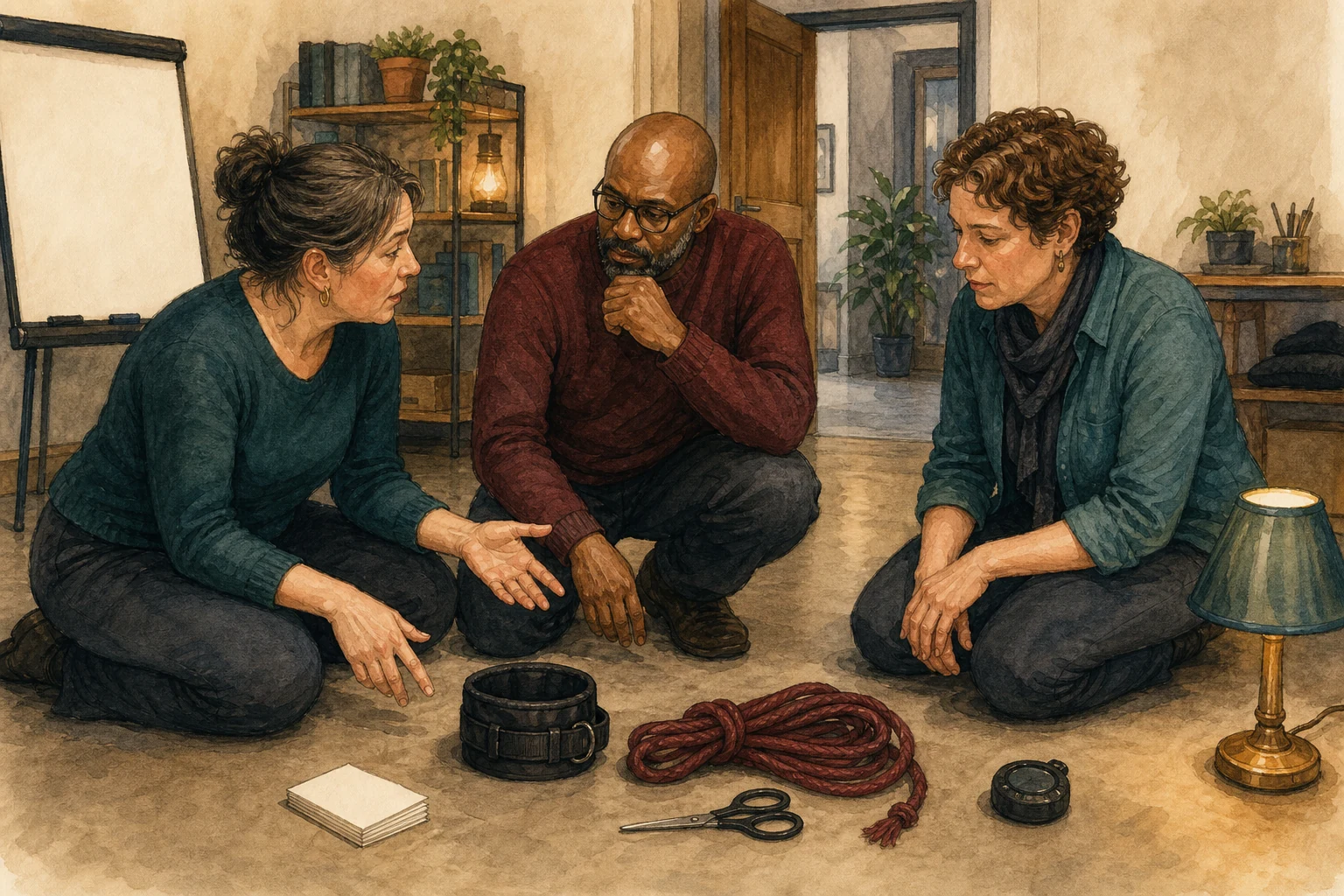
Pressure, circulation, nerves, joints, falls, heat and delayed release can change quickly. Materials, bodies, environment and rescue capability must be considered together.
Illustration created using generative AI; not documentary evidence.Clinical and UK legal distinctions
Consensual adult bondage is not a paraphilic disorder merely because it is unconventional. ICD-11 distinguishes consensual adult interests from disorders involving marked distress not explained solely by rejection, significant injury risk, or people who are unwilling or unable to consent. Only a suitably qualified clinician can assess an individual diagnosis; equipment, clothing and community identity are not diagnostic evidence.
UK law is jurisdiction-specific and consent to an activity does not necessarily make resulting injury lawful. In England and Wales, section 71 of the Domestic Abuse Act 2021 restates that consent is not a defence to serious harm inflicted for sexual gratification. Northern Ireland has a related provision in section 27 of its 2022 Act; Scotland applies its own criminal law. The law also distinguishes consensual restraint from conduct after consent is withdrawn or where freedom or capacity is absent. Specific incidents need qualified legal advice rather than conclusions from a glossary.
Non-graphic examples
What the umbrella may include
- Two adults use open cuffs and rope as visual symbols in an agreed, non-restrictive photograph.
- An adult enjoys the weight and industrial appearance of a chain without treating it as permission for anyone else to restrict them.
- A participant likes the psychological idea of stillness but declines suspension and other forms that carry different risks.
- Adults discuss material allergies, mobility needs, communication access and privacy before deciding whether any restraint is within their boundaries.
- A person withdraws agreement after restraint has begun; the previous negotiation does not authorise continued restriction.
Prepare for an appointment
Questions you could ask a professional
- What information would help you understand my question?
- What are the realistic options and uncertainties?
- How can disability, communication or privacy needs be accommodated?
- When should the situation be reviewed again?
These prompts do not replace assessment and do not imply that every reader needs professional care.
Continue learning
Take the next step from definition to context.
Continue with independent guidance connecting bondage to evidence, consent, safety, uncertainty and practical decisions.
Plan restraint release before use: check manufacturer instructions, accessible exits and backup shears, with warning signs and UK help routes.
Read the guideRelated in-depth reading
Read the full guide.
Explore a connected question with context and UK support routes.
Shibari and kinbaku meaning, Japanese history, respectful learning, teacher checks, consent and rope risks without tying instructions.
Read the full guide Community & cultureWhat is BDSM? A beginner's guideA plain-English introduction to adult BDSM, its language, consent, risk, UK law and the questions worth asking before any activity.
Read the full guide Community & cultureList of kinks and fetishes: an A–Z of 120+ termsList of kinks and fetishes: 120 A–Z terms with plain definitions, glossary links and UK guidance on consent, boundaries and finding help.
Read the full guide Products, materials and safetyRope bondage for beginners: nerves and circulationRecognise rope restraint warning signs, plan immediate release, and know when numbness, weakness or other symptoms need medical help.
Read the full guideOptional product education
Check materials, fit and care independently.
Some product guides include a separate, disclosed optional retailer box. A term alone does not make a product suitable or safe for a person.
Read the criteria before deciding whether to shop.
Read the full guide Independent product guideBDSM collars and restraints: how to chooseRead the criteria before deciding whether to shop.
Open the guide Independent product guideBondage kits and gear: a beginner's buying guideRead the criteria before deciding whether to shop.
Open the guide