Role-play is when consenting adults temporarily use fictional characters, relationships, settings or stories to explore a fantasy. It can be spoken, written, costumed, lightly improvised or carefully scripted. The imaginary frame changes the story, not anyone’s real-world rights.
 The UK Kink GuideEvidence-led glossary
 Back to the glossaryPower & roleIn plain English Words in context A non-graphic adult example What not to assume
Role-play
The consensual adoption of fictional roles, settings or scripts to explore identity, authority, vulnerability or fantasy. Participants remain responsible for agreeing boundaries even when the story itself imagines resistance or unequal power.
Start here
New to this term?
Character play centres on a fictional persona; scenario play centres on a setting or story; and power-role play performs unequal status. A fantasy is imagined content, behaviour is what someone actually does, and identity is a label they choose. These do not automatically match.
Two adults agree to portray fictional authority roles for one evening, choose language that stays within their boundaries and use an ordinary phrase to stop. Afterward they drop the character names and discuss the experience as themselves.
A fictional role does not prove a real occupation, identity, political belief, trauma history or wish to repeat the scenario. Imagined resistance is not actual consent. Costumes, scripts and previous participation never authorise touching, recording, sharing or continuing after agreement changes.
Sources and evidence type
Manual claim and limitation notes are shown where an individual source audit is complete. Other evidence-type labels are a publisher aid awaiting source-by-source confirmation.
Rehor (2015), survey of women from kink communitiesResearch study
- Source design
- Peer-reviewed research or review
- What it can support
- The specific population, measures and findings reported by the paper.
- Important limitation
- It cannot automatically establish UK prevalence, causation, diagnosis, consent or an individual outcome. Check recruitment, definitions and study design.
Herbenick et al. (2017), US adult probability surveyResearch study
- Source design
- Peer-reviewed research or review
- What it can support
- The specific population, measures and findings reported by the paper.
- Important limitation
- It cannot automatically establish UK prevalence, causation, diagnosis, consent or an individual outcome. Check recruitment, definitions and study design.
Dunkley & Brotto (2020), BDSM consent reviewResearch study
- Source design
- Peer-reviewed research or review
- What it can support
- The specific population, measures and findings reported by the paper.
- Important limitation
- It cannot automatically establish UK prevalence, causation, diagnosis, consent or an individual outcome. Check recruitment, definitions and study design.
WHO ICD-11 clinical requirements (2024)Clinical guideline
- Source design
- Current public-health or clinical guidance
- What it can support
- Service pathways, health definitions and recommended public-health or clinical actions within its stated scope.
- Important limitation
- General guidance cannot assess an individual’s symptoms, exposure, medicine, contraindications or urgency.
Sexual Offences Act 2003, section 74Law or regulator
- Source design
- Primary legislation, prosecutorial or regulator guidance
- What it can support
- The legal provision or official regulatory position for the jurisdiction and date stated.
- Important limitation
- It is not fact-specific legal advice. Commencement, amendments, jurisdiction and case law may affect application.

Power & role
Illustration created using generative AI; not documentary evidence.
In brief
Fiction can change the frame, not the right to choose.
Adult role-play uses an agreed fictional frame—a character, setting, relationship or story—to explore feelings and possibilities that need not describe anyone's everyday identity or wishes. The fiction can alter how an interaction feels, but it never suspends real-world agency: the adults involved remain themselves, with an unchanged right to pause, revise or end what is happening.
What research can describe
Role-play appears in population and kink-community surveys, but studies define it differently. Rehor's survey of 1,580 women recruited from kink communities included ten role-play scenario categories, while Herbenick and colleagues included role-playing in a US probability survey of adult sexual diversity. These studies show that role-play is measurable as an adult behaviour; they do not establish one motive, script or meaning.
Broader BDSM research describes fantasy, identity, leisure, intimacy and power as overlapping motivations. Because samples, questions and cultural settings vary, findings about one scenario or community cannot be used to predict an individual's history, personality or preferred boundaries.
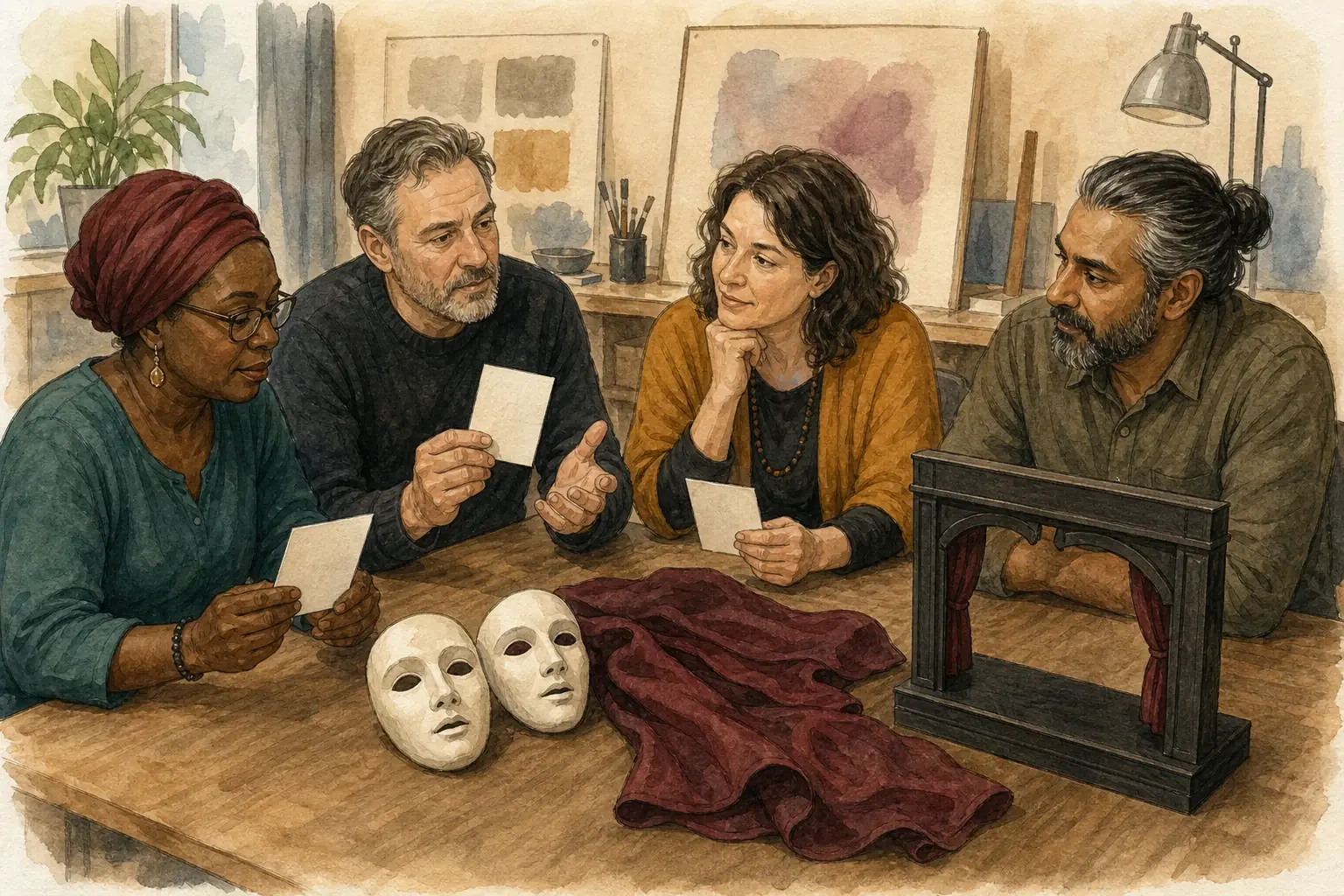
Research can describe themes and reported motivations, but a fictional role does not by itself reveal identity, real-world intention, prevalence or clinical significance.
Illustration created using generative AI; not documentary evidence.- Status
- Detailed editorial draft
- Publisher
- The UK Kink Guide
- Reviewed
- Structured draft present; individual review date not recorded
- Evidence
- 5 cited sources · types labelled below
- Jurisdiction
- UK-focused general education
Read the rest: evidence, law, safety and sources
Adopting a fictional personality, profession or archetype for a scene, conversation or costume.
Using an invented setting or story structure, with as much or as little improvisation as the adults want.
Temporarily performing unequal authority or status. The performed hierarchy does not create authority outside the agreement.
A role may express part of a person, provide distance from it or be pure invention; no single interpretation should be assumed.
Scripts, costumes and sensory cues
A role may be supported by an adult costume, mask, prop key, blank badge, character card, changed form of address, music or lighting. These cues can create anticipation, distance from everyday life or a clearer transition into and out of character. They are optional: spoken imagination alone can be enough.
Props should remain visibly fictional where confusion could affect other people. A costume or badge does not confer professional, legal or institutional authority, and realistic weapons, emergency insignia or another person's genuine credentials are not harmless theatrical shortcuts.

Costumes, language and sensory cues can help frame a fiction. Adults still need to agree what is included, what remains outside the story and how to stop.
Illustration created using generative AI; not documentary evidence.Consent inside and outside the story
Useful negotiation distinguishes the fictional script from the real agreement around it: themes that are welcome, words or identities that are off-limits, privacy, photographs, a way to stop, and what happens if someone departs from character. Ordinary language and accessible non-verbal signals remain valid even when they do not fit the story.
A fictional refusal or unequal role must never be used to reinterpret an actual withdrawal of consent. Under section 74 of the Sexual Offences Act 2003 in England and Wales, consent requires agreement by choice with freedom and capacity to make that choice; Scotland and Northern Ireland have separate legislation with the same practical need to distinguish fantasy from present agreement.
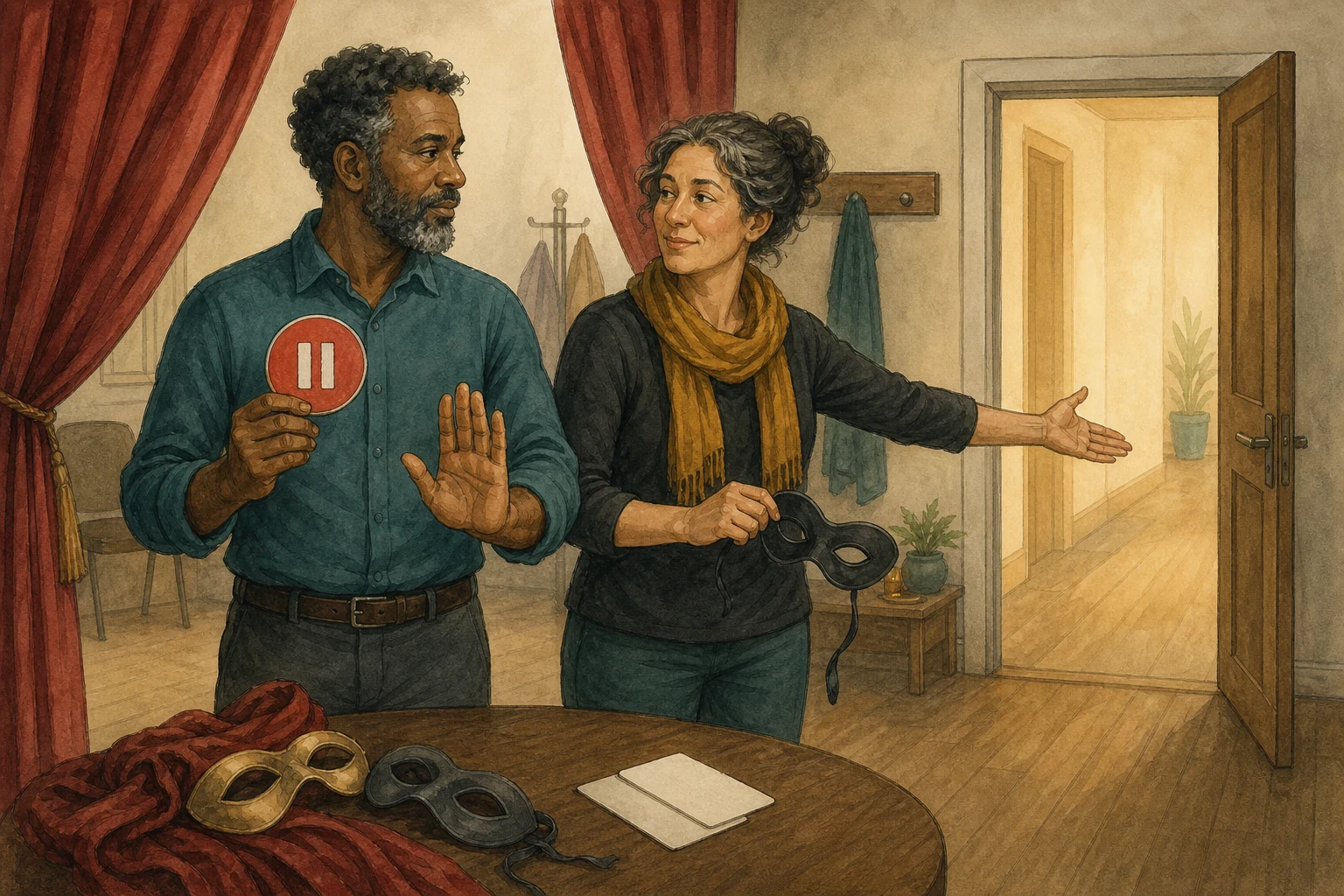
No character, script or earlier agreement makes refusal fictional. A safeword can help, but ordinary language, behaviour and capacity remain decisive.
Illustration created using generative AI; not documentary evidence.Clinical and wellbeing distinction
Enjoying an unconventional adult story is not itself a disorder. WHO's ICD-11 framework focuses clinical concern on matters such as marked distress not explained solely by social rejection, significant impairment, non-consent or serious risk—not the mere presence of costumes, fantasy or role language.
A role can still feel unexpectedly upsetting or linger after the agreed scene. That calls for listening, stopping and appropriate support, not an amateur diagnosis. Fiction also cannot excuse harassment, discrimination, impersonation, coercion or conduct involving people who did not agree to participate.
Non-graphic examples
What the umbrella may include
- Two adults using invented names and a fictional setting for a time-limited scene.
- Wearing a generic adult costume to explore confidence or a different social role.
- Using a character card to separate welcome themes from subjects that remain out of bounds.
- Dropping the script immediately when someone uses ordinary language to pause.
- Enjoying collaborative storytelling without any specialist equipment or continuing power exchange.
Prepare for an appointment
Questions you could ask a professional
- What information would help you understand my question?
- What are the realistic options and uncertainties?
- How can disability, communication or privacy needs be accommodated?
- When should the situation be reviewed again?
These prompts do not replace assessment and do not imply that every reader needs professional care.
Continue learning
Take the next step from definition to context.
Continue with independent guidance connecting role-play to evidence, consent, safety, uncertainty and practical decisions.
Build an adult fictional scene with clear boundaries, check-ins and a simple way to step out of character, without pressure to perform.
Read the full guideRelated in-depth reading
Read the full guide.
Explore a connected question with context and UK support routes.
Pet play and pup play are adult roleplay interests. Understand community, optional gear, consent, comfort, privacy and UK support.
Read the full guide consent relationshipsAdult authority roleplay: a consent-first guideAdult authority roleplay: agree fictional roles, boundaries, costumes, privacy and stopping without confusing character power with consent.
Read the full guide products materialsRoleplay costumes and uniforms: care and privacyAdult roleplay costumes and uniforms: compare fit, fabrics, fastenings, care and photo privacy without assuming clothing means consent.
Read the full guide Community & cultureList of kinks and fetishes: an A–Z of 120+ termsList of kinks and fetishes: 120 A–Z terms with plain definitions, glossary links and UK guidance on consent, boundaries and finding help.
Read the full guide