In consensual adult kink, sadism means interest in creating an agreed intense sensation or psychological experience, while masochism means interest in receiving it. The combined term is sadomasochism or S/M. Either interest can exist without the other and without becoming an identity.
 The UK Kink GuideEvidence-led glossary
 Back to the glossaryPower & roleIn plain English Words in context A non-graphic adult example What not to assume
Sadism and masochism
Also known as S&M · SM · sadomasochism
In consensual adult kink, sadism and masochism describe interests in creating or receiving agreed physical sensation, discomfort or psychological intensity. The terms do not by themselves imply cruelty, abuse, self-harm or a clinical disorder, and they never include causing suffering without consent.
Start here
New to this term?
A sadistic or masochistic interest may be a fantasy, preference, behaviour or chosen community label. A top and bottom describe who gives and receives a particular activity; dominant and submissive describe authority roles. Clinical diagnoses use separate requirements involving distress, consent and serious risk.
One adult may enjoy offering a carefully bounded sensation that a partner actively wants; the partner may value the challenge, symbolism or emotional intensity. Another person may enjoy similar imagery only in fantasy and have no wish to enact it.
These words do not mean enjoying unwanted suffering, wanting harm in everyday life, consenting to every intense activity or having a disorder. Agreement does not eliminate injury risk or make every act lawful. Research samples cannot reveal one cause, personality or safe intensity for everyone.
Sources and evidence type
Manual claim and limitation notes are shown where an individual source audit is complete. Other evidence-type labels are a publisher aid awaiting source-by-source confirmation.
De Neef et al. (2019), biopsychosocial systematic reviewResearch study
- Source design
- Peer-reviewed research or review
- What it can support
- The specific population, measures and findings reported by the paper.
- Important limitation
- It cannot automatically establish UK prevalence, causation, diagnosis, consent or an individual outcome. Check recruitment, definitions and study design.
Dunkley & Brotto (2020), BDSM consent reviewResearch study
- Source design
- Peer-reviewed research or review
- What it can support
- The specific population, measures and findings reported by the paper.
- Important limitation
- It cannot automatically establish UK prevalence, causation, diagnosis, consent or an individual outcome. Check recruitment, definitions and study design.
Wuyts & Morrens (2022), biological systematic reviewResearch study
- Source design
- Peer-reviewed research or review
- What it can support
- The specific population, measures and findings reported by the paper.
- Important limitation
- It cannot automatically establish UK prevalence, causation, diagnosis, consent or an individual outcome. Check recruitment, definitions and study design.
WHO ICD-11 clinical descriptions and diagnostic requirements (2024)Clinical guideline
- Source design
- Current public-health or clinical guidance
- What it can support
- Service pathways, health definitions and recommended public-health or clinical actions within its stated scope.
- Important limitation
- General guidance cannot assess an individual’s symptoms, exposure, medicine, contraindications or urgency.
NHS first-aid guidanceClinical guideline
- Source design
- Current public-health or clinical guidance
- What it can support
- Service pathways, health definitions and recommended public-health or clinical actions within its stated scope.
- Important limitation
- General guidance cannot assess an individual’s symptoms, exposure, medicine, contraindications or urgency.
Domestic Abuse Act 2021, section 71 (England and Wales)Law or regulator
- Source design
- Primary legislation, prosecutorial or regulator guidance
- What it can support
- The legal provision or official regulatory position for the jurisdiction and date stated.
- Important limitation
- It is not fact-specific legal advice. Commencement, amendments, jurisdiction and case law may affect application.
Justice (Sexual Offences and Trafficking Victims) Act (Northern Ireland) 2022, section 27Law or regulator
- Source design
- Primary legislation, prosecutorial or regulator guidance
- What it can support
- The legal provision or official regulatory position for the jurisdiction and date stated.
- Important limitation
- It is not fact-specific legal advice. Commencement, amendments, jurisdiction and case law may affect application.

Power & role
Illustration created using generative AI; not documentary evidence.
In brief
Agreed intensity is not a licence to harm.
Sadism and masochism—often combined as sadomasochism or shortened to S/M—are community terms for complementary but independent interests. One adult may enjoy creating a carefully agreed intense experience, another may value receiving it, and some people enjoy both positions or neither. Sensation can matter physically, emotionally, symbolically or as part of a role; the label cannot reveal what a particular person wants, how intense it is, or whether any specialist object is involved.
Terminology, roles and overlap
S/M forms one part of the wider BDSM acronym, but it is not synonymous with bondage, dominance or submission. A person who creates sensation is not necessarily dominant, and a person who receives it is not necessarily submissive. The same adult may change position by partner, occasion or type of sensation, while some experiences are deliberately mutual rather than divided into giver and receiver.
Everyday speech sometimes uses ‘sadist’ to mean a cruel person and ‘masochist’ to mean someone who enjoys any difficulty. Those casual meanings should not be imported into an account of consensual adult sexuality. Conversely, a self-chosen kink label cannot make coercion, assault or disregard for another person's wellbeing consensual.

Sadism, masochism, top, bottom and switch can overlap without being interchangeable. A label cannot reveal preferred sensations, limits or consent.
Illustration created using generative AI; not documentary evidence.- Status
- Detailed editorial draft
- Publisher
- The UK Kink Guide
- Reviewed
- Structured draft present; individual review date not recorded
- Evidence
- 7 cited sources · types labelled below
- Jurisdiction
- UK-focused general education
Read the rest: evidence, law, safety and sources
Interest in creating an agreed sensation, challenge or psychological intensity for an adult who wants that experience. It does not mean enjoying another person's unwanted suffering.
Interest in receiving or experiencing agreed sensation, discomfort, challenge or vulnerability. It is not evidence that a person wants harm generally or has consented to every intense activity.
An umbrella expression for the overlap between these interests. It may describe a scene, preference or community vocabulary rather than a fixed identity or relationship role.
Diagnostic classifications use narrower requirements involving the nature of an arousal pattern, consent, distress, impairment and serious risk. A community label or consensual adult interest is not a diagnosis.
Sensation, symbolism and associated objects
People may value intensity for different reasons: focused bodily sensation, anticipation, endurance, trust, role expression, emotional contrast or the meaning of giving and receiving attention. Not every S/M interest centres on pain, and visible intensity does not reliably indicate how an experience feels to the participant. Research cannot assign one motive or psychological history to everyone using the label.
Associated objects may include textured fabric, leather garments, padded implements, protective coverings, timers or agreed communication tokens. Their relevance may lie in material, weight, sound, appearance, ritual or symbolism rather than a single prescribed use. Ordinary objects should not be assumed suitable merely because they look familiar, and specialist branding does not prove that an item fits a person, context or purpose. This page describes meanings rather than techniques.
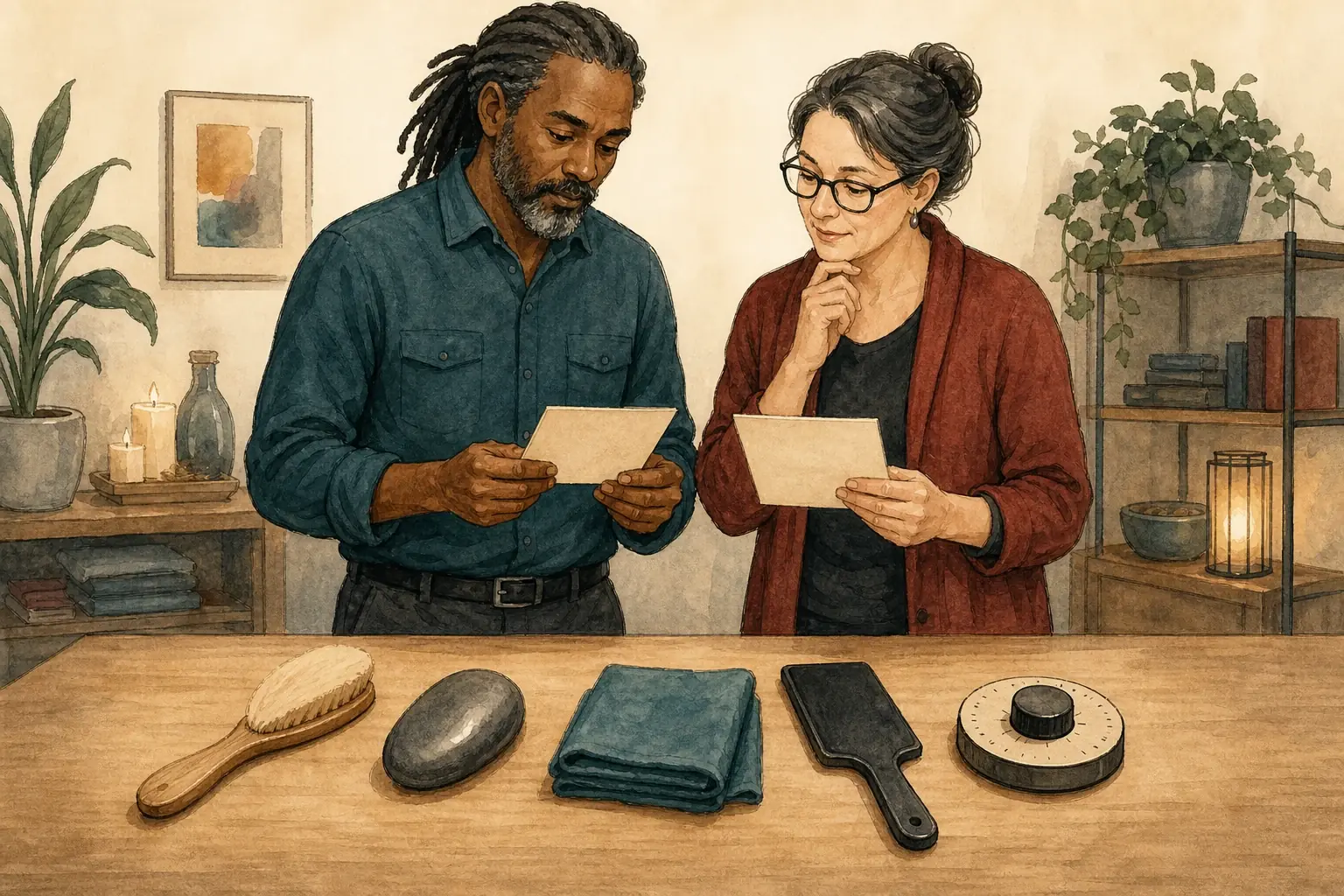
Material, force, duration, body area, health and environment all affect experience and risk. An object has no fixed or universally safe intensity.
Illustration created using generative AI; not documentary evidence.Consent, wellbeing and UK legal limits
Consent must cover the particular people, activity, intensity and circumstances, and it can be revised or withdrawn. Agreement to one sensation does not imply agreement to another; accepting a role, garment or object does not create blanket permission. A safeword or other signal may support communication, but ordinary words, distress and loss of capacity still matter. Silence or enduring discomfort is not proof of consent.
Physical and psychological intensity can cause injury or distress, and consent does not remove those risks. NHS first-aid guidance should take priority when someone is unresponsive, breathing abnormally or otherwise needs urgent help. In England and Wales, section 71 of the Domestic Abuse Act 2021 provides that consent is not a defence to serious harm inflicted for sexual gratification. Northern Ireland has a related statutory provision, while Scotland applies its own criminal law. The legal position depends on the conduct and jurisdiction, not the S/M label.
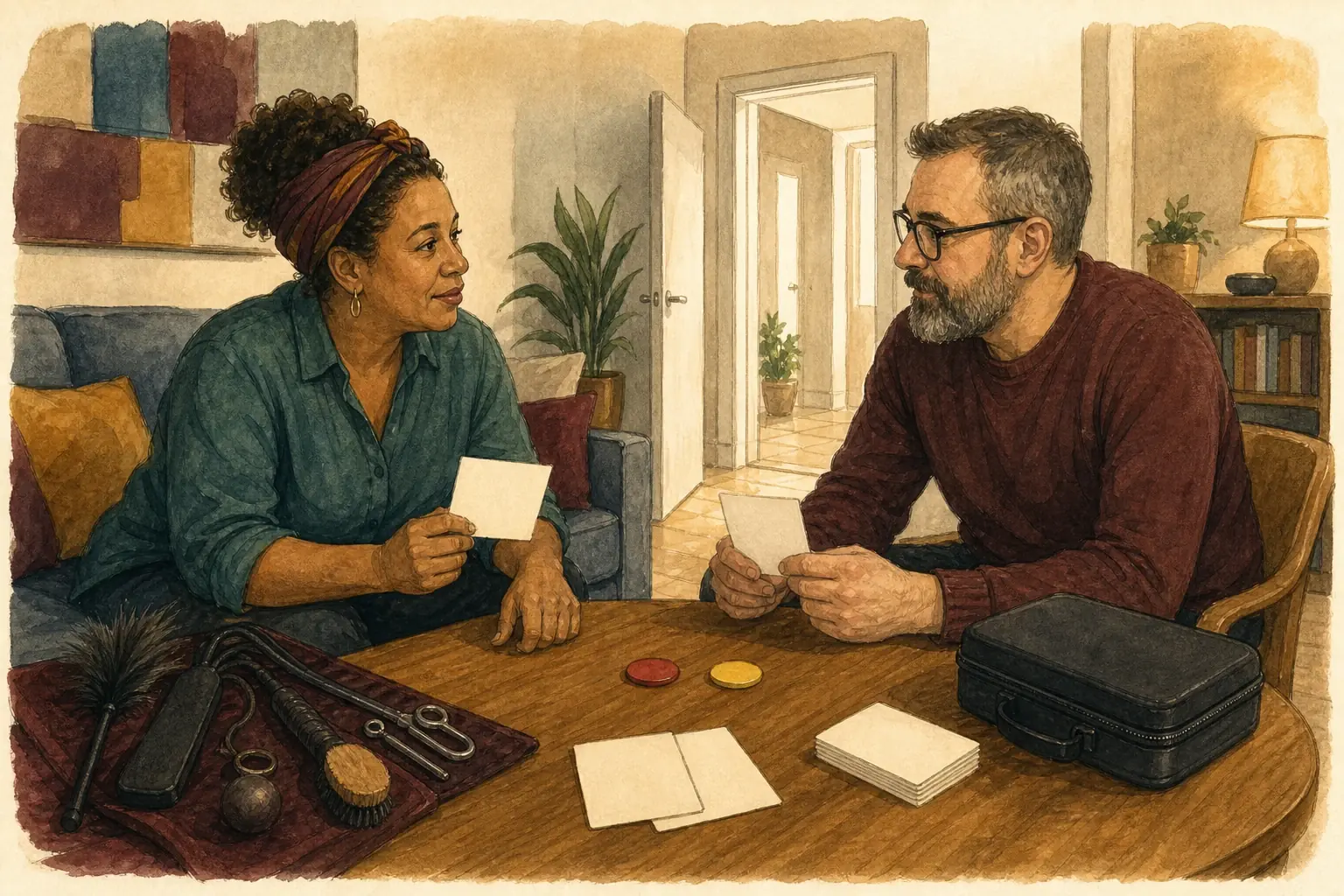
Agreement remains specific and withdrawable, while UK criminal law places separate limits on injury. A scene label cannot settle a fact-specific legal or clinical question.
Illustration created using generative AI; not documentary evidence.What research and diagnosis can show
Systematic reviews describe BDSM as a diverse group of fantasies, activities, relationships and identities. De Neef and colleagues found a growing but largely descriptive evidence base, while Wuyts and Morrens included only ten biological studies and called for replication. These studies cannot provide a universal explanation, predict an individual's response or turn a community label into a clinical finding.
The World Health Organization distinguishes atypical interests involving consenting adults from paraphilic disorders. Consensual adult S/M is not a disorder merely because it is unconventional; clinical concern instead requires the relevant diagnostic features, such as marked distress not explained solely by rejection or significant risk of injury or death. Only a suitably qualified clinician can assess an individual, and an object, fantasy, role or chosen identity is not diagnostic evidence.
Non-graphic examples
What the umbrella may include
- Two adults agreeing that one will create a time-limited intense sensory experience while the other chooses to receive it.
- A person enjoying psychological challenge or anticipation without wanting physical pain.
- Partners changing or sharing roles rather than treating sadistic and masochistic interests as fixed opposites.
- A leather garment, textured fabric or symbolic token contributing atmosphere or meaning without determining what activity occurs.
- An adult deciding that a previously appealing sensation is no longer wanted and having that decision respected immediately.
Prepare for an appointment
Questions you could ask a professional
- What information would help you understand my question?
- What are the realistic options and uncertainties?
- How can disability, communication or privacy needs be accommodated?
- When should the situation be reviewed again?
These prompts do not replace assessment and do not imply that every reader needs professional care.
Continue learning
Take the next step from definition to context.
Continue with independent guidance connecting sadism and masochism to evidence, consent, safety, uncertainty and practical decisions.
Set the scope of adult power-exchange roles, keep a working stop route, recognise pressure and find UK support.
Read the guideRelated in-depth reading
Read the full guide.
Explore a connected question with context and UK support routes.
Sadism and masochism meaning, consensual kink versus diagnoses, UK injury-law limits, aftercare and qualified support.
Read the full guide Community & cultureWhat is BDSM? A beginner's guideA plain-English introduction to adult BDSM, its language, consent, risk, UK law and the questions worth asking before any activity.
Read the full guide Community & cultureKink vs fetish vs BDSMHow three overlapping adult terms differ, where clinical language has a separate purpose, and how to ask what someone means.
Read the full guide