Advanced bondage in which equipment supports some or all of an adult participant's body weight above the floor, creating serious fall, compression, circulation and rescue risks.
Sources and evidence type
Manual claim and limitation notes are shown where an individual source audit is complete. Other evidence-type labels are a publisher aid awaiting source-by-source confirmation.
Lee et al. (2023), compression neuropathy in rope suspensionResearch study
Source design
Peer-reviewed research or review
What it can support
The specific population, measures and findings reported by the paper.
Important limitation
It cannot automatically establish UK prevalence, causation, diagnosis, consent or an individual outcome. Check recruitment, definitions and study design.
Illustration created using generative AI; not documentary evidence.
In brief
Suspension is a life-safety system requiring in-person competence and independent rescue capability.
Suspension is not simply floor bondage performed higher up. Partial suspension can still load nerves and create a fall, while full suspension makes the entire support system life-critical. Rope, harnesses, connectors, anchors, structure, geometry, bodies and rescue capability form one system whose weakest element can fail. This glossary describes risks and boundaries but intentionally provides no rigging instruction.
Training and system integrity
Seek qualified in-person instruction before suspension. Ratings must cover each component, direction and configuration, including the building structure and dynamic movement.
Do not use decorative hardware, unknown anchors or improvised household fixtures. Inspection history and retirement criteria matter even when equipment looks intact.
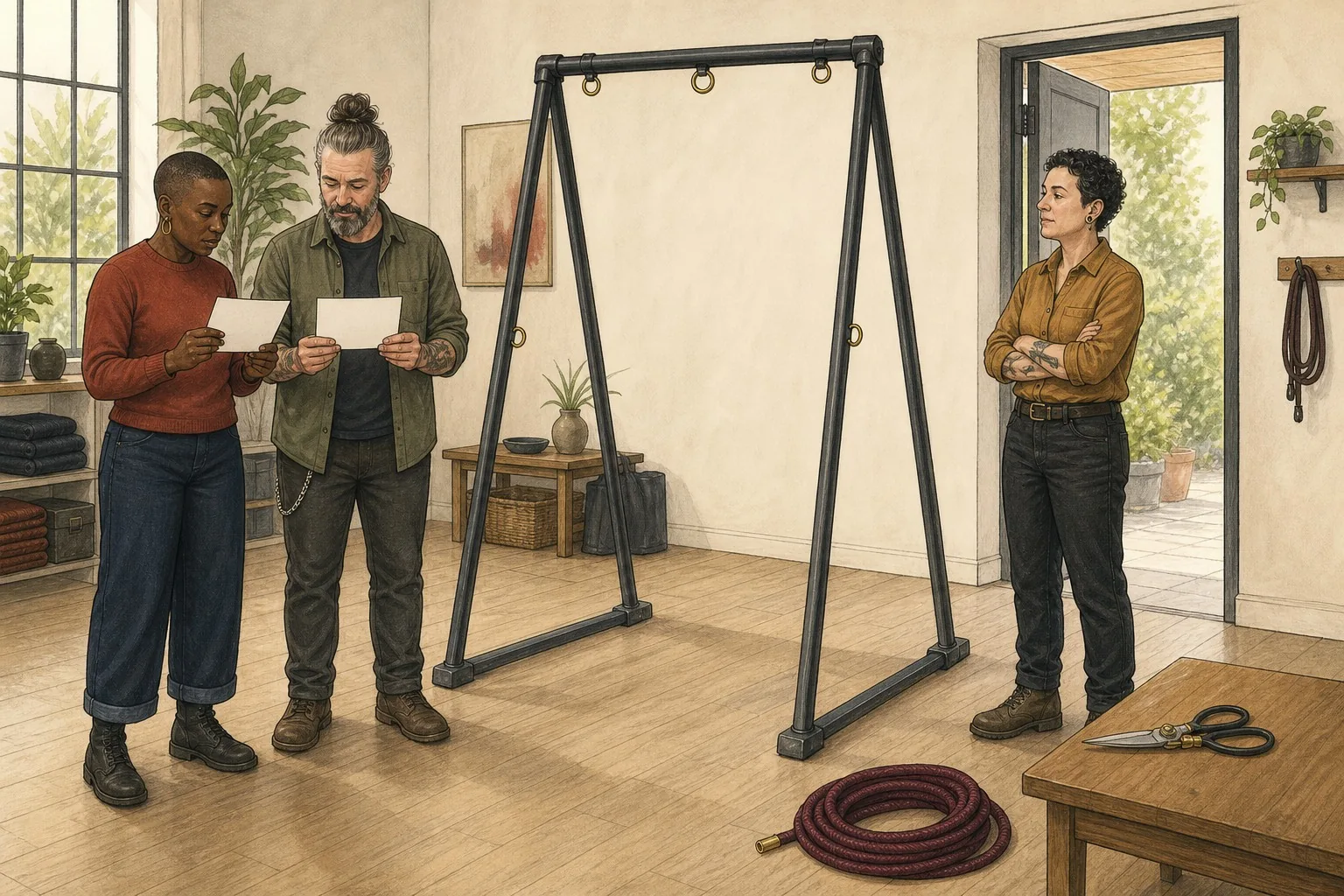
EDITORIAL ILLUSTRATIONThe whole system carries the load
Rope, connectors, anchors, structure, geometry and inspection history must be assessed together. Decorative hardware, unknown fixtures and a component rating alone cannot validate a suspension system.
Illustration created using generative AI; not documentary evidence.
Status
Detailed editorial draft
Publisher
The UK Kink Guide
Reviewed
Structured draft present; individual review date not recorded
Evidence
3 cited sources · types labelled below
Jurisdiction
UK-focused general education
Read the rest: evidence, law, safety and sources
Full suspension
All body weight is supported off the floor.
Partial suspension
Some body contact remains, but equipment still carries meaningful load and a fall may occur.
Floor bondage
Restraint without intentional body-weight suspension; it retains nerve and circulation risks.
Performance rigging
Professional or artistic aerial systems governed by different training, equipment and workplace contexts.
Nerves, circulation and consciousness
Compression neuropathy can cause numbness, tingling, burning, weakness or loss of movement and may take months to recover. Pain alone is not an adequate warning.
Faintness, breathing change, confusion, colour change or neurological symptoms require immediate controlled lowering and appropriate medical assessment.
EDITORIAL ILLUSTRATIONPain is not the only warning
Numbness, tingling, burning, weakness, movement loss, faintness, breathing change or confusion require immediate controlled lowering and appropriate medical assessment.
Illustration created using generative AI; not documentary evidence.
Consent and monitoring
Agree the broad form, limits, signals, photography and stop criteria, but retain authority to abort whenever conditions change. Altered states or reduced speech are not evidence of continuing consent.
Continuous one-to-one attention is essential. Never leave a suspended person alone or depend on them to perform their own rescue.
Rescue and evidence limits
A rescue plan must work if the rigger, bottom, primary line or power source fails. Appropriate cutting or lowering equipment must be immediately usable without creating an uncontrolled fall.
Published injury evidence is based on small samples and cases, so incidence is unknown. Lack of symptoms in prior suspensions does not demonstrate future safety.
EDITORIAL ILLUSTRATIONRescue must work when something fails
Suspension should never be solo or unattended. An independent plan and immediately usable equipment must still work if a participant, primary line, power source or rigger cannot perform as expected.
Illustration created using generative AI; not documentary evidence.
Non-graphic examples
What the umbrella may include
Keeping suspension out of self-taught experimentation.
Including the ceiling structure in the load assessment.
Lowering immediately after hand weakness.
Using an independent trained spotter and rescue plan.
Choosing floor-based practice while developing competence.
Prepare for an appointment
Questions you could ask a professional
What information would help you understand my question?
What are the realistic options and uncertainties?
How can disability, communication or privacy needs be accommodated?
When should the situation be reviewed again?
These prompts do not replace assessment and do not imply that every reader needs professional care.
Continue learning
Take the next step from definition to context.
Continue with independent guidance connecting suspension bondage to evidence, consent, safety, uncertainty and practical decisions.