
Decide whether restraint is necessary
Quick-release restraints need a practical exit plan, not just a reassuring product label. Check the manufacturer’s instructions, including whether the release works under tension, and keep a suitable backup available. Never leave someone restrained alone. Stop and release immediately if they withdraw consent, feel unwell or report warning symptoms.
An adult may be interested in the idea of limited movement, a visual prop or a role, while having no wish to be physically held in place. Ask which part matters and whether an unrestrained alternative can meet it. A conversation, clothing choice or symbolic prop avoids the extra problem of getting somebody free in a hurry. Bondage is a broad label; it does not identify an individual's consent or a safe arrangement. This page concerns risk recognition and support, not tying, locking, positioning or an allowable duration. The swings and door-restraint buying guide examines structural requirements, ratings and release without providing installation or suspension instructions. For mattress compatibility, cuff dimensions and accessible release, compare under-bed restraints.
If there is any doubt about whether the person can communicate a stop or the other person can respond immediately, do not proceed. Being intoxicated, drowsy, frightened, overwhelmed or under pressure can undermine a meaningful choice. Discuss who is present, who will watch for a problem and whether a person can leave after release. The safeword guide covers spoken and non-verbal signals, but no codeword should be the only route to stopping when a person's speech or awareness may change.
Quick-release restraints: what to look for
Look for clear manufacturer instructions explaining the intended use and how every restraint can be fully released. A quick-release label alone does not establish that a clip will open under tension. Ask for explicit documentation of that behaviour for the intended use; do not assume that different clips work alike or experiment on a restrained person to find out. If this cannot be established, choose an unrestrained alternative.
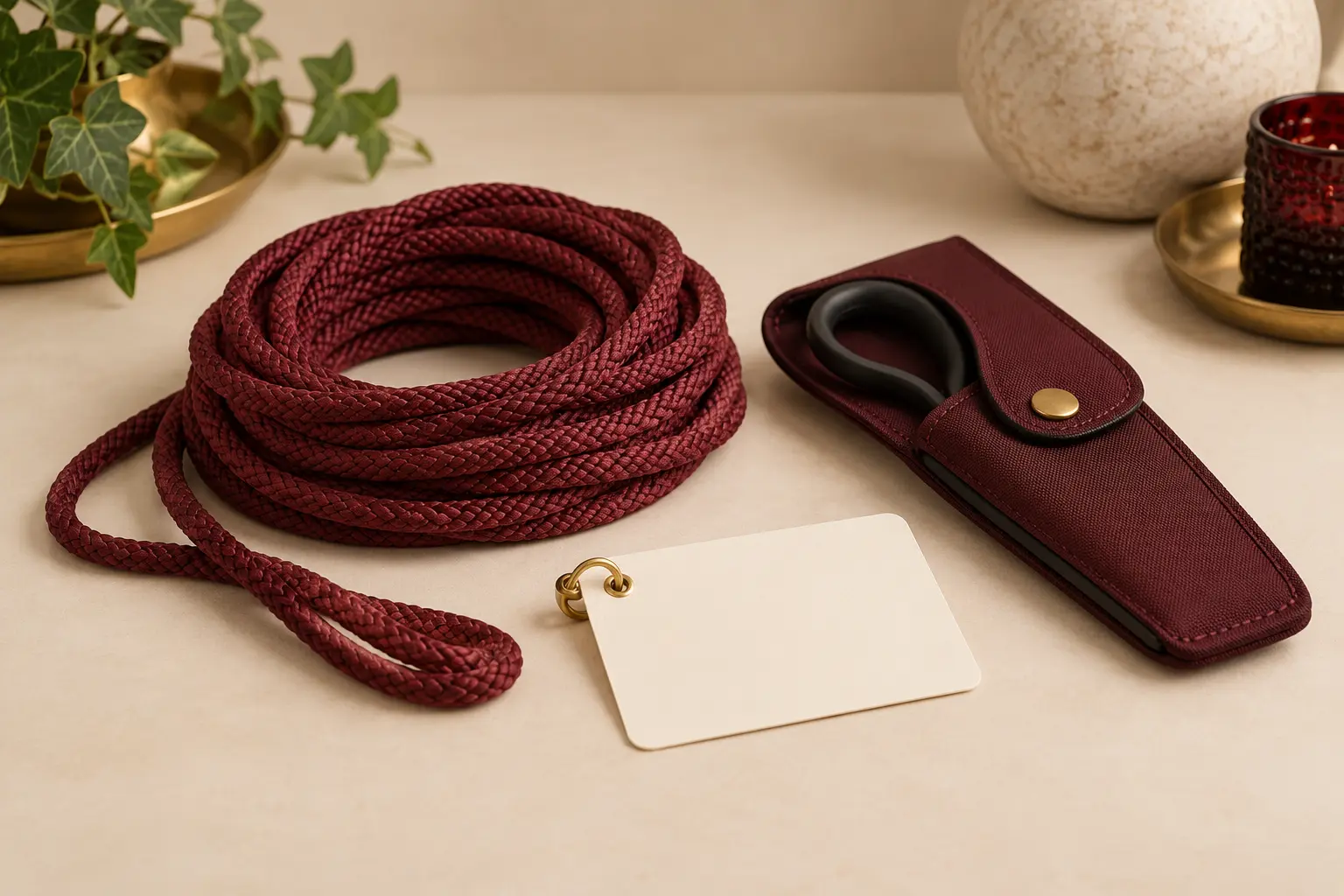
Release controls must remain reachable by the person responsible for release. Plan for a stuck fastening, missing key or loss of communication before anything starts. Suitable safety shears should be reachable as a backup for material they can cut; they are not a universal solution for metal or every other material. This page does not endorse a product or give a cutting technique.
Never leave a restrained person alone. Agree frequent check-ins and stop immediately if consent is withdrawn or communication becomes uncertain. Numbness, tingling, coldness, colour change, weakness or sharp pain mean stop and release, not wait for a planned finishing time. The rope safety guide explains these warning signs and the limits of checking for them.
Release readiness is only one part of deciding whether to avoid restraint altogether. Review the existing consent, injury and UK-help sections below together. No product description, backup tool or previous uneventful use guarantees that a person can be restrained safely.
Agree limits before any equipment
Talk outside a role or scene about what each adult does and does not want. Separate agreement to a theme from agreement to any device, loss of movement, photography or marks. The CPS guidance for England and Wales says consent is ongoing and may be conditional even within BDSM. Prior participation, silence or a written agreement does not stand in for the present decision. Either person should be able to call a halt without punishment or a demand to explain it before release.
Consider mobility, circulation, pain, nerve symptoms, skin condition, medications and disability access as questions to discuss with the person and, where relevant, a clinician. Do not turn a general checklist into medical clearance. A partner who says 'I cannot feel my hand' needs action, not a debate over whether it is expected. Agree that the observer will check for changes in speech, awareness, hand colour and movement as well as words. The withdrawal of consent glossary explains why stopping remains available at any point.
Why novelty handcuffs can injure
A hard, narrow edge can put concentrated pressure on the wrist; a tightening or jammed mechanism can make prompt release difficult. These are foreseeable mechanical hazards, not a claim that every handcuff produces the same injury. NHS hand-pain guidance treats tingling, loss of sensation and a change of hand colour as reasons for medical advice. NHS wrist-injury guidance treats worsening swelling or bruising as a concern. There is no UK safety standard or certification specific to novelty handcuffs for adult restraint. A seller's 'safe' or 'beginner proof' claim is not independent proof of safe fit or reliable release; assess the particular item and choose an unrestrained alternative if release is uncertain.
Novelty handcuffs may have small keys, brittle parts, rough edges or unclear maker information; inspect the particular product's instructions and traceability rather than assuming a costume label is a quality mark. UK product safety alerts can identify a known recall, but absence from a recall database is no clearance. A lock whose key is missing, inaccessible or obstructed is unacceptable for a plan that relies on immediate release. Do not improvise with hardware that was designed for security, punishment or decoration. This section covers the planned handcuffs-versus-cuffs question without recommending a model or giving a use method.
Choose an exit that does not rely on luck
The lower-risk option is no physical restraint. If adults still consider a product, prefer one whose maker states its intended use, materials, care and accessible release mechanism; a broad, soft surface and clearly verifiable release may be more suitable than a rigid novelty handcuff, but neither is a guarantee. Check whether the person actually controls or can reach a release. Do not buy on a photograph, a 'quick release' label or a friend's experience. The product-claims guide explains how to question a maker's evidence without treating it as a safety certificate.
A release plan should account for a stuck mechanism, a missing key, a person becoming unable to speak and a helper being unavailable. Before anything begins, know how the entire arrangement can be ended promptly and who will act; if that cannot be established, abandon the restraint. Never leave a restrained person alone. The rope safety guide explains how pressure and nerve signs can emerge without offering knots or tying instructions. A product's advertised release feature does not make the whole scene safe under stress.
Treat nerve and circulation signs as a stop
Numbness, pins and needles, weakness, unusual pain, swelling, a hand becoming unusually cold, or colour change can signal a problem. These signs may be harder to see on darker skin, so ask about sensation and movement rather than relying on a glance. Stop and fully release immediately; do not loosen a little and wait to see whether a symptom goes away while restraint continues. NHS pins-and-needles guidance says persistent or recurrent symptoms merit GP assessment. NHS hand-pain advice identifies loss of sensation and colour change as reasons to seek help.
After release, note which limb is affected, when the change began and whether normal sensation and movement return. Ask NHS 111 or an urgent service about a persistent or worsening symptom; a GP can assess ongoing weakness, pain or recurrent numbness. If an injury is severe, there is loss of consciousness or breathing trouble, call 999. The risk profile glossary names individual factors, but no profile predicts that pressure will be harmless. This is an injury response, not a test of whether someone is 'good at' restraint.
Keep breathing and awareness unobstructed
Do not place pressure on the neck, obstruct the mouth or nose, restrict breathing or combine restraint with a loss of communication. CPS guidance explains that the England-and-Wales offence of non-fatal strangulation or suffocation can arise without visible injury, and that medical effects can be serious. The existence of a limited statutory consent defence is not a safety claim or a general permission to practise it. An observer must stop immediately if the person has trouble breathing, becomes confused, unresponsive or unable to communicate clearly.
If breathing difficulty, collapse, seizure or another life-threatening symptom occurs, release, call 999 and follow the call handler's advice. The NHS 999 guide distinguishes life-threatening emergencies from NHS 111 assessment of urgent but non-emergency problems. Even after someone seems better, explain any neck pressure, breathing restriction or loss of awareness to clinicians accurately. The impact and law guide discusses why consent does not erase injury limits, but this page does not provide a legal opinion on a particular event.
Aftercare and a factual account
Once free, check breathing, awareness, pain, limb sensation and movement; ask what comfort or space the person wants. Do not assume that a blanket, reassurance or a ritual can reverse a nerve injury. The aftercare guide explains how to agree needs that differ between people. An adult can also prefer no touch, privacy or a later conversation. If there is a mark or injury, ask before taking a photograph or sharing anything about the event.
For medical help, describe the device or material, area of pressure, approximate timing, any tightening or delay in release and symptoms before and after. This helps clinicians assess an injury; it is not a confession script or a request to conceal context. If someone was unable to refuse or their stop signal was ignored, they can seek independent support through UK help. Treat a damaged or jammed product as unusable, record its model and check safety alerts rather than trying it again on a person.
Common questions about restraint planning
Are novelty handcuffs safe because they are sold as toys? No seller label establishes fit, release reliability or injury risk. Are broad cuffs guaranteed safe? No; pressure and an ineffective release can still cause harm. What if a hand tingles briefly? Stop and release fully, then seek advice if symptoms persist, return or worsen. Can someone agree in advance to ignore a stop word? A present withdrawal of consent must be respected. Does a photo of a release button prove the whole setup can be exited? No. Can a key held in another room count as an emergency plan? No.
Should a new reader learn rope knots here? No; this is not a technique guide. What if a partner asks for a blindfold as well? Communication becomes harder, so reconsider whether any restraint is suitable. Is a bruise proof of consent or abuse? Neither inference follows from a mark alone; discuss symptoms and context privately with a professional. What if breathing is affected? Release and seek emergency care. What if the person cannot leave or the helper refuses to release? Call for outside help; a scene agreement does not remove their right to safety.
UK routes for injury and support
Call 999 for breathing difficulty, collapse, serious injury or immediate danger. In England use NHS 111 for urgent non-emergency assessment; Wales has NHS 111 Wales, Scotland NHS 24, and Northern Ireland HSC directs local urgent care. A GP can review persistent hand symptoms. Tell the clinician what happened rather than offering a vague 'strain' that conceals the pressure mechanism. The UK help directory gives support routes for coercion or a boundary crossing.
If a product failed, note its maker, model and batch and consult UK product safety alerts and Citizens Advice about a fault. A fault report and a medical assessment are different steps. This is general health and legal information, not training, individual clinical advice or a legal opinion. The site does not recommend a cuff, a tie, a position or a duration; if safe release cannot be shown before contact, choose an unrestrained alternative.