
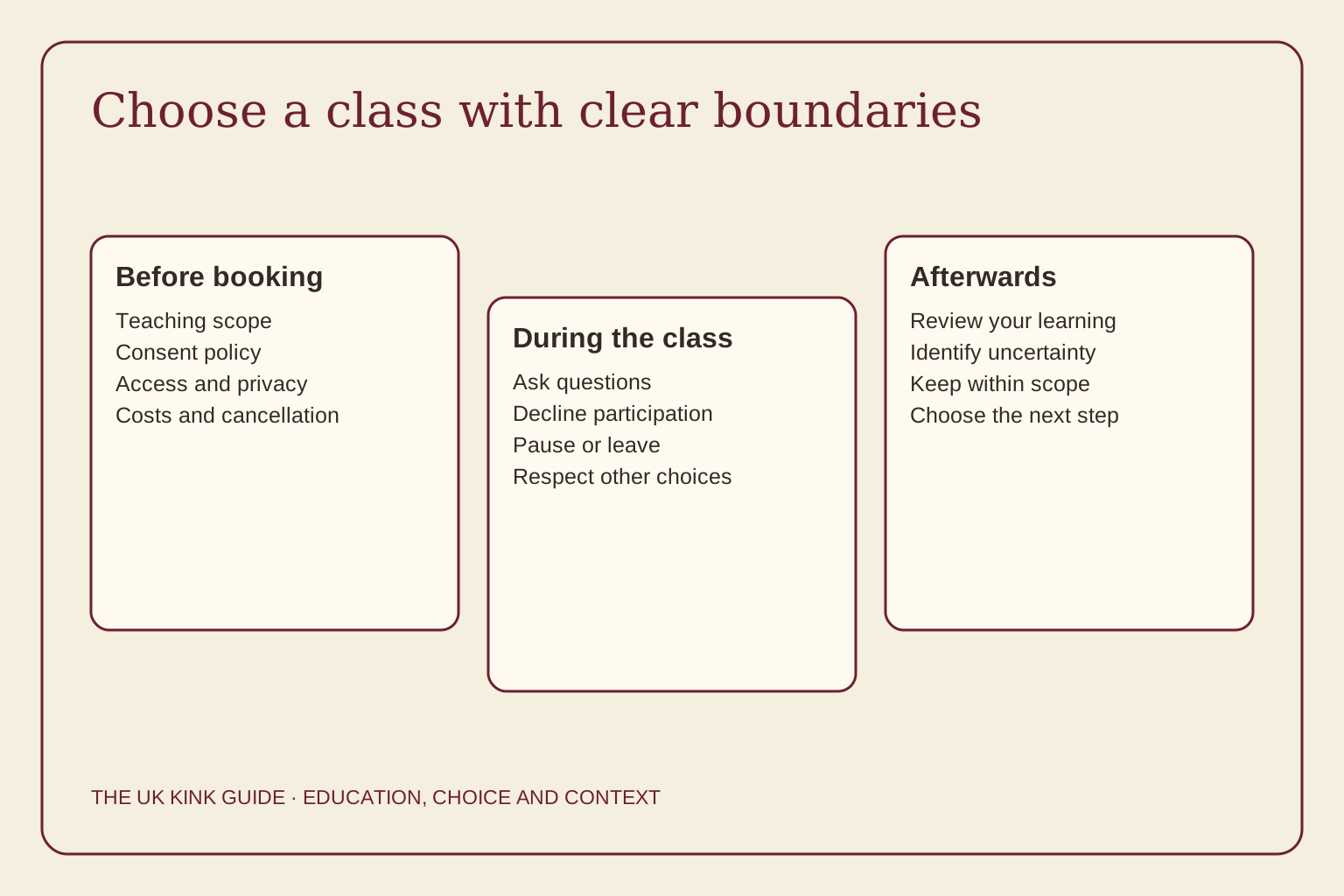
Choose the teaching before the label
A useful class explains its scope, consent rules, access arrangements and the experience it assumes before you book. Choose a teacher who welcomes questions and lets you decline participation, rather than treating a beginner label as a guarantee that every activity will suit you.
This guide offers a way to assess a workshop, not a list of endorsed providers. No named provider or price range is included because a current website, suitable course description and published consent policy would all need to be checked together. You can use the questions here when considering a class found through your own community or local search.
Learning can remain observational or theoretical. You do not need to take part in a practical exercise to demonstrate interest, and attending a class does not create an obligation to continue with a person you meet there. Keep the booking decision separate from any later decision about practising.
Different kinds of class
Rope workshops can vary in purpose, assumed knowledge and practical content. A class described as introductory might cover terminology and communication, or expect participation in exercises. Ask which applies before booking. The shibari classes guide offers rope-specific questions, while this page focuses on choosing and assessing education.
An impact workshop also needs a clear scope and an honest account of limits. A class title cannot establish medical suitability or legal permission. Ask what is taught, what is excluded and whether observation is possible. This publication does not provide striking techniques or treat attendance as proof that a person is ready to practise.
Communication and negotiation workshops may concentrate on boundaries, language and discussing an agreement. They can be useful without equipment or physical participation. Ask whether exercises involve sharing personal experiences, working with an assigned partner or speaking in a group. You can want the information while preferring not to disclose private details publicly.
First-aid education is a separate area of competence. If a provider advertises first aid for kink, ask about the instructor's qualifications, the recognised course behind the teaching and what any certificate actually represents. Do not assume that a themed title is equivalent to a recognised first-aid qualification or that it covers every emergency.
Assessing a teacher
Read the trust guide before treating confidence or popularity as expertise. Ask what the teacher's relevant experience is, how they keep learning and how they respond when a question falls outside their knowledge. An honest limit is more useful than a promise that their approach is completely safe.
Look for a description of the learning objectives. You should be able to tell what you are expected to understand by the end and what remains beyond the session. Ask how many people attend, whether assistants are available and how individual questions are handled. These details help you assess the format without requiring a claim that one class size is universally best.
A good answer should address your question rather than your status as a beginner. Notice whether an enquiry receives practical information or pressure to trust the teacher unquestioningly. You can decide not to book if important details remain vague. Paying for access is not a reason to suspend your judgement about the explanation offered.
Consent policy and complaints
Read the published consent policy before paying. Look for rules about touching, demonstrations, photography, opting out and contact after the class. Ask who receives a concern and what happens if it involves the main teacher. A policy should be usable by a participant, rather than merely a statement that the community values consent.
Clarify whether a demonstration requires separate agreement and whether a person may stop after initially volunteering. Ask how the class accommodates someone who wants to watch without being involved. If the answer implies that everyone must participate to avoid disappointing the group, consider a different learning route.
Do not assume a waiver resolves these questions. Read any form carefully and ask what it is intended to cover. This guide cannot assess its legal effect. Keep a copy of booking information and policies relevant to your decision, so you can refer to what was offered if something later changes.
Access and the venue
Ask about the actual room rather than relying on a general statement that a venue is accessible. Useful questions include step-free access, toilets, seating, breaks, lighting, noise and whether there is somewhere to pause privately. You can describe the adjustment you need without disclosing a diagnosis or a personal history.
Find out whether the venue is shared and how arrivals are handled. Consider the name shown on booking messages and whether a public attendee list is used. If privacy matters, ask about photographs, tagging and recordings as well as the classroom itself. A closed door does not settle how information about attendance may be shared online.
Check travel and the return journey before committing. You should have a way to leave independently if the class is unsuitable or you feel uncomfortable. Do not build your only transport plan around a new acquaintance or assume that an organiser can solve a late change in your arrangements.
What to expect on the day
Ask in advance what clothing, materials and preparation are required. You can choose a clothed, discussion-based or observation-friendly option, but those features should be confirmed rather than assumed. Check whether equipment is provided and whether you are expected to bring a partner. Avoid buying specialist items before you know what the course actually requires.
At the start, listen for introductions to the rules, scope and stop procedures. If the programme differs materially from the booking description, you can ask for clarification before deciding whether to stay. A change that another participant accepts does not mean you must accept it too.
Keep your own boundaries available during exercises. You may decline a pairing, stop participating or leave a discussion that asks for more personal disclosure than you want. Treat other participants' choices with the same respect. Being in a class together does not create permission for private messages, photographs or contact afterwards.
Finding possible classes
A munch can be a place to ask where people find education, while FetLife event listings and venue websites can provide starting points for research. A recommendation is still someone's experience, not an independent assessment. Follow through to the provider's current information and policy before booking.
Use the FetLife introduction and privacy guide if you are considering an account to browse listings. Check RSVP visibility before announcing attendance. A public search can also be enough to find a provider's own site; you do not have to join a social platform solely to prove that you belong in a class.
The first-venue guide covers a separate decision about attending a social space. Do not assume a workshop and a later event have the same ticket, rules or expectations. Ask where one ends and the other begins, including whether you may attend only the educational part.
Costs, booking and afterwards
Compare the total cost rather than the headline fee alone. Ask about materials, travel, cancellation, refunds and any companion ticket. No price range is quoted here because current charges have not been verified. Keep the provider's written answer if an important booking detail is not clear on the page.
Afterwards, review what you understood and what remains uncertain. An introductory session is not a general qualification or a reason to attempt something beyond its scope. If you want further learning, ask about prerequisites and take time to decide. You can also conclude that the subject is not for you, or that you prefer to keep learning through reading and conversation.
Common questions
Can I attend without a partner?
That depends on the class, so check before booking. Ask whether observation or independent participation is available and whether pairing is optional.
Do I have to take part in demonstrations?
Choose a class whose policy lets you decline or stop participation. Confirm how that works before paying, rather than assuming every provider uses the same rules.
Does a beginner class make me qualified?
No, attendance alone does not establish competence for every practical situation. Keep further learning within the scope you actually understand.
How much do UK kink workshops cost?
No current price range has been verified for this guide. Check the provider's total fee, materials and cancellation terms directly.