
Start with the question
Research is useful when the study's question matches the claim you are trying to assess. Before accepting a headline about sex or relationships, check who was studied, what was measured and what the result can actually show.
A study about fantasies is not automatically evidence about behaviour. A study about people who attend a particular event is not automatically a survey of the UK population. Keep the original question in view as you read, especially when a headline replaces a narrow finding with a statement about what everyone wants or does.
You do not need to become a statistician to ask these questions. Begin with the abstract or plain-language summary, then look for the methods and limitations. If the article does not link to the research, treat that absence as a reason to withhold judgement rather than to fill in the missing details yourself.
Systematic reviews
A systematic review uses an explicit question and a planned approach to find, assess and bring together relevant studies. Cochrane explains that reviewers consider how research was carried out as well as its results. Some reviews combine numerical findings, but a pooled figure is not the only possible output.
A review is useful because it puts individual studies in context. Its conclusion still depends on what evidence exists, how comparable the studies are and how reliable their methods are. Check the search date and the certainty of the evidence. The word systematic does not mean that every question has a definite answer.
Trials and comparisons
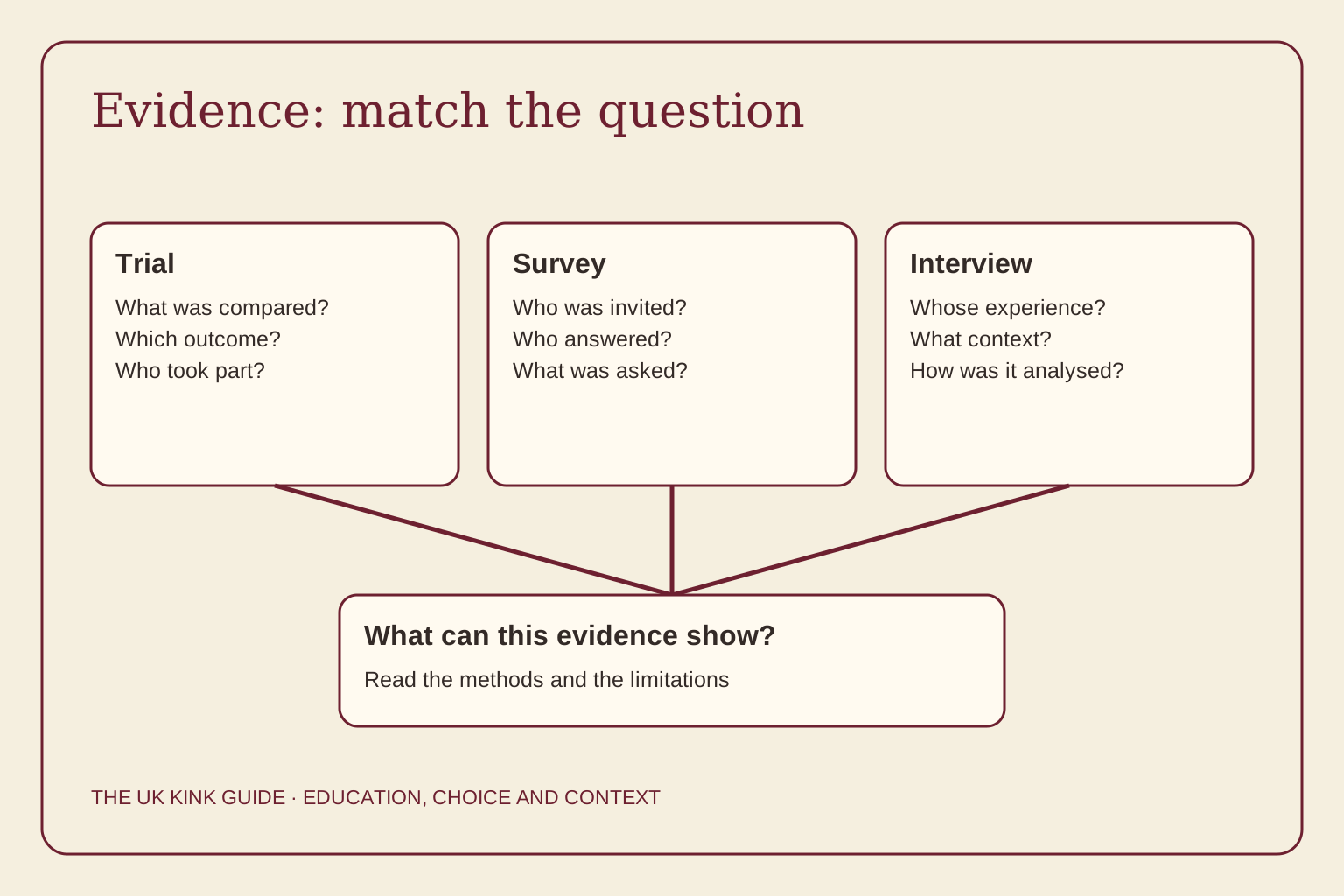
A randomised controlled trial assigns participants to comparison groups by chance. That design can help investigate the effect of an intervention, such as a treatment, while reducing differences between the groups. Ask what was compared, which outcomes were measured and whether the people studied resemble those the headline discusses.
A trial cannot answer every ethical or practical question. Its findings concern the intervention and circumstances actually studied, not every activity with a similar label. Look for harms and withdrawals as well as benefits. A result described as statistically detectable may still have a small practical effect for the decision you face.
Cohort and cross-sectional studies
A cohort study follows a group over time to examine exposures and later outcomes. A cross-sectional study examines information at one point in time. These designs can describe patterns and associations, but they do not create the same comparison as randomly assigning an intervention.
An association means that two things occur together in the data. It does not by itself establish that one caused the other. Another factor may influence both, or the direction of the relationship may differ from the headline's suggestion. Ask whether the researchers discuss alternative explanations and what their design can distinguish.
Surveys and self-selection
Surveys ask a sample of people questions rather than asking everyone in a population. How those people were recruited matters. An open questionnaire shared in an interest group may be useful for learning about respondents, while being unsuitable for estimating how common the same interest is across Britain.
People who choose to answer can differ from those who never see the invitation or decline it. A very large response count does not automatically correct that selection. Look for the sampling method, response information and the population the researchers intended to describe. The House of Commons Library's sampling guide explains why these details matter.
The wording matters too. Ask whether a question measured an identity, an occasional fantasy, a lifetime experience or something that happened recently. Those are different categories. Do not compare percentages from differently worded questions as though they were measurements of the same thing.
Interviews and qualitative evidence
Qualitative interviews can explore how people understand experiences, negotiate meaning and describe their lives. UKRI explains that these methods examine detailed accounts and context. They can reveal a question that a fixed-choice questionnaire misses, or show why an apparently simple label means different things to different participants.
A rich account is not a population count. A small interview study need not be dismissed simply because it has fewer participants than a survey; assess it against its purpose. Equally, a vivid quotation should not be used to claim that everyone in a community feels the same way. Ask how participants were selected and how the analysis was developed.
Sample size and uncertainty
Sample size is one part of the picture. A larger well-designed sample can provide more precise estimates, while a poorly selected sample can remain biased. The Office for National Statistics explains that survey findings are estimates with uncertainty because the whole population has not been measured.
Look for intervals or other explanations of uncertainty rather than treating one number as exact. If an article compares groups, check whether the difference is clear enough to support the claim being made. Avoid turning a small or uncertain difference into a fixed rule about individuals. Group-level findings cannot tell you what a particular partner wants.
Community sources and lived experience
Community sources can help explain how a word is used, what concerns people raise and how a practice is understood within a group. They can be valuable for meaning without being clinical evidence. A retailer's guide may explain a product, but its commercial purpose should remain visible when assessing a recommendation.
Ask what kind of authority the source actually has. An account of personal experience can describe that experience; it cannot establish a universal safety threshold. A legal source may establish a rule in one jurisdiction; it cannot decide the facts of your individual situation. Use each source for the question it can answer.
Reading a headline carefully
Trace the claim back to the original work. Compare the headline's wording with the study's outcome, population and limitations. Notice changes such as association becoming cause, some respondents becoming all adults, or an exploratory result becoming a recommendation. These changes can happen even when the underlying research is carefully written.
Check the date, funding and declared interests, but do not use one detail as a shortcut to accepting or rejecting everything. Ask whether the methods and conclusions are clear enough to assess. If evidence conflicts, look for differences in questions and methods before assuming that one result must make every other study worthless.
How this site labels sources
The editorial methodology distinguishes research, professional guidance, law or regulator material and community context. A label describes the role a source plays; it is not a score proving that every claim on the page is correct. Checked dates show when a source was reviewed, not continuous monitoring.
Use the glossary's source list alongside its definition. Follow the reference that supports the claim you care about and consider its scope. If the page overstates what a source can show, report the wording through the corrections policy. A useful correction explains the mismatch without requiring you to disclose personal experiences.