
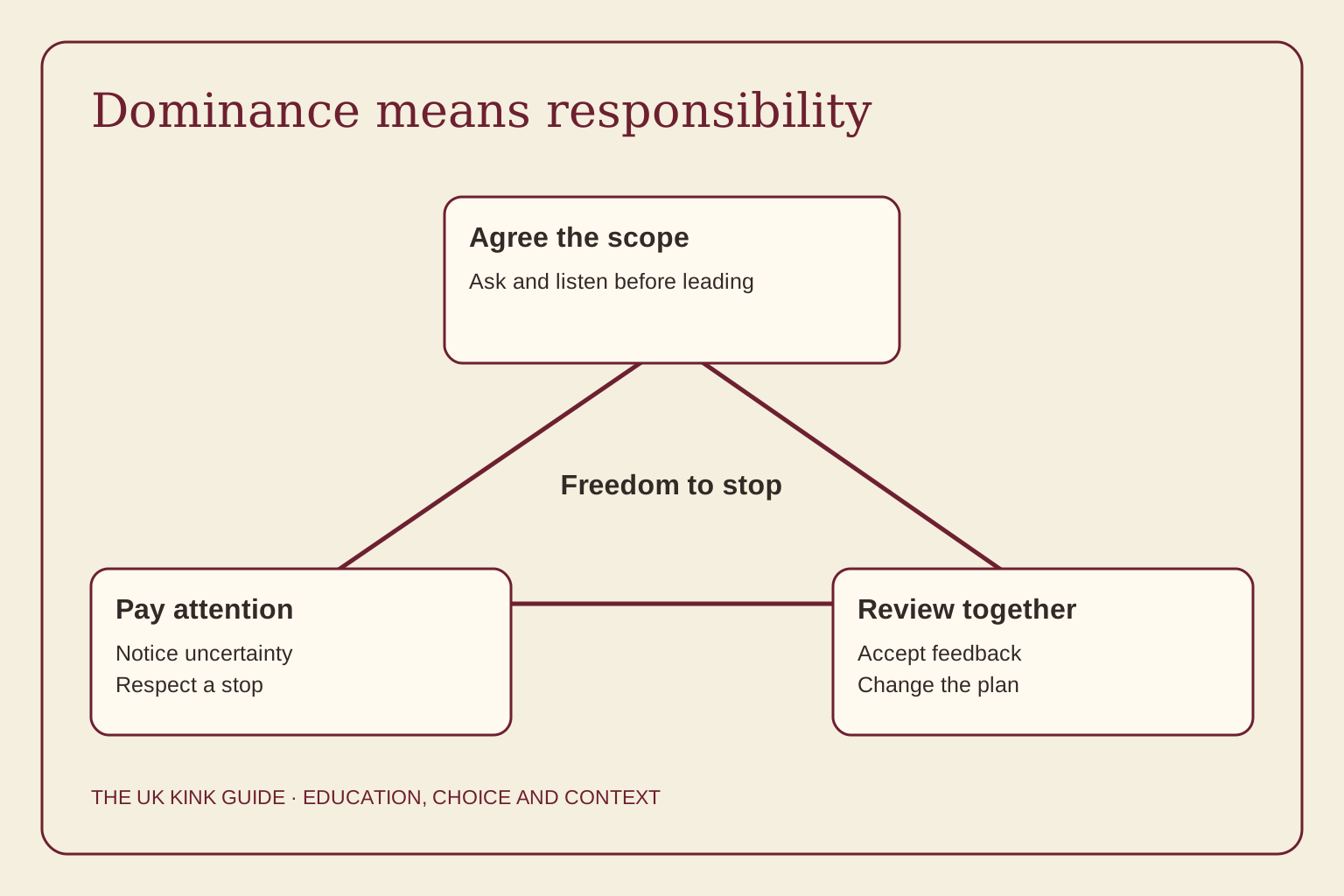
Responsibility comes before a role
Being a dom means taking an agreed leading role while remaining attentive to the other person's choices and limits. It does not give you authority outside that agreement or permission to continue when someone is unwilling, uncertain or distressed.
Start by asking what kind of responsibility you are willing and able to take. You may enjoy planning, giving focused attention or helping create a clear structure. Those preferences do not automatically equip you for every activity someone associates with dominance. Recognising what you do not know is part of making a sensible decision about your scope.
You do not need a forceful personality or a polished performance. A calm conversation, an honest account of your experience and a respectful response to a refusal are more useful than imitating an image of confidence. The aim is an agreement that works for both people, not proof that you can make another person comply.
Understand what the other person wants
Ask what submission or being led means to the person you are talking with. They may want reassurance, a limited decision made for them or a particular style of attention. Avoid filling in the gaps from a profile, a quiz result or something they enjoyed with somebody else.
Listen for differences between an appealing idea and an activity they want now. A person can describe a fantasy without inviting you to organise it. They can also be interested but undecided. Keep those distinctions clear rather than interpreting uncertainty as a challenge to your ability to persuade.
Share your own preferences and limits too. Dominance does not require making yourself available at all times or agreeing to something you cannot responsibly offer. If your interests do not fit, say so without suggesting that either person is inadequate. A mismatch is information, not a failure that must be corrected through persistence.
Styles without a hierarchy
The roles guide explains labels including soft dom, service top and stricter styles. These terms can start a discussion about tone and expectations, but their meanings are not fixed. Ask what behaviour a label is meant to describe and what would fall outside it.
A gentle style does not remove the need for boundaries, and a formal style does not require cruelty or distance. A person may want clarity without stern language, or playful structure without an ongoing authority arrangement. The combination belongs to the people making the agreement rather than to a standard role description.
Distinguish topping, leading a particular activity, from a broader dominance agreement. Neither implies permission for unrelated decisions. If you want a continuing arrangement, discuss it explicitly, including the times when ordinary conversation takes priority. Do not let a temporary role expand because nobody felt able to interrupt it.
Negotiate before you lead
Use the negotiation checklist to organise preferences, uncertainties and limits. Discuss the particular plan in plain language, including what it involves and what it does not. A list is a conversation aid, not a contract that turns every marked item into permanent permission.
Set the beginning, ending and review point. Include privacy, access needs, time, spending and how to communicate between meetings. If you introduce a new detail, make room for a new decision. The other person's enthusiasm about the original idea does not cover a different arrangement you have not yet explained.
Check your understanding by summarising it and inviting correction. Do this outside any role language that might make disagreement harder. A useful agreement should be understandable when neither person is trying to impress the other. If the proposal cannot be explained without ambiguity, simplify it or leave it aside.
Safewords and your duty to notice
Read the safeword guide together. Agree how to stop, pause or request a check-in, and make sure the method fits the circumstances. Do not demand a special signal before respecting an ordinary No. Communication tools supplement attention; they do not transfer all responsibility onto the person being led.
If behaviour changes or you are unsure whether someone is comfortable, stop and check. Do not interpret silence, stillness or an earlier agreement as certainty about what is happening now. A pause is not a loss of authority. It is a chance to return to a clear, mutual decision.
Safewords cannot make a dangerous activity safe or establish that it is lawful. This guide does not teach physical techniques, and confidence cannot substitute for relevant knowledge. Keep anything you cannot responsibly assess outside your plans. You can decline an activity even when the other person requests it enthusiastically.
Check-ins that allow a real answer
Make it easy to give an answer other than reassurance. Ask about comfort, uncertainty and whether the person wants to continue, without making your approval depend on their response. Listen to the answer itself rather than searching for a reason it should be different.
Agree how much conversation is useful and when to revisit the experience afterwards. Some people want time to reflect before describing what worked. A delayed concern still matters. Do not dismiss it because the person seemed pleased earlier or because you remember the interaction differently.
Your response to feedback shapes whether future feedback feels possible. Thank the person for being clear, take responsibility for your own conduct and decide what needs to change. If a limit was crossed, focus first on their needs and the conduct involved, rather than on obtaining immediate forgiveness or defending your intentions.
First steps without buying anything
You can explore a leading role through a bounded conversation about preferences, language or a shared routine. A simple agreement should have a purpose both people understand and a clear way to stop. Avoid making essential needs, access to support or important financial decisions dependent on compliance.
If praise appeals, use the praise guide to discuss words that are welcome. Focused appreciation can be direct and specific without adopting language the other person dislikes. Do not assume that an encouraging tone makes every comment comfortable; ask what meaning the words have for them.
If service appeals, the service guide can help distinguish a chosen gesture from an unspoken workload. Discuss the task, available time and whether it can be declined. A routine or rule should be reviewed for whether it is useful, not preserved simply because you introduced it. No purchase is necessary to have these conversations.
Aftercare includes both people
Plan the period after an interaction as carefully as the beginning. The aftercare guide covers preferences for company, space, practical comfort and a later check-in. Do not assume the person you lead wants to provide reassurance immediately, or that your preferred form of closeness will help them.
People sometimes use dom drop to describe difficult feelings after an intense experience. The term is community language, not a diagnosis or a fixed biological explanation. If you feel unsettled, acknowledge it without making the other person responsible for proving that you did everything correctly. You can seek support while respecting their privacy.
Persistent distress, injury or a concern about consent needs attention on its own terms. Aftercare is not a way to erase a boundary crossing or make an unsuitable plan acceptable. Review what happened, consider appropriate professional help where needed and do not resume an arrangement merely to restore a reassuring sense of normality.
Dominance and coercive control
Read the abuse and consensual-dynamics guide for the distinction between negotiated roles and coercive behaviour. Threats, isolation, monitoring and interference with a person's independent choices do not become acceptable because a relationship uses dominance language. A role is not a defence for making someone afraid to refuse.
Pay attention to your own response when a plan changes. Disappointment does not entitle you to punishment, repeated persuasion or withdrawal of ordinary care. Step out of the role and address the disagreement as people with equal standing. If you cannot accept a boundary, you cannot continue the proposed agreement responsibly.
Never use private information as pressure to keep a person in a dynamic. Protect confidentiality when seeking advice, and avoid naming someone unnecessarily in community conversations. If you recognise harmful conduct in your own behaviour, stop the conduct and seek suitable help rather than asking the person affected to manage your change.
Learning without performing certainty
Choose education that welcomes questions and explains its limits. The trust guide offers ways to assess advice and teaching claims. Popularity, a confident manner and a long personal history are not enough to establish competence for the question you have.
Keep learning separate from pressure to progress. A class or article can help you identify what you do not know; it cannot certify that you are ready for every practical situation. Discuss any proposed change with your partner before treating new information as an addition to an existing agreement.
You can read the beginner submission guide to understand the other role's questions. Preserve ordinary communication outside both roles and review whether the arrangement still fits. Responsible leadership includes being willing to stop, simplify or decide together that this is not the right arrangement now.
Common questions
Can I be a dom if I am quiet or gentle?
Yes, a role does not require a forceful personality. Discuss the tone and responsibilities both people actually want.
Does a safeword make an activity safe?
No, a safeword is a communication tool rather than a safety guarantee. You still need to assess whether the activity belongs within your knowledge and agreement.
Can a dom say no?
Yes, your limits and willingness matter too. Decline anything you cannot responsibly or willingly offer.
What is dom drop?
It is a community term for difficult feelings after an intense experience. It is not a diagnosis or a reason to ignore persistent distress or a boundary concern.