
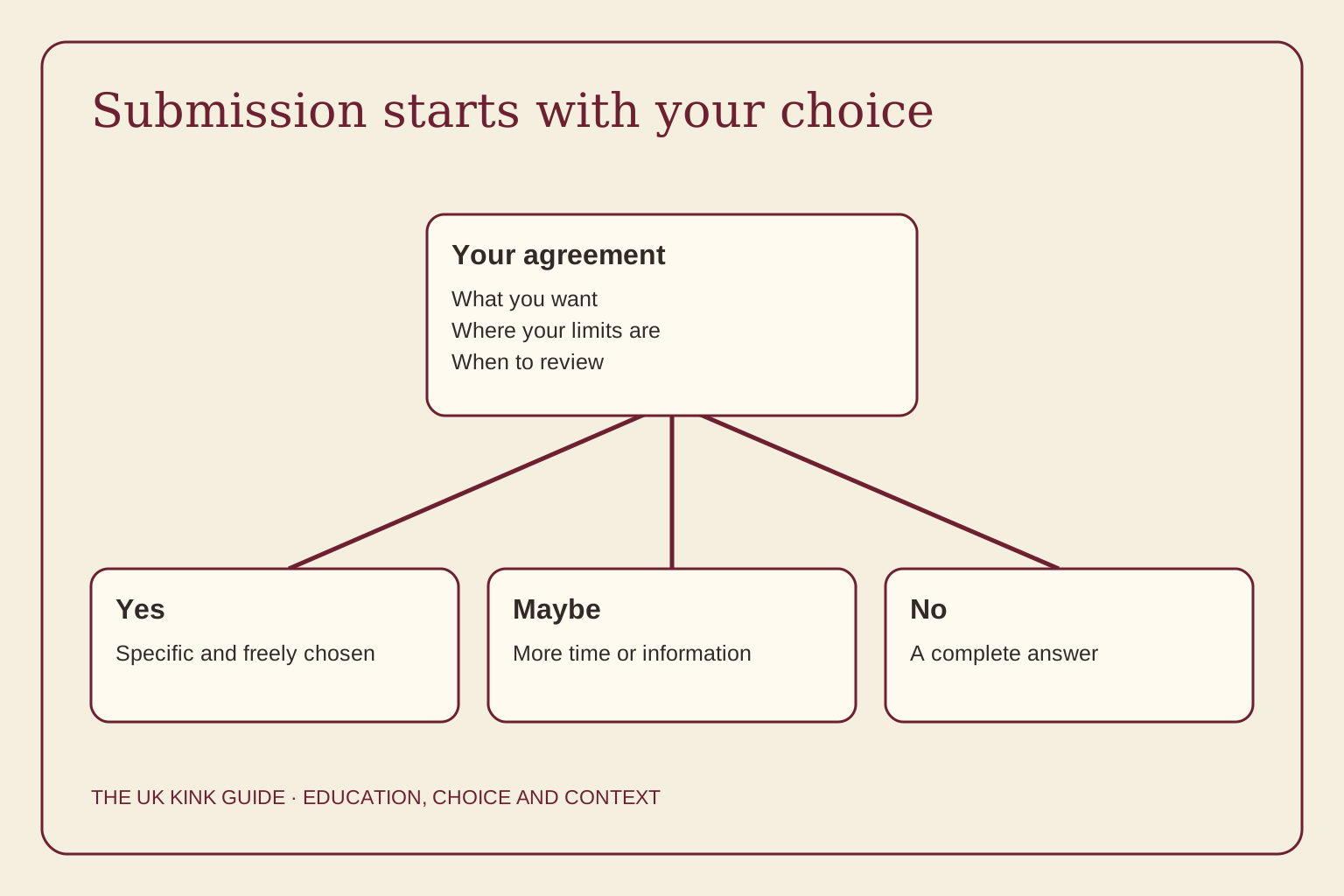
Submission begins with your choice
Being a sub means choosing a submissive role within an agreement you understand and want. It does not mean losing the right to refuse, accepting every request or proving your worth through endurance.
Begin with the part of submission that interests you. That might be receiving attention, following an agreed structure, offering a chosen service or letting a partner lead a limited decision. These are different preferences. You can be curious about one without wanting the others, and you do not need a complete identity or a partner before reflecting on them.
The useful question is what you want to agree, with whom and under what conditions. A label can introduce that conversation but cannot finish it. You remain a person with responsibilities, preferences and needs outside the role. Submission should not be used to make those ordinary parts of your life disappear.
What submission does not require
There is no universal test of a good submissive. A person who asks questions, declines an activity or changes their mind is communicating information that matters. If a proposed dynamic only works when your doubts are hidden, its apparent agreement is missing something important.
Do not treat inexperience as a debt to someone more experienced. Their knowledge may help you ask better questions, but it does not entitle them to decide your limits. You can ask for explanations in ordinary language and take time to consider an invitation away from the person making it.
A role is also not a diagnosis of your personality. You may enjoy leadership elsewhere, dislike particular forms of authority or use different roles with different partners. There is no need to make the rest of your life conform to a word you find useful in one relationship. Your own description may change as you learn.
Different styles and what they mean to you
The types of doms and subs guide introduces community labels such as service-oriented submission and other styles. Use these as vocabulary to explore, not a list of milestones. People can use the same term while imagining quite different agreements, including different levels of formality and time commitment.
Separate the feeling you want from the activity you imagine producing it. Wanting reassurance is not the same as wanting a rule; wanting structure is not the same as wanting someone to manage your finances. Naming the underlying appeal helps you discuss a limited, practical choice without accepting a whole package of expectations.
Ask what the other person means as well. A partner may use a familiar label because it fits their preferred tone, while you use it to describe a particular kind of attention. Finding that difference early can prevent a disappointing or pressured arrangement. Compatibility is about the actual agreement, not matching vocabulary alone.
Working out what you want
You can reflect privately before discussing anything. Write down what appeals, what is uncertain and what you do not want, including matters unrelated to physical activity: privacy, time, language, contact between meetings and whether a role is public. Keep the notes somewhere that suits your privacy needs.
The private kink test can offer prompts, but a result is not an instruction or a measure of suitability. A high score cannot decide what you should try, and a skipped answer does not need an explanation. Use only the parts that help you notice a question you would like to explore.
The Yes, No, Maybe checklist offers another way to organise a conversation. A Maybe is a request for more thought or information, not a delayed Yes. Matching answers still need discussion about the particular people, setting and timing. You can move an item back to No whenever your view changes.
Negotiating a limited agreement
Discuss the scope before adopting a role. Identify what is included, what is excluded, when it begins and ends, and how either person can pause it. Avoid vague promises to do whatever is asked. A clear, modest agreement is easier to understand than a sweeping commitment made while excited or anxious to please.
Include ordinary practical limits such as work, sleep, spending, access needs and responsibilities to other people. A role agreement should not quietly turn into permission to interrupt every part of your day. If a proposal affects someone outside the agreement, their privacy and choices matter too.
Take time to review the proposal in your own words. You do not need to demonstrate instant enthusiasm. If the other person changes an important detail, revisit the agreement instead of treating your earlier answer as covering the new version. Agreement to discuss submission is not agreement to begin an activity immediately.
Safewords and ordinary communication
The safeword guide explains how an agreed signal can support clear communication. Decide what a stop or pause means and how you will communicate it in the actual circumstances. An unusual word is not required for an ordinary refusal to count, and a safeword never replaces attention to distress or uncertainty.
You may find it easier to discuss hesitation before an activity than to explain it during one. Include a way to ask for a check-in without having to produce a detailed reason. The other person should respond to uncertainty by making space, not by demanding that you justify why you are no longer comfortable.
No signal makes an activity medically safe or legally permitted. It is a communication tool within a broader decision about whether something is appropriate at all. This beginner guide does not teach restraint, impact or other physical techniques. If a proposal raises safety questions you cannot answer, leave it outside the agreement.
First steps without equipment
You can explore the meaning of a role through conversation alone. Agreeing preferred words, discussing a limited routine or offering a chosen everyday service can reveal whether the underlying idea appeals. Keep any arrangement easy to stop and separate from essential needs, employment, money or access to support.
The praise guide explains why words that feel affirming to one person may be uncomfortable to another. Ask about wording rather than assuming that a generic style of praise will suit you. You can prefer straightforward appreciation without wanting a role, or enjoy role language only in a clearly agreed context.
For service-oriented interests, distinguish a freely chosen gesture from an obligation to absorb all of another person's work. Discuss the task, time and whether it can be declined. For rules, consider their purpose and review point. A rule that no longer serves either person can be changed or removed rather than defended as a test of loyalty.
Aftercare and later reflection
Plan what happens afterwards before you need it. The aftercare guide offers questions about company, space, practical comfort and a later check-in. Do not assume that closeness, conversation or immediate reassurance is welcome in the same form for everyone. Ask what would help and what would feel intrusive.
People sometimes use sub drop to describe a difficult emotional or physical period after an intense experience. It is a community description, not a diagnosis with one proven cause or a guaranteed timetable. Avoid explaining every uncomfortable feeling through that label, especially if a boundary was crossed or symptoms need professional attention.
When you review the experience, separate what felt good, what was unclear and what you would change. You can appreciate part of an interaction while deciding not to repeat it. Later reflection is not a breach of an earlier agreement. It is new information about whether the arrangement suits you.
Recognising unhealthy pressure
Read the guide to coercive control and consensual dynamics if you are being frightened, isolated, monitored or pressured. A role label does not excuse threats, humiliation outside agreed limits or interference with your access to friends, money and support. Consent should not depend on fearing the consequences of refusal.
Watch how a person responds to a small No or a request for time. A respectful response does not require you to soothe their disappointment or offer a substitute activity. Someone can be disappointed and still respect your choice. Repeated efforts to wear down a boundary deserve attention even when they are described as affection or training.
You do not need to settle a debate about whether the relationship counts as kink before seeking private support. Use UK help to find an appropriate route. If you feel unsafe, seek support suited to your circumstances rather than relying on a joint negotiation to resolve the problem.
Choosing your next step
You may decide to keep reading, talk with a partner or do nothing further. All are legitimate outcomes. The beginner dominance guide can help you understand the responsibilities of the other role without deciding that you must find or satisfy a particular kind of partner.
Return to the simplest question: does the specific agreement fit what you want now? Keep access to ordinary conversation outside the role, protect time to reflect and retain the freedom to leave an arrangement that no longer works. A useful label should help you express yourself, not make it harder to be heard.
Common questions
What makes someone a good submissive?
There is no universal performance test. Honest communication and the freedom to refuse matter more than meeting someone else's image of the role.
Can I be submissive without wanting pain or restraint?
Yes, preferences about roles and particular activities are separate. Discuss what appeals without treating one label as agreement to everything associated with it.
Can a sub change their mind?
Yes, agreement can change and a refusal must be respected. Earlier enthusiasm does not require you to continue.
Do I need a partner or equipment to start?
No, you can begin by reading and reflecting privately. Buying something or finding a partner is not a requirement for understanding an interest.