Independent education for adults 18+

Back to the glossarySensation & activity

Kinbaku

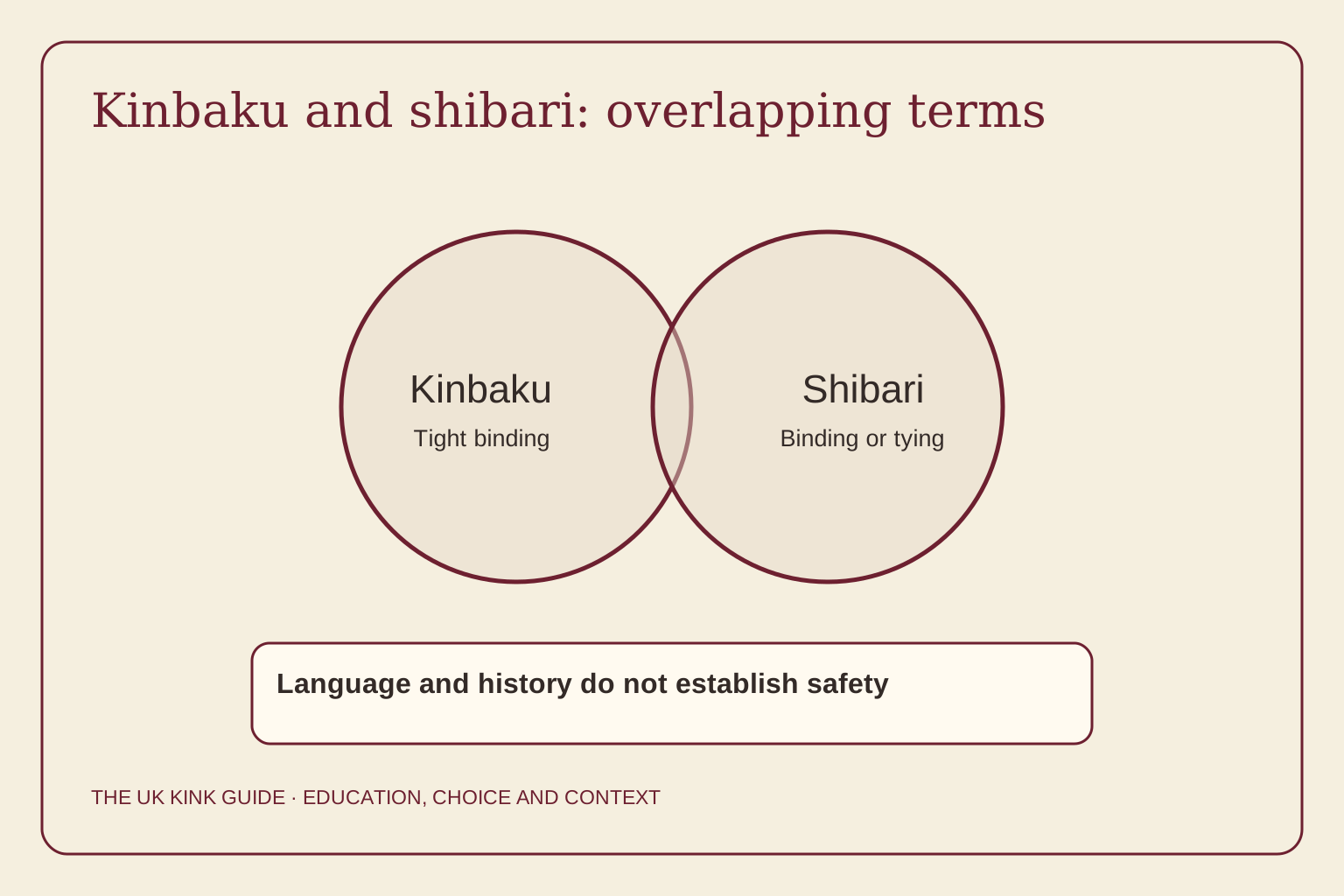
Kinbaku means “tight binding” and is a Japanese term associated with artistic rope bondage. It overlaps with shibari, although individuals and communities may use the words differently.

For the wider terminology and learning context, read the full shibari guide.

Sources

About this entry: definitions describe how terms are commonly used by adults; they can't assess your situation. How we choose and label sources.

Two overlapping outlined circles labelled Kinbaku and Shibari, with language, history and consent beneath. No tying technique is shown.
AI-generated illustration, not a photograph

In brief

Language, history and limits

Kinbaku and shibari

Kinbaku and shibari overlap in everyday usage. Shibari broadly means binding or tying, while kinbaku is commonly translated as tight binding. Neither word gives you a complete account of a particular person's interests, the context in which they use rope or the limits they have agreed.

Some Western practitioners distinguish an aesthetic emphasis under shibari from a broader relational practice under kinbaku. That is not a universal Japanese distinction. The terminology reference linked here describes overlapping usage, so it is more accurate to ask what a teacher means than to insist that one label always identifies art and the other always identifies intimacy.

A photograph can show a visual arrangement without showing preparation, communication, discomfort or what happened afterwards. Treat descriptions and images as context, not as instructions. The full shibari guide explains the language without presenting a sequence of ties.

Read the rest: evidence, law, safety and sources

Historical context

Accounts of Japanese bondage connect its development with hojōjutsu, the historical binding of prisoners, and describe the artist Seiu Ito's study of that tradition. Ito is commonly credited in those accounts as a founding figure in modern kinbaku. This is a brief historical orientation rather than a claim that present-day consensual practice simply reproduces a single unchanged tradition.

The coercive context of prisoner restraint is different from a freely negotiated adult relationship. Historical origin does not make a technique appropriate, safe or consensual today. Equally, contemporary artistic presentation does not remove the need to consider the individual people involved. Culture, aesthetics and personal meaning are useful subjects to study separately from practical risk.

Safety and personal limits

Rope can affect nerves and circulation. The safety guide discusses why appearance, a familiar pattern or someone's confidence cannot establish that a situation is safe. This entry does not teach tying, suspension, load-bearing arrangements or other restraint techniques. A short definition cannot assess health conditions, mobility, sensation or emergency arrangements.

Read the rope-bondage safety guide before deciding whether practical learning is appropriate. A person must be able to stop without punishment or pressure, and consent can change during an activity. Discuss how to communicate uncertainty as well as a definite stop. Silence, endurance and a previously stated interest are not substitutes for continuing willingness.

Learning and choosing a teacher

The UK classes guide offers questions about a teacher's scope, consent policy, access arrangements and approach to questions. Ask whether you may observe, decline participation or leave, and what experience the particular class assumes. An introductory label does not tell you everything about the activities planned.

You can learn about the history and terminology without being restrained or restraining anyone. If a teacher treats questions as disloyalty, promises complete safety or dismisses personal limits, choose another route. Practical learning should make uncertainty easier to discuss, not create pressure to perform confidence. Take time to reflect afterwards before agreeing to anything beyond the class you actually attended.

Continue learning

Take the next step from definition to context.

Continue with independent guidance connecting kinbaku to evidence, consent, safety, uncertainty and practical decisions.

Community & cultureSensation play: planning, pacing and risk

Plan sensation play by naming the actual experience—such as comparing fabrics, listening to chosen sounds or discussing a removable eye mask—and agreeing what stays out. Keep choices easy to change, avoid surprises and treat pain, altered sensation or distress as reasons to stop rather than goals to reach.

Read the guide

Related in-depth reading

Read the full guide.

Explore a connected question with context and UK support routes.

Products & materialsRope bondage for beginners: nerves and circulation

Recognise rope restraint warning signs, plan immediate release, and know when numbness, weakness or other symptoms need medical help.

Read the full guide
Community & cultureShibari classes and rope workshops in the UK: how to find a good teacher

Find adult beginner rope teaching through the verified organiser routes below in London, Bristol and Belfast, then check the exact session before booking. A social rope jam is not necessarily a class, and a listing does not establish safety, accessibility or a guaranteed practice partner.

Read the full guide
Community & cultureShibari and kinbaku: meaning, history and safety

Shibari is a term used for Japanese rope bondage, with overlapping artistic and relational meanings. Shibari and kinbaku are discussed together here, alongside consent, learning and the risks that rope can create.

Read the full guide

Related explanations

Useful overlaps, not assumptions.

Sensation & activityRope bondage

A form of bondage using rope for restraint, connection, visual composition or ritual. Japanese-derived practices are often called shibari or kinbaku in English-language communities, though histories and preferred terminology are debated.

Read the explanation
Sensation & activityBlindfold play

The consensual reduction or removal of sight using a blindfold to alter anticipation, attention, sensory balance or role experience.

Read the explanation
Sensation & activityBlood interests and blood play

An adult interest, fantasy or activity involving blood imagery or blood. Blood exposure can transmit infection and needs to be distinguished from fantasy, medical care, self-harm or non-consensual injury.

Read the explanation

What should I do next?

Choose the route that fits your question.

Information can clarify a term, but it cannot decide consent, diagnose symptoms or assess a legal situation for you.

Find UK help and specialist services Use the access and safety planning prompts Explore all 294 definitions Report an error or omission
About this page: sources, review and limits

UK-focused general education

AI-created editorial illustration; not documentary evidence.

How sources are checked